Jingu Keiichi, Matsushita Haruo, Yamamoto Takaya, Umezawa Rei, Ishikawa Yojiro, Takahashi Noriyoshi, Katagiri Yu, Takeda Kazuya, Kadoya Noriyuki
1 Department of Radiation Oncology, Tohoku University Graduate School of Medicine, Sendai, Japan.
Technol Cancer Res Treat. 2018 Jan 1;17:1533033818794936. doi: 10.1177/1533033818794936.
The purpose of this study was to determine whether pulmonary oligometastases from colorectal cancer have greater radioresistance than that of pulmonary oligometastases from other cancers and whether good local control can be achieved by dose escalation in stereotactic body radiotherapy.
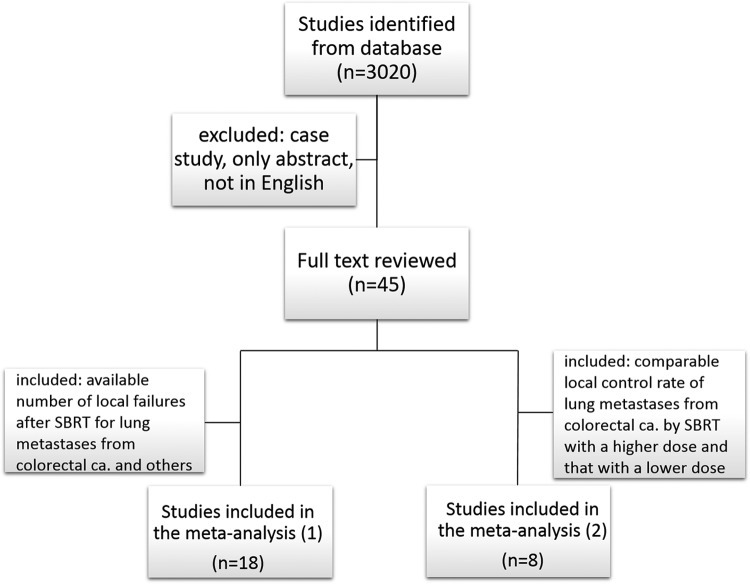
This systematic review and meta-analysis were conducted according to the preferred reporting items for systematic reviews and meta-analyses statement and methods. Studies were obtained from a database search of PubMed, Web of Science, and Google Scholar for publications using search terms designed to identify studies on "oligometastases," "lung," "stereotactic radiotherapy," and "colorectal cancer." For meta-analysis 1, studies that showed the number of local failures after stereotactic body radiotherapy for pulmonary metastases from colorectal carcinoma and other cancers were included. For meta-analysis2, studies in which a comparison was made of local control rates of pulmonary metastases from colorectal carcinoma by stereotactic body radiotherapy with a higher dose and that with a lower dose were included. A meta-analysis was performed using Mantel-Haenszel statics with the fixed or random-effect model by Review Manager 5.3.
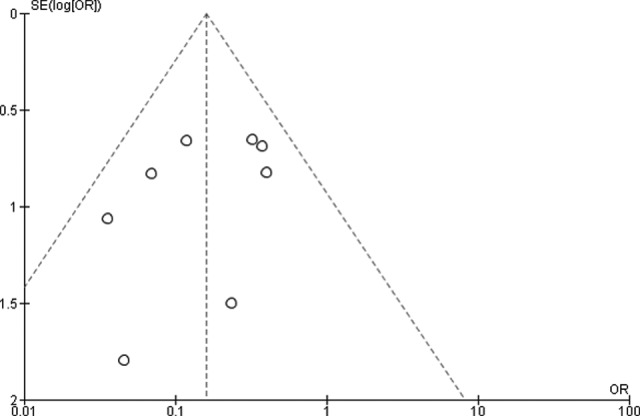
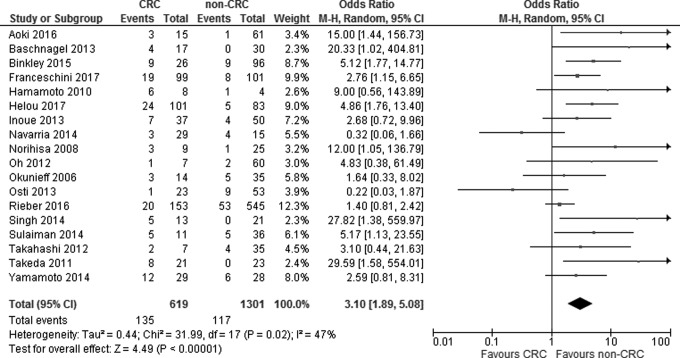
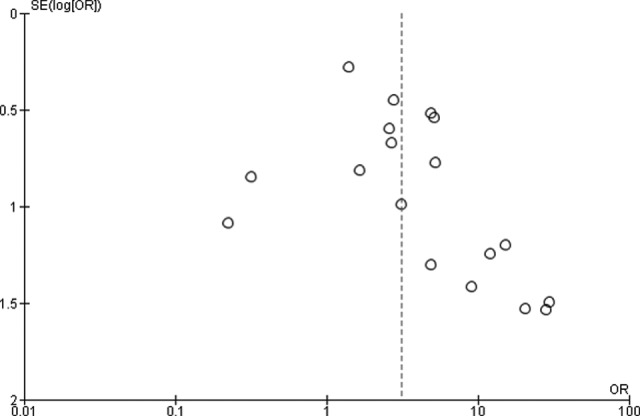
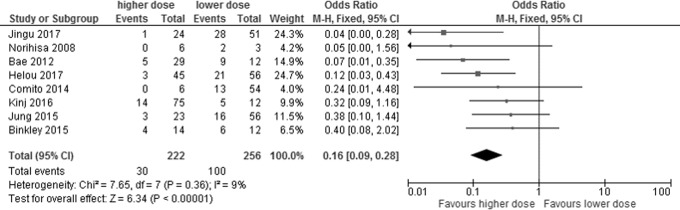
Eighteen retrospective studies with 1920 patients with pulmonary oligometastases were used in meta-analysis 1. The local control rate in patients with pulmonary oligometastases from colorectal cancer was significantly lower than that in patients with pulmonary oligometastases from other cancers (odds ratio = 3.10, P < .00001). Next, 8 retrospective studies with 478 patients were included in meta-analysis 2 for dose escalation. Better local control was achieved by a higher prescription dose than by a lower prescription dose (odds ratio = 0.16, P < .00001).
Our meta-analysis indicated that local control of pulmonary oligometastases from colorectal cancer by stereotactic body radiotherapy was significantly worse than that of pulmonary metastases from other cancers; however, our results also indicated that good local control of pulmonary oligometastases from colorectal cancer can be achieved by dose escalation.
本研究旨在确定结直肠癌肺寡转移灶是否比其他癌症的肺寡转移灶具有更高的放射抗性,以及在立体定向体部放射治疗中增加剂量是否能实现良好的局部控制。
本系统评价和荟萃分析按照系统评价和荟萃分析的首选报告项目声明及方法进行。通过在PubMed、科学网和谷歌学术数据库中搜索,使用旨在识别关于“寡转移灶”“肺”“立体定向放射治疗”和“结直肠癌”研究的检索词获取研究。对于荟萃分析1,纳入显示结直肠癌和其他癌症肺转移灶立体定向体部放射治疗后局部失败数量的研究。对于荟萃分析2,纳入比较结直肠癌肺转移灶高剂量和低剂量立体定向体部放射治疗局部控制率的研究。使用Review Manager 5.3软件,采用Mantel-Haenszel统计量及固定效应或随机效应模型进行荟萃分析。
荟萃分析1使用了18项回顾性研究,共1920例肺寡转移患者。结直肠癌肺寡转移患者的局部控制率显著低于其他癌症肺寡转移患者(比值比 = 3.10,P < .00001)。接下来,荟萃分析2纳入了8项回顾性研究,共478例患者进行剂量递增分析。较高的处方剂量比低处方剂量能实现更好的局部控制(比值比 = 0.16,P < .00001)。
我们的荟萃分析表明,结直肠癌肺寡转移灶立体定向体部放射治疗的局部控制明显差于其他癌症的肺转移灶;然而,我们的结果也表明,通过增加剂量可实现结直肠癌肺寡转移灶的良好局部控制。