Cury Eunice Stella Jardim, Chang Marilene Rodrigues, Pontes Elenir Rose Jardim Cury
Universidade Federal do Mato Grosso do Sul - UFMS, Campo Grande, MS, Brazil.
Universidade Federal do Mato Grosso do Sul - UFMS, Campo Grande, MS, Brazil.
Braz J Microbiol. 2018 Nov;49 Suppl 1(Suppl 1):205-212. doi: 10.1016/j.bjm.2018.05.002. Epub 2018 Aug 14.
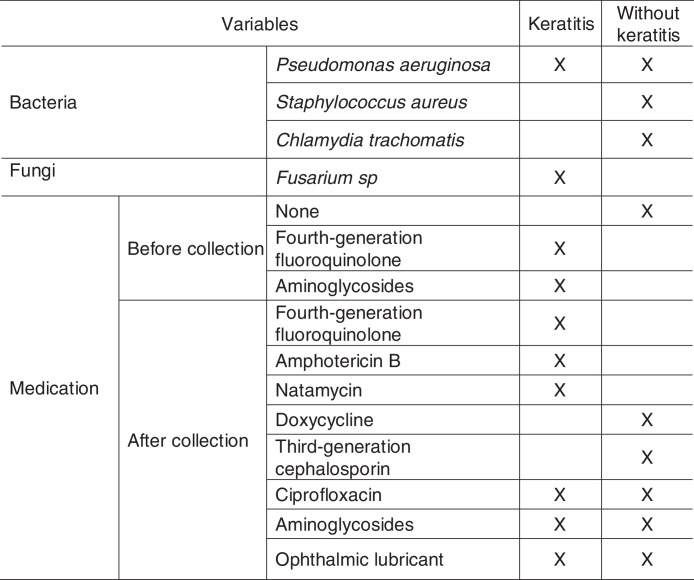
This study compares patients with and without non-viral microbial keratitis in relation to sociodemographic variables, clinical aspects, and involved causative agent. Clinical aspects, etiology and therapeutic procedures were assessed in patients with and without keratitis that were diagnosed in an Eye Care Center in Campo Grande, MS, Brazil. Patients were divided into two groups: (a) cases: 64 patients with non-viral microbial keratitis diagnosed at biomicroscopy; and (b) controls: 47 patients with other eye disorders that were not keratitis. Labor activity related to agriculture, cattle raising, and contact lens use were all linked to keratitis occurrence (p<0.005). In patients with keratitis, the most common symptoms were pain and photophobia, and the most frequently used medicines were fourth-generation fluoroquinolones (34.4%), amphotericin B (31.3%), and natamycin (28.1%). Microbial keratitis evolved to corneal perforation in 15.6% of cases; transplant was indicated in 10.9% of cases. Regarding the etiology of this condition, 23 (42.2%) keratitis cases were caused by bacteria (Pseudomonas aeruginosa, 12.5%), 17 (39.1%) by fungi (Fusarium spp., 14.1% and Aspergillus spp., 4.7%), and 4 (6.3%) by Acanthamoeba. Patients with keratitis present with a poorer prognosis. Rapid identification of the etiologic agent is indispensable and depends on appropriate ophthalmological collection and microbiological techniques.
本研究比较了患有和未患有非病毒性微生物性角膜炎的患者在社会人口统计学变量、临床特征及相关病原体方面的情况。对巴西马托格罗索州大坎普市一家眼科护理中心诊断的患有和未患有角膜炎的患者的临床特征、病因及治疗方法进行了评估。患者分为两组:(a)病例组:64例经生物显微镜检查诊断为非病毒性微生物性角膜炎的患者;(b)对照组:47例患有其他非角膜炎眼部疾病的患者。与农业、畜牧业相关的劳动活动以及隐形眼镜的使用均与角膜炎的发生有关(p<0.005)。角膜炎患者最常见的症状是疼痛和畏光,最常用的药物是第四代氟喹诺酮类药物(34.4%)、两性霉素B(31.3%)和那他霉素(28.1%)。15.6%的病例中微生物性角膜炎发展为角膜穿孔;10.9%的病例需要进行角膜移植。关于该病的病因,23例(42.2%)角膜炎病例由细菌引起(铜绿假单胞菌,12.5%),17例(39.1%)由真菌引起(镰刀菌属,14.1%;曲霉菌属,4.7%),4例(6.3%)由棘阿米巴引起。角膜炎患者预后较差。快速鉴定病原体必不可少,这取决于适当的眼科采集和微生物学技术。