Atluri Sridevi, Sarathi Vijaya, Goel Amit, Boppana Rakesh, Shivaprasad C
Department of Endocrinology, Vydehi Institute of Medical Sciences and Research Center, Bengaluru, Karnataka, India.
Indian J Endocrinol Metab. 2018 Jul-Aug;22(4):489-493. doi: 10.4103/ijem.IJEM_89_18.
Recent increase in the non-specific use of prokinetics in clinical practice may alter the etiological profile of hyperprolactinemia and galactorrhea. Hence, we have studied the etiological profile of patients presenting with galactorrhea and characteristics of drug-induced galactorrhea.
This retrospective study was conducted at a tertiary health care center from South India. Patients who presented with or referred for galactorrhea and/or hyperprolactinemia to the Department of Endocrinology between January 2017 and December 2017 were included in the study.
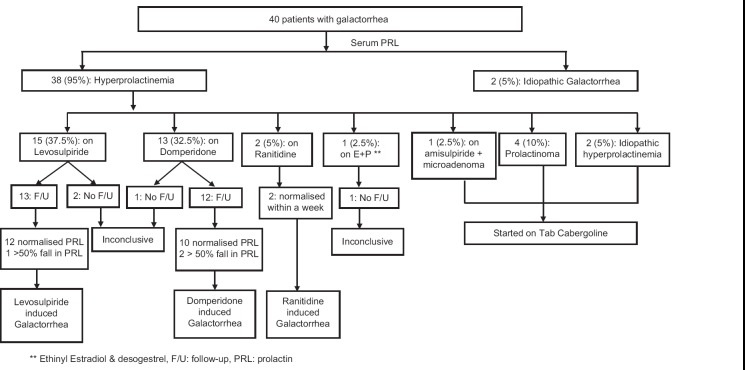
Forty women presented with or referred for galactorrhea to the Department of Endocrinology during the study period. Thirty-two patients had received drugs that are associated with hyperprolactinemia (levosulpiride in 15, domperidone in 13, ranitidine in 2, oral contraceptive pill in 1, and amisulpiride in 1) of whom etiology was proved in 27 patients, whereas in four patients the cause was inconclusive due to lack of follow-up. The patient on amisulpiride was found to have concomitant pituitary microadenoma. Idiopathic galactorrhea ( = 2), idiopathic hyperprolactinemia ( = 2), and prolactinoma ( = 4) accounted for the remaining cases. Six patients with prokinetic-induced galactorrhea had received cabergoline inspite of which hyperprolactinemia and/or galactorrhea persisted and six patients had also undergone pituitary magnetic resonance imaging (MRI) for evaluation of galactorrhea.
Prokinetic use is the most common cause of galactorrhea in our study and often was investigated with costly tests and treated with D2 agonists unnecessarily. Hence, there is a need to ensure measures to reduce the non-specific use of prokinetics and increase awareness regarding the occurrence of galactorrhea with prokinetics use, to reduce unnecessary investigations and treatment.
近期临床实践中促动力药非特异性使用的增加可能会改变高催乳素血症和溢乳的病因谱。因此,我们研究了溢乳患者的病因谱以及药物性溢乳的特征。
这项回顾性研究在印度南部的一家三级医疗保健中心进行。纳入2017年1月至2017年12月期间因溢乳和/或高催乳素血症就诊或转诊至内分泌科的患者。
在研究期间,40名女性因溢乳就诊或转诊至内分泌科。32名患者曾使用过与高催乳素血症相关的药物(15例使用左舒必利,13例使用多潘立酮,2例使用雷尼替丁,1例使用口服避孕药,1例使用氨磺必利),其中27例病因得到证实,4例因缺乏随访病因未明确。使用氨磺必利的患者被发现合并垂体微腺瘤。其余病例包括特发性溢乳(=2)、特发性高催乳素血症(=2)和催乳素瘤(=4)。6例促动力药所致溢乳患者尽管接受了卡麦角林治疗,但高催乳素血症和/或溢乳仍持续存在,6例患者还接受了垂体磁共振成像(MRI)以评估溢乳情况。
在我们的研究中,促动力药的使用是溢乳最常见的原因,且常进行昂贵的检查并不必要地使用D2激动剂进行治疗。因此,需要采取措施减少促动力药的非特异性使用,并提高对促动力药使用导致溢乳的认识,以减少不必要的检查和治疗。