Department of Hematology, The Third Xiangya Hospital of Central South University, Changsha, Hunan, China (mainland).
Department of Hematology, Changsha Central Hospital, Changsha, Hunan, China (mainland).
Med Sci Monit. 2018 Aug 27;24:5973-5979. doi: 10.12659/MSM.908130.
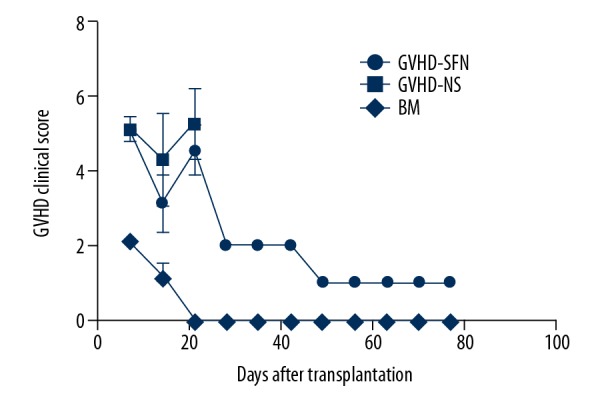
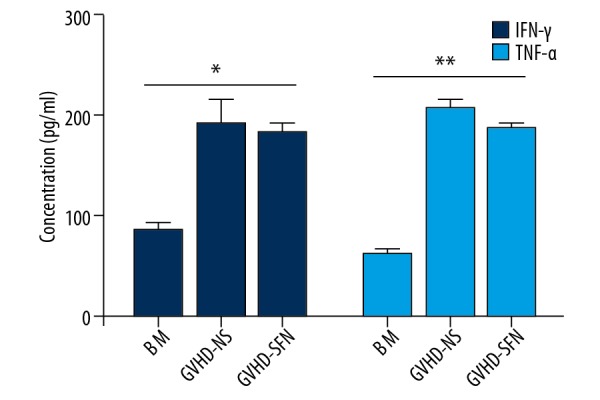
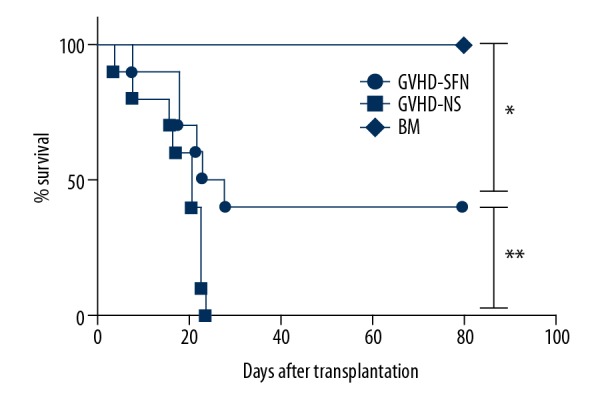
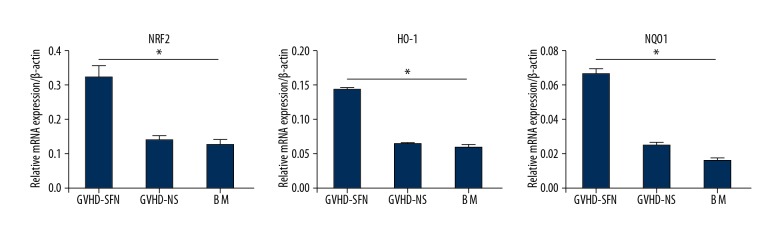
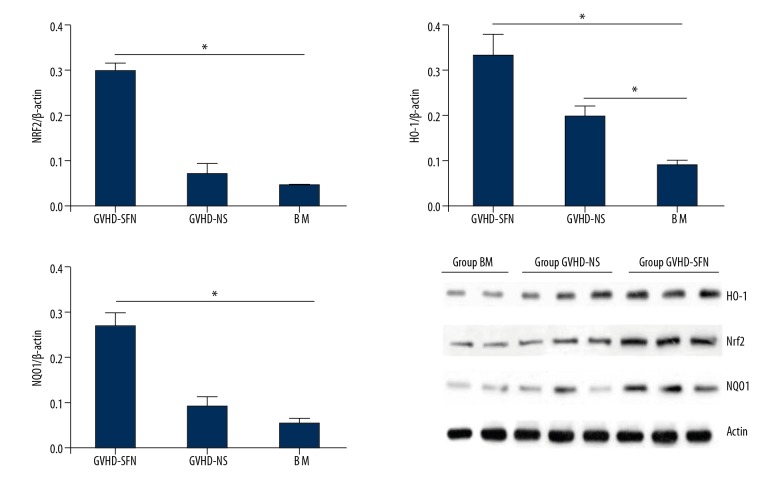
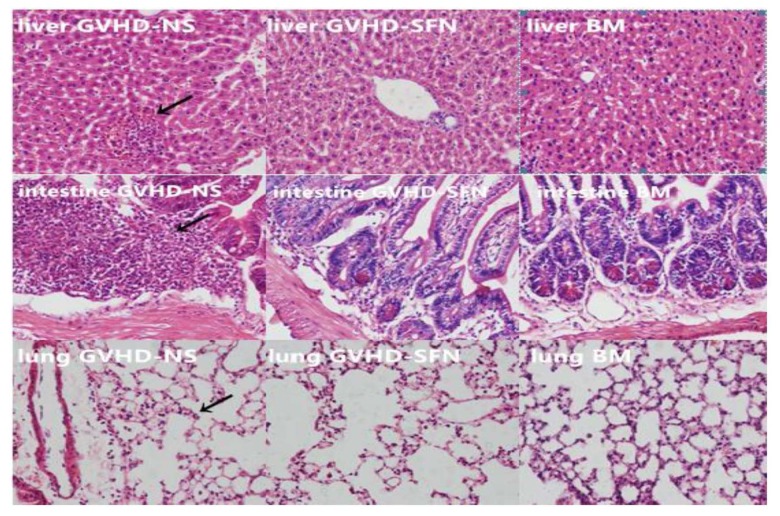
BACKGROUND Acute graft-versus-host disease (aGVHD) limits the wider application of hematopoietic stem cell transplantation (HSCT). We explored the relationship between the Nrf2-ARE signaling pathway and aGVHD and identified effective and efficient therapeutic targets for the prevention and management of aGVHD following HSCT. MATERIAL AND METHODS C57BL/6 and BALB/c mice were used to establish the aGVHD model. The bone marrow and spleen mononuclear cells were separated from the donor mice and injected into the caudal vein of recipient mice that had undergone total body irradiation (TBI, 8 Gy). Sulforaphane (SFN) was used to activate the Nrf2-ARE signaling pathway. RESULTS The long-term survival rate of the SFN group was higher than that of the control group (40% vs. 0%, p<0.05, n=10). There were worse pathological changes and a greater infiltration of inflammatory cells in the liver, small intestine, and lung tissues of the control group. Furthermore, the Nrf2, NQO1, and HO-1 mRNA and protein levels were higher in the small intestines of the SFN group than in the control group (p<0.05, n=4). CONCLUSIONS The Nrf2-ARE signaling pathway plays a vital role in preventing aGVHD in an HSCT mouse model by regulating the expression of the downstream antioxidant genes NQO1 and HO-1 and by inhibiting the local inflammatory reaction.
急性移植物抗宿主病(aGVHD)限制了造血干细胞移植(HSCT)的广泛应用。我们探索了 Nrf2-ARE 信号通路与 aGVHD 的关系,并确定了针对 HSCT 后预防和管理 aGVHD 的有效和高效治疗靶点。
使用 C57BL/6 和 BALB/c 小鼠建立 aGVHD 模型。从供体小鼠中分离骨髓和脾单核细胞,并将其注入接受全身照射(TBI,8 Gy)的受体小鼠尾静脉。用萝卜硫素(SFN)激活 Nrf2-ARE 信号通路。
SFN 组的长期存活率高于对照组(40%比 0%,p<0.05,n=10)。对照组肝、小肠和肺组织的病理变化更严重,炎症细胞浸润更多。此外,SFN 组小肠中的 Nrf2、NQO1 和 HO-1 mRNA 和蛋白水平高于对照组(p<0.05,n=4)。
Nrf2-ARE 信号通路通过调节下游抗氧化基因 NQO1 和 HO-1 的表达,抑制局部炎症反应,在 HSCT 小鼠模型中对预防 aGVHD 发挥重要作用。