Department of Pharmacy, The Third Affiliated Hospital of Guangzhou Medical University, Guangzhou, China.
College of Pharmacy, Jinan University, Guangzhou, China.
PLoS One. 2018 Aug 27;13(8):e0202563. doi: 10.1371/journal.pone.0202563. eCollection 2018.
This study aimed to investigate the efficacy and safety of dual therapy comprising sulfonylurea (SU) plus antidiabetic drugs for the treatment of type 2 diabetes mellitus (T2DM).
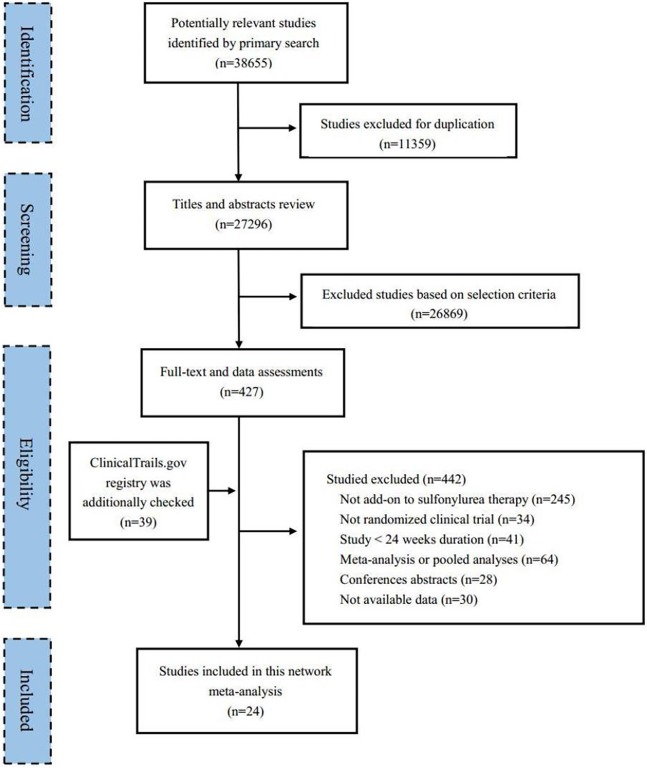
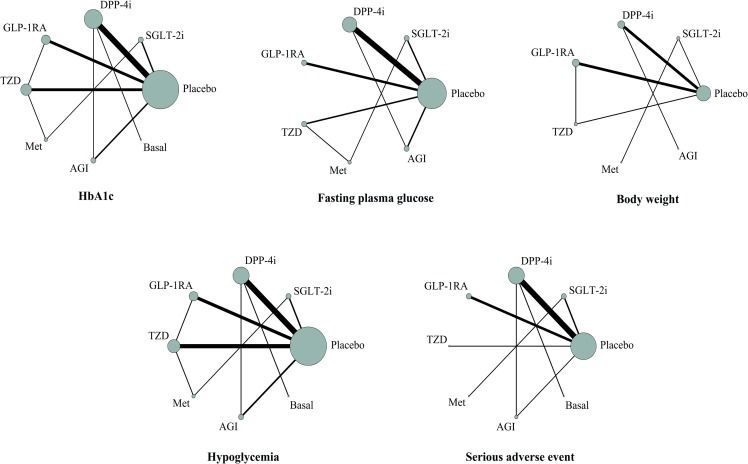
We searched the PubMed, Cochrane library, and Embase databases for randomized clinical trials (≥24 weeks) published up to December 28, 2017. Subsequently, we conducted pairwise and network meta-analyses to calculate the odds ratios (ORs) and mean differences (MDs) with 95% confidence intervals (CIs) of the outcomes.
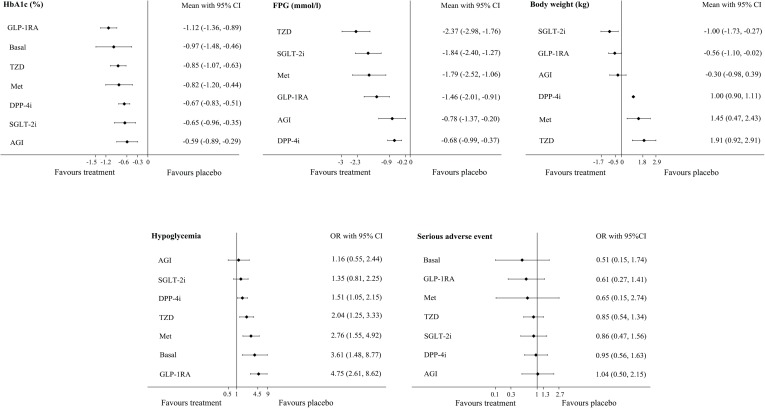
The final analyses included 24 trials with a total of 10,032 patients. Compared with placebo, all treatment regimens were associated with a significantly higher risk of hypoglycemia, except the combinations of SU plus sodium-glucose co-transporter-2 inhibitor (SGLT-2i) [OR, 1.35 (95% CI: 0.81 to 2.25)] or alpha-glucosidase inhibitor (AGI) [OR, 1.16 (95% CI: 0.55 to 2.44)]. Notably, the combination of SU plus glucagon-like peptide-1 receptor agonist (GLP-1RA) was associated with the most significant increase in the risk of hypoglycemia. Furthermore, all SU-based combination regimens reduced the glycated hemoglobin (HbA1c) and fasting plasma glucose levels (FPG). However, only combinations containing SGLT-2i [MD, -1.00 kg (95% CI: -1.73 to -0.27)] and GLP-1RA [MD, -0.56 kg (95% CI: -1.10 to -0.02)] led to weight loss.
Our findings highlight the importance of considering the risk of hypoglycemia when selecting antidiabetic drugs to be administered concomitantly with SU. Although all classes of antidiabetic drugs improved glucose control when administered in combination with SU, SGLT-2i might be the best option with respect to factors such as hypoglycemia and body weight.
本研究旨在探讨磺酰脲类药物(SU)联合其他降糖药物的双联疗法治疗 2 型糖尿病(T2DM)的疗效和安全性。
我们检索了 PubMed、Cochrane 图书馆和 Embase 数据库中截至 2017 年 12 月 28 日发表的随机临床试验(≥24 周)。随后,我们进行了两两和网络荟萃分析,以计算结局的优势比(OR)和均数差值(MD)及其 95%置信区间(CI)。
最终分析纳入了 24 项试验,共 10032 例患者。与安慰剂相比,除 SU 联合钠-葡萄糖共转运蛋白-2 抑制剂(SGLT-2i)[OR,1.35(95%CI:0.81 至 2.25)]或α-葡萄糖苷酶抑制剂(AGI)[OR,1.16(95%CI:0.55 至 2.44)]外,所有治疗方案均与低血糖风险显著升高相关。值得注意的是,SU 联合胰高血糖素样肽-1 受体激动剂(GLP-1RA)的治疗方案与低血糖风险的显著增加最为相关。此外,所有基于 SU 的联合治疗方案均降低了糖化血红蛋白(HbA1c)和空腹血糖水平(FPG)。然而,只有包含 SGLT-2i 的联合方案[MD,-1.00kg(95%CI:-1.73 至 -0.27)]和 GLP-1RA [MD,-0.56kg(95%CI:-1.10 至 -0.02)]导致体重减轻。
我们的研究结果强调了在选择与 SU 同时使用的降糖药物时,应考虑低血糖风险。虽然所有类别的降糖药物与 SU 联合应用均能改善血糖控制,但就低血糖和体重等因素而言,SGLT-2i 可能是最佳选择。