Department of Internal Medicine, Hanyang University Guri Hospital, Guri, South Korea.
Department of Internal Medicine, Seoul National University Hospital, Seoul, South Korea.
PLoS One. 2018 Aug 27;13(8):e0202676. doi: 10.1371/journal.pone.0202676. eCollection 2018.
Albuminuria is a predictor of disease progression in patients with chronic kidney disease (CKD). However, the ability of proteinuria parameters measured at various time periods to predict renal outcomes is unclear.
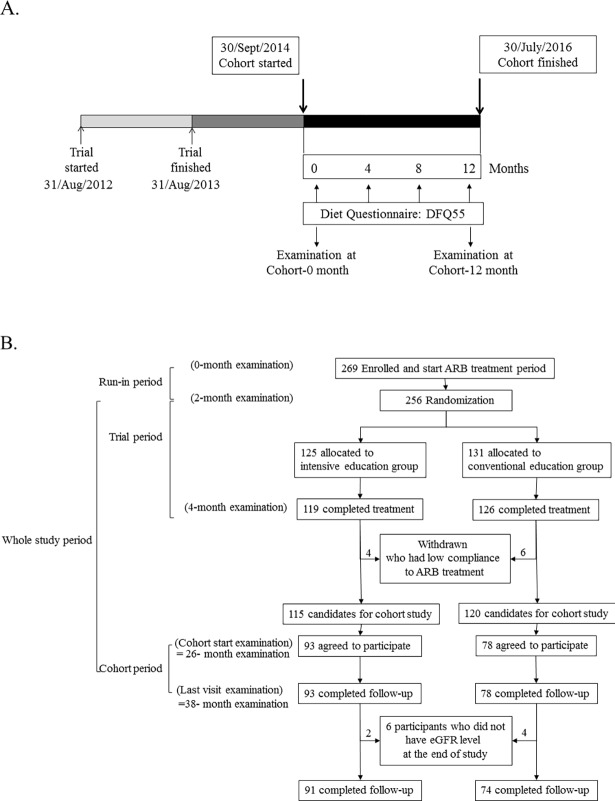
This observational cohort study included 165 non-diabetic hypertensive CKD patients who took olmesartan medoxomil. We measured the albuminuria at five different time points (0, 2, 4, 26, and 38 months) and the mean levels. The mean albuminuria levels were calculated during 0-4 months, 0-26 months, and 0-38 months. The renal outcome was defined as a decline in eGFR ≥ 40% during the entire study period.
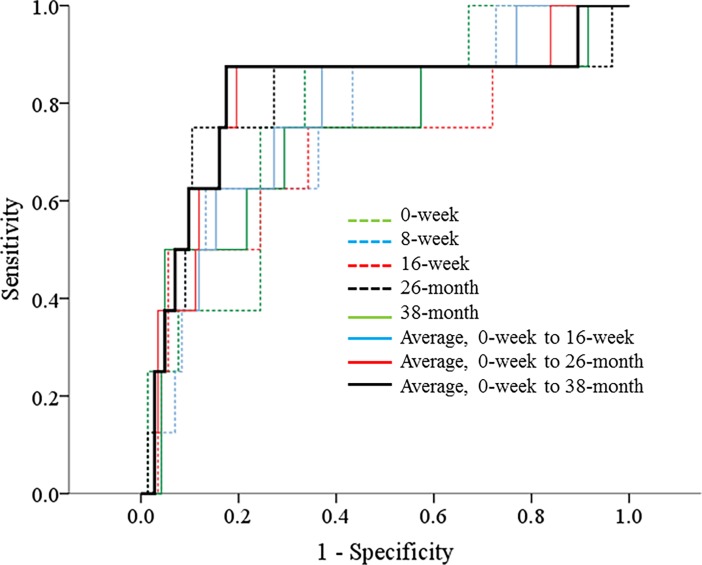
The albuminuria at five different time points and the mean albuminuria levels were independent risk factors for a worse renal outcome after adjusting for age, sex, and estimated glomerular filtration rate (eGFR) at enrollment and were able to predict the renal outcome, although the performance of the estimation tended to be more effective using the mean albuminuria level at the 38-month follow-up time point. The risk of a decline in eGFR ≥ 40% was increased by 1.690-folds [95% CI 1.110-2.572, P = 0.014] per 500 mg/day increase in the mean albuminuria at 38 months. With a cut-off value of 897 mg/day for mean albuminuria at 38 months after treatment, a decline in eGFR ≥ 40% was predicted with a sensitivity of 88.9% and specificity of 81.3%. The ability of albuminuria to predict a renal event at different measurement points does not differ in CKD patients.
The time-averaged albuminuria cut-off of 900 mg/day during the 3-year follow-up period showed high sensitivity and specificity for predicting a decline in eGFR ≥ 40% in CKD patients, although the albuminuria at different measurement points did not predict a worse renal outcome.
蛋白尿是慢性肾脏病(CKD)患者疾病进展的预测指标。然而,不同时间点测量的蛋白尿参数预测肾脏结局的能力尚不清楚。
本观察性队列研究纳入了 165 例服用奥美沙坦酯的非糖尿病高血压性 CKD 患者。我们在五个不同时间点(0、2、4、26 和 38 个月)测量了蛋白尿,并测量了平均值。在 0-4 个月、0-26 个月和 0-38 个月期间计算平均蛋白尿水平。肾脏结局定义为整个研究期间 eGFR 下降≥40%。
五个不同时间点的蛋白尿和平均蛋白尿水平是调整年龄、性别和入组时估计肾小球滤过率(eGFR)后肾脏结局较差的独立危险因素,能够预测肾脏结局,尽管使用 38 个月随访时的平均蛋白尿水平进行估计的效果更有效。eGFR 下降≥40%的风险增加了 1.690 倍[95%CI 1.110-2.572,P=0.014],每增加 500mg/天的平均蛋白尿水平。治疗后 38 个月平均蛋白尿的截断值为 897mg/天,eGFR 下降≥40%的预测敏感性为 88.9%,特异性为 81.3%。不同测量点的蛋白尿预测肾脏事件的能力在 CKD 患者中没有差异。
在 3 年随访期间,平均蛋白尿截定点为 900mg/天,对预测 CKD 患者 eGFR 下降≥40%具有较高的敏感性和特异性,尽管不同测量点的蛋白尿并未预测肾脏预后不良。