Galloway Laura F, Watson Ray H B, Prendeville Holly R
Department of Biology University of Virginia Charlottesville Virginia.
Present address: USDA FS Pacific Northwest Research Station Corvallis Oregon.
Ecol Evol. 2018 Jul 12;8(15):7688-7696. doi: 10.1002/ece3.4334. eCollection 2018 Aug.
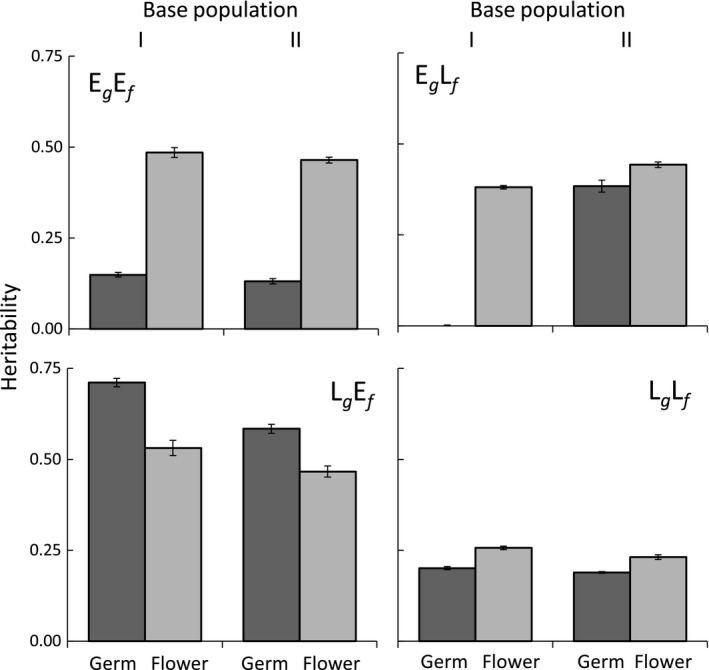
Flowering and germination time are components of phenology, a complex phenotype that incorporates a number of traits. In natural populations, selection is likely to occur on multiple components of phenology at once. However, we have little knowledge of how joint selection on several phenological traits influences evolutionary response. We conducted one generation of artificial selection for all combinations of early and late germination and flowering on replicated lines within two independent base populations in the herb . We then measured response to selection and realized heritability for each trait. Response to selection and heritability were greater for flowering time than germination time, indicating greater evolutionary potential of this trait. Selection for earlier phenology, both flowering and germination, did not depend on the direction of selection on the other trait, whereas response to selection to delay germination and flowering was greater when selection on the other trait was in the opposite direction (e.g., early germination and late flowering), indicating a negative genetic correlation between the traits. Therefore, the extent to which correlations shaped response to selection depended on the direction of selection. Furthermore, the genetic correlation between timing of germination and flowering varies across the trait distributions. The negative correlation between germination and flowering time found when selecting for delayed phenology follows theoretical predictions of constraint for traits that jointly determine life history schedule. In contrast, the lack of constraint found when selecting for an accelerated phenology suggests a reduction of the covariance due to strong selection favoring earlier flowering and a shorter life cycle. This genetic architecture, in turn, will facilitate further evolution of the early phenology often favored in warm climates.
开花和萌发时间是物候学的组成部分,物候学是一种包含许多性状的复杂表型。在自然种群中,物候学的多个组成部分可能会同时发生选择。然而,我们对几个物候性状的联合选择如何影响进化响应知之甚少。我们对该草本植物两个独立基础种群内的重复株系进行了早萌发和晚萌发与开花所有组合的一代人工选择。然后我们测量了对选择的响应以及每个性状的实现遗传力。开花时间的选择响应和遗传力大于萌发时间,表明该性状具有更大的进化潜力。对更早物候(包括开花和萌发)的选择并不取决于对另一个性状的选择方向,而当对另一个性状的选择方向相反时(例如,早萌发和晚开花),延迟萌发和开花的选择响应更大,这表明性状之间存在负遗传相关性。因此,相关性影响选择响应的程度取决于选择方向。此外,萌发时间和开花时间之间的遗传相关性在性状分布上有所不同。在选择延迟物候时发现的萌发与开花时间之间的负相关符合共同决定生活史时间表的性状的限制理论预测。相比之下,在选择加速物候时发现缺乏限制,这表明由于强烈选择有利于更早开花和更短生命周期,协方差降低。这种遗传结构反过来将促进温暖气候中常受青睐的早物候的进一步进化。