Gastrointestinal Surgery, Nottingham Digestive Diseases Centre, National Institute for Health (NIHR) Research Nottingham Biomedical Research Centre, Nottingham University Hospitals and University of Nottingham, Queen's Medical Centre, Nottingham United Kingdom.
Sir Peter Mansfield Imaging Centre (SPMIC), University of Nottingham, University Park, Nottingham, United Kingdom.
Nutrition. 2019 Jan;57:92-96. doi: 10.1016/j.nut.2018.06.003. Epub 2018 Jul 11.
The analysis of body composition from computed tomography (CT) imaging has become widespread. However, the methodology used is far from established. Two main software packages are commonly used for body composition analysis, with results used interchangeably. However, the equivalence of these has not been well established. The aim of this study was to compare the results of body composition analysis performed using the two software packages to assess their equivalence.
Triphasic abdominal CT scans from 50 patients were analyzed for a range of body composition measures at the third lumbar vertebral level using OsiriX (v7.5.1, Pixmeo, Switzerland) and SliceOmatic (v5.0, TomoVision, Montreal, Canada) software packages. Measures analyzed were skeletal muscle index (SMI), fat mass (FM), fat-free mass (FFM), and mean skeletal muscle Hounsfield Units (SMHU).
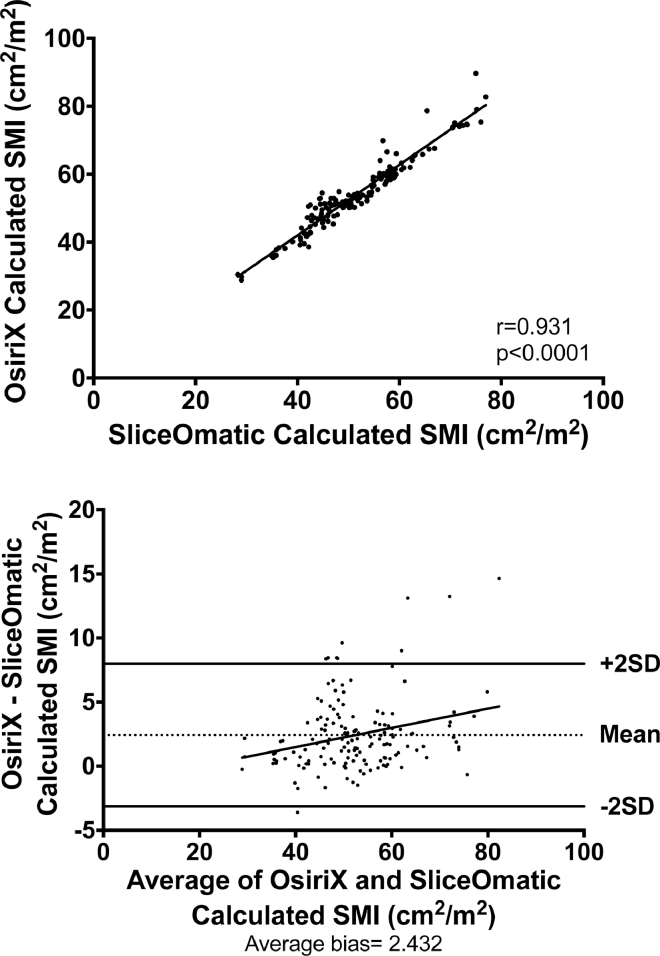
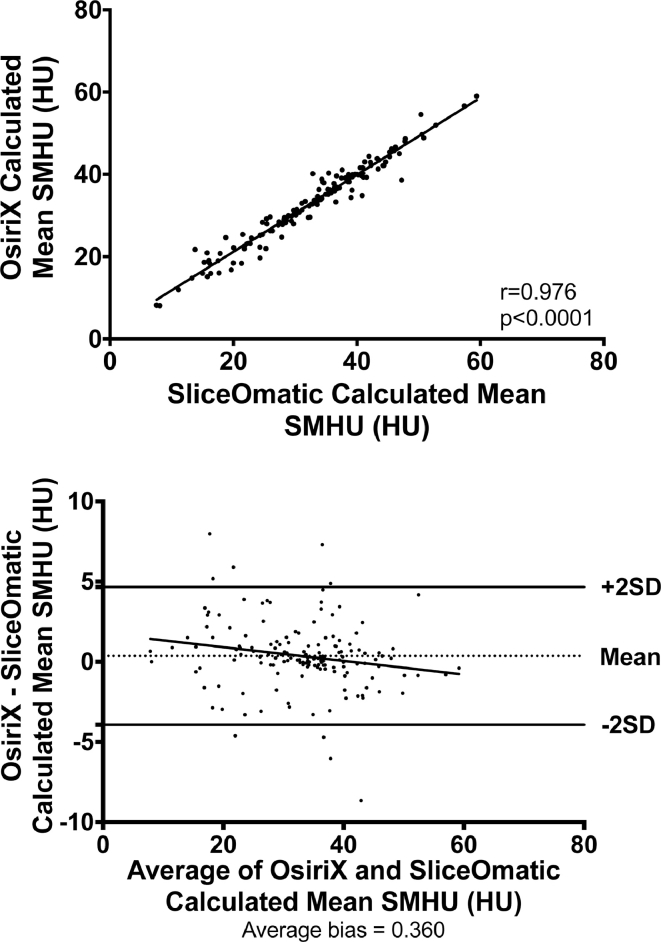
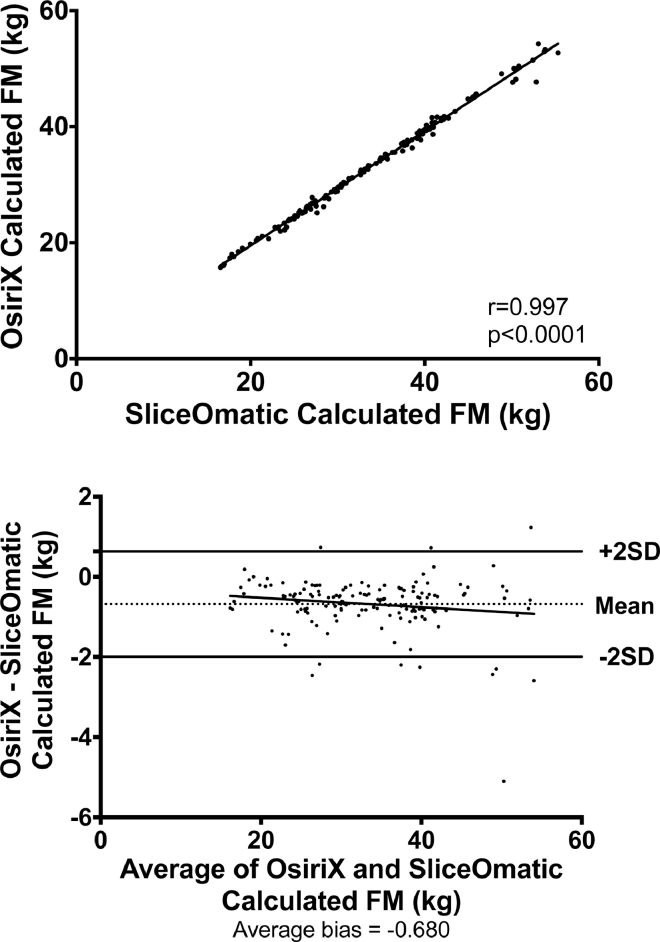
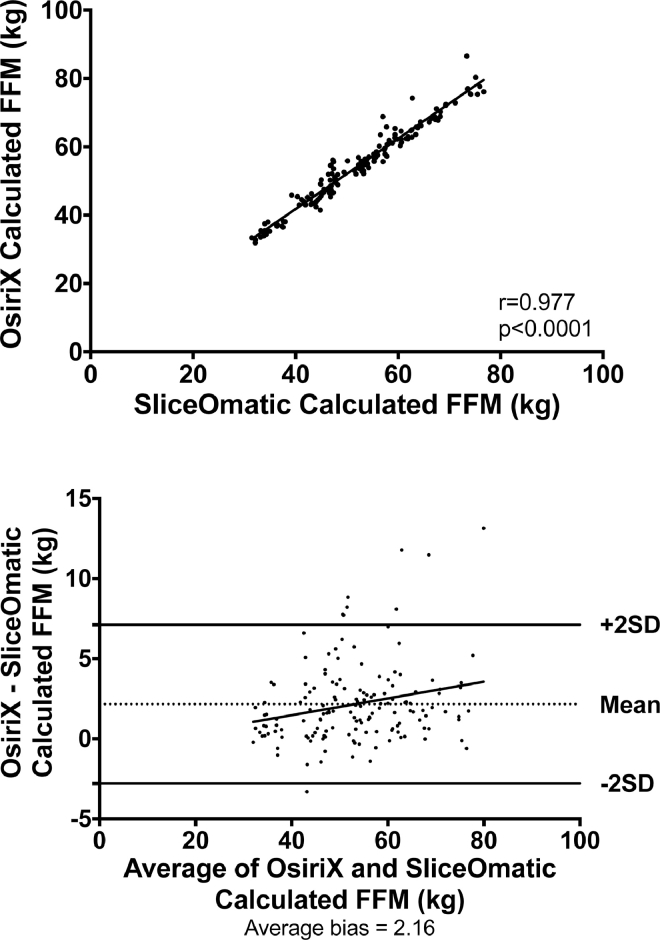
The overall mean SMI calculated using the two software packages was significantly different (SliceOmatic 51.33 versus OsiriX 53.77, P < 0.0001), and this difference remained significant for non-contrast and arterial scans. When FM and FFM were considered, again the results were significantly different (SliceOmatic 33.7 versus OsiriX 33.1 kg, P < 0.0001; SliceOmatic 52.1 versus OsiriX 54.2 kg, P < 0.0001, respectively), and this difference remained for all phases of CT. Finally, when analyzed, mean SMHU was also significantly different (SliceOmatic 32.7 versus OsiriX 33.1 HU, P = 0.046).
All four body composition measures were statistically significantly different by the software package used for analysis; however, the clinical significance of these differences is doubtful. Nevertheless, the same software package should be used if serial measurements are being performed.
从计算机断层扫描(CT)图像分析人体成分已经变得非常普遍。然而,所使用的方法远未得到确立。两种主要的软件包通常用于人体成分分析,其结果可以互换使用。但是,这些结果的等效性尚未得到很好的证实。本研究的目的是比较使用两种软件包进行人体成分分析的结果,以评估它们的等效性。
对 50 例患者的三期腹部 CT 扫描进行分析,在第三腰椎水平使用 OsiriX(v7.5.1,Pixmeo,瑞士)和 SliceOmatic(v5.0,TomoVision,蒙特利尔,加拿大)软件包分析一系列人体成分指标,包括骨骼肌指数(SMI)、脂肪量(FM)、去脂体重(FFM)和平均骨骼肌亨氏单位(SMHU)。
使用两种软件包计算的总体平均 SMI 存在显著差异(SliceOmatic 为 51.33,OsiriX 为 53.77,P < 0.0001),这种差异在非对比和动脉扫描中仍然显著。当考虑 FM 和 FFM 时,结果也存在显著差异(SliceOmatic 为 33.7 千克,OsiriX 为 33.1 千克,P < 0.0001;SliceOmatic 为 52.1 千克,OsiriX 为 54.2 千克,P < 0.0001),这种差异在 CT 的所有阶段都存在。最后,当进行分析时,平均 SMHU 也存在显著差异(SliceOmatic 为 32.7 HU,OsiriX 为 33.1 HU,P = 0.046)。
使用分析的软件包,所有四个人体成分测量值都存在统计学显著差异;然而,这些差异的临床意义值得怀疑。然而,如果要进行连续测量,则应使用相同的软件包。