Department of Radiation Oncology, University Hospital of Heidelberg, Im Neuenheimer Feld 400, 69120, Heidelberg, Germany.
Heidelberg Institute of Radiation Oncology (HIRO), Im Neuenheimer Feld 280, 69120, Heidelberg, Germany.
BMC Cancer. 2018 Aug 31;18(1):859. doi: 10.1186/s12885-018-4777-8.
This was a prespecified secondary analysis of a randomized trial, which analyzed bone density following stereotactic body radiotherapy (SBRT) versus conventional three-dimensional conformal radiotherapy (3DCRT) as part of palliative management of painful spinal metastases.
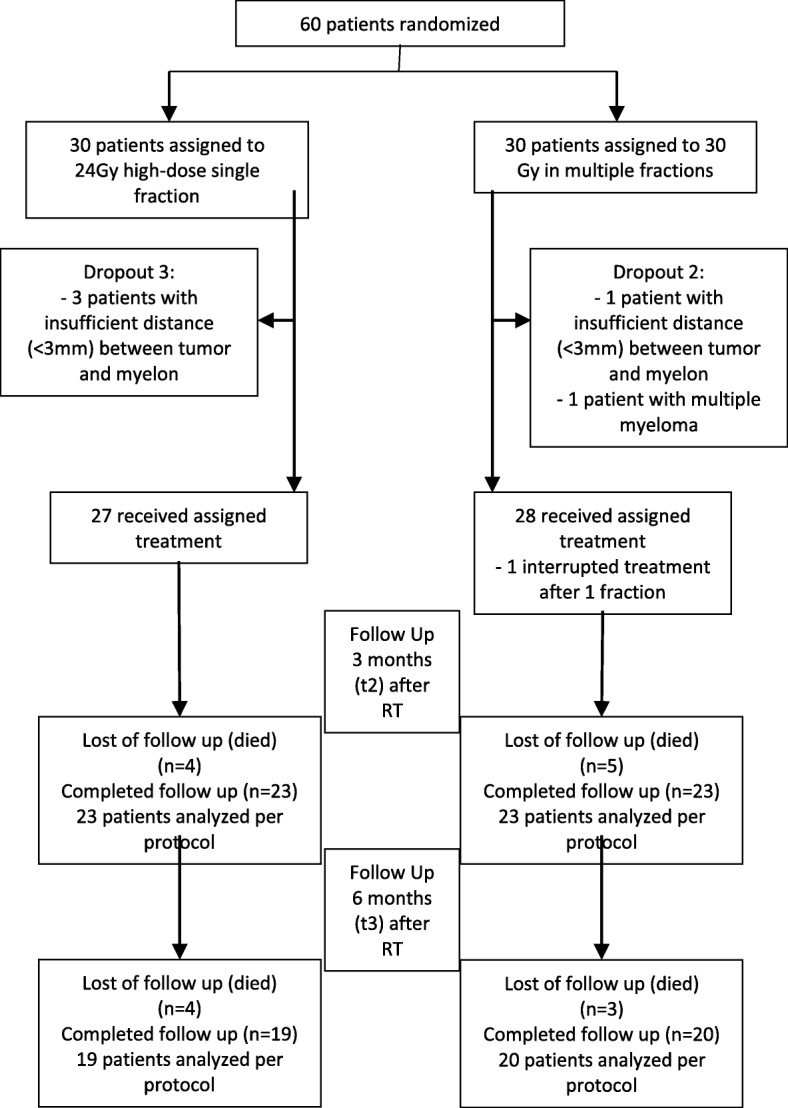
Fifty-five patients were enrolled in this single-institutional randomized exploratory trial (NCT02358720). Participants were randomly assigned to receive SBRT (single-fraction 24 Gy) or 3DCRT (30 Gy/10 fractions). Quantitative bone density was evaluated at baseline, 3 and 6 months in both irradiated and unirradiated spinal bodies, along with rates of pathologic fractures and vertebral compression fractures.
As compared to baseline, bone density became significantly higher at 3 and 6 months following SBRT by a median of 33.8% and 72.1%, respectively (p < 0.01 for both). These figures in the 3DCRT cohort were 32.9% and 41.2%, respectively (p < 0.01 for both). There were no statistical differences in bone density between SBRT and 3DCRT at 3 (p = 0.629) or 6 months (p = 0.327). Subgroup analysis of osteolytic metastases showed an increase in bone density relative to baseline in the SBRT (but not 3DCRT) arm. Bone density in unaffected vertebrae did not show substantial changes in either group. The 3-month incidence of new pathological fractures was 8.7% in the SBRT arm vs. 4.3% in the 3DCRT arm.
Despite high ablative doses in the SBRT arm, the significant increase in bone density after 3 and 6 months was similar to that of 3DCRT. Our trial demonstrated a moderate rate of subsequent pathological fracture after SBRT. Future randomized investigations with larger sample sizes are recommended.
www.clinicaltrials.gov : NCT02358720 on 9nd of February 2015.
这是一项立体定向体部放疗(SBRT)与常规三维适形放疗(3DCRT)对比治疗疼痛性脊柱转移瘤姑息治疗的随机试验的预设二次分析。
本单中心随机探索性试验(NCT02358720)共纳入 55 例患者。参与者被随机分为 SBRT 组(单次 24 Gy)或 3DCRT 组(30 Gy/10 次)。在接受放疗和未接受放疗的脊柱骨中,在基线、3 个月和 6 个月时评估定量骨密度,并记录病理性骨折和椎体压缩性骨折的发生率。
与基线相比,SBRT 组在 3 个月和 6 个月时的骨密度分别显著增加了中位数 33.8%和 72.1%(均 P < 0.01)。3DCRT 组的相应数据分别为 32.9%和 41.2%(均 P < 0.01)。在 3 个月(P = 0.629)和 6 个月(P = 0.327)时,SBRT 组与 3DCRT 组之间的骨密度无统计学差异。溶骨性转移亚组分析显示,SBRT 组(而非 3DCRT 组)的骨密度较基线增加。两组中未受影响的椎体的骨密度均无明显变化。SBRT 组新发病理性骨折的 3 个月发生率为 8.7%,3DCRT 组为 4.3%。
尽管 SBRT 组的消融剂量较高,但 3 个月和 6 个月后的骨密度显著增加与 3DCRT 相似。本试验显示 SBRT 后发生病理性骨折的比例中等。建议开展更大样本量的随机研究。
www.clinicaltrials.gov:于 2015 年 2 月 9 日注册,注册号 NCT02358720。