Machin Nicoletta, Ragni Margaret V
Department of Medicine, University of Pittsburgh, Hemophilia Center of Western Pennsylvania, Pittsburgh, PA, USA,
J Blood Med. 2018 Aug 22;9:135-140. doi: 10.2147/JBM.S159297. eCollection 2018.
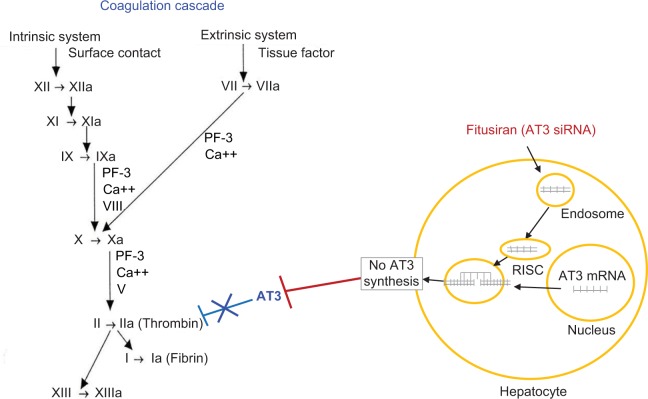
Fitusiran is an RNA interference therapeutic that targets antithrombin (AT) in the liver and interferes with AT translation by binding and degrading messenger RNA-AT, thereby silencing AT gene expression and preventing AT synthesis. In both preclinical and clinical studies, AT knockdown results in dose-dependent AT lowering when fitusiran is given weekly or monthly subcutaneously. In clinical trials, fitusiran dose escalation has resulted in improved thrombin generation and clinical hemostasis as measured by reduction in annualized bleed rate. Unlike currently licensed drugs, this improvement was not only in patients with hemophilia A but in also those with hemophilia B, with or without inhibitors. In dental and surgical procedures, fitusiran also provided perioperative hemostasis in association with AT lowering. Fitusiran is well tolerated, with minor local injection site reactions, but in one subject with severe hemophilia A, the concomitant use of daily high-dose factor VIII, inconsistent with trial guidance to avoid high, repeat doses of clotting factor, was associated with fatal thrombosis, suggesting the need for caution when using hemostatic agents in conjunction with fitusiran. Preclinical in vitro and in silico studies indicate improvement in thrombin generation in rare bleeding disorder plasmas, including in plasmas from patients with severe factors V, VII, and X deficiency, suggesting potential therapeutic benefit.
非图西然是一种RNA干扰疗法,作用于肝脏中的抗凝血酶(AT),通过结合并降解信使核糖核酸-AT干扰AT翻译,从而使AT基因表达沉默并阻止AT合成。在临床前和临床研究中,当每周或每月皮下注射非图西然时,AT水平降低呈剂量依赖性。在临床试验中,非图西然剂量递增使凝血酶生成改善,临床止血效果通过年化出血率降低得以衡量。与目前已获许可的药物不同,这种改善不仅见于甲型血友病患者,也见于乙型血友病患者,无论有无抑制剂。在牙科和外科手术中,非图西然也能在降低AT水平的同时提供围手术期止血。非图西然耐受性良好,仅有轻微的局部注射部位反应,但在一名重度甲型血友病患者中,每日同时使用高剂量的凝血因子VIII(与避免高剂量、重复使用凝血因子的试验指导不一致)与致命性血栓形成有关,这表明在与非图西然联合使用止血剂时需谨慎。临床前体外和计算机模拟研究表明,在罕见出血性疾病血浆中,包括重度V、VII和X因子缺乏患者的血浆中,凝血酶生成有所改善,提示可能具有治疗益处。