Department of Hepatobiliary Surgery, Affiliated Tumor Hospital of Guangxi Medical University, Guangxi Zhuang Autonomous Region, Nanning, 530021, China.
Guangxi Liver Cancer Diagnosis and Treatment Engineering and Technology Research Center, Guangxi Zhuang Autonomous Region, Nanning, 530021, China.
J Exp Clin Cancer Res. 2018 Sep 3;37(1):212. doi: 10.1186/s13046-018-0852-x.
Misregulation of the p53-mdm2 loop function is a major mechanism to promote hepatocellular carcinoma (HCC). RBM38, a member of the RNA recognition motif (RRM) family of RNA binding proteins (RBPs), plays a fundamental role in the posttranscriptional control of gene expression and regulatory functions in human tumors. A novel RBM38-p53-mdm2 autoregulatory feedback loop has been demonstrated. However, its mechanistic role in HCC remains unclear.
In the present study, we investigated the role and molecular mechanism of misregulation in the p53-mdm2 loop function by RBM38 in HCC. First we investigated the correlation of RBM38 activity and p53-mdm2 loop function in liver cancer cells and HCC tissues by western blot and quantitative RT-PCR. We then conducted functional assays to investigate the molecular roles of RBM38 in inhibiting liver cancer cells aggressiveness in vitro and suppressing tumorigenicity in vivo.
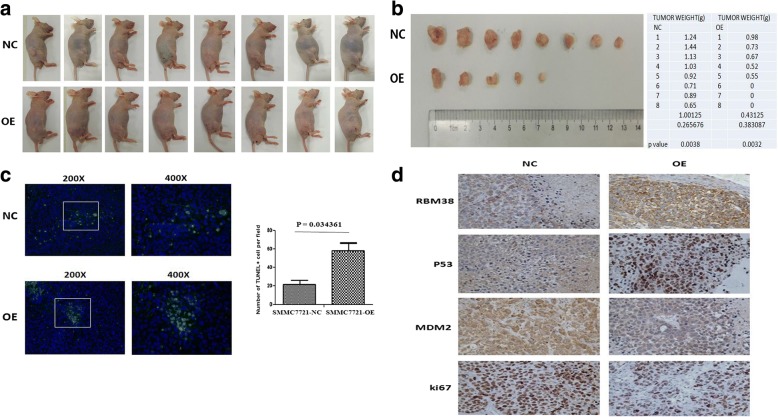
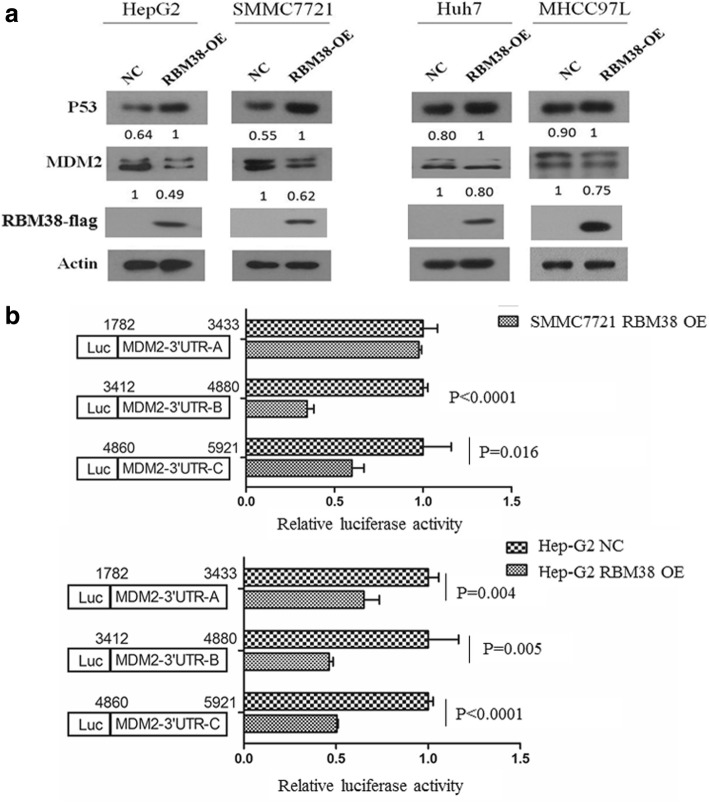
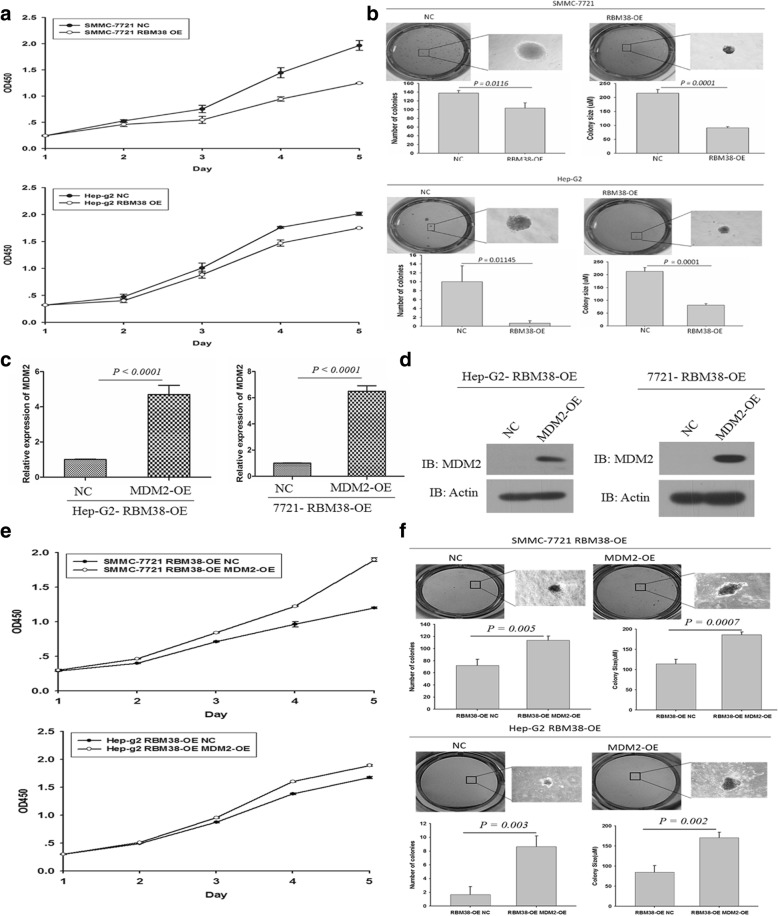
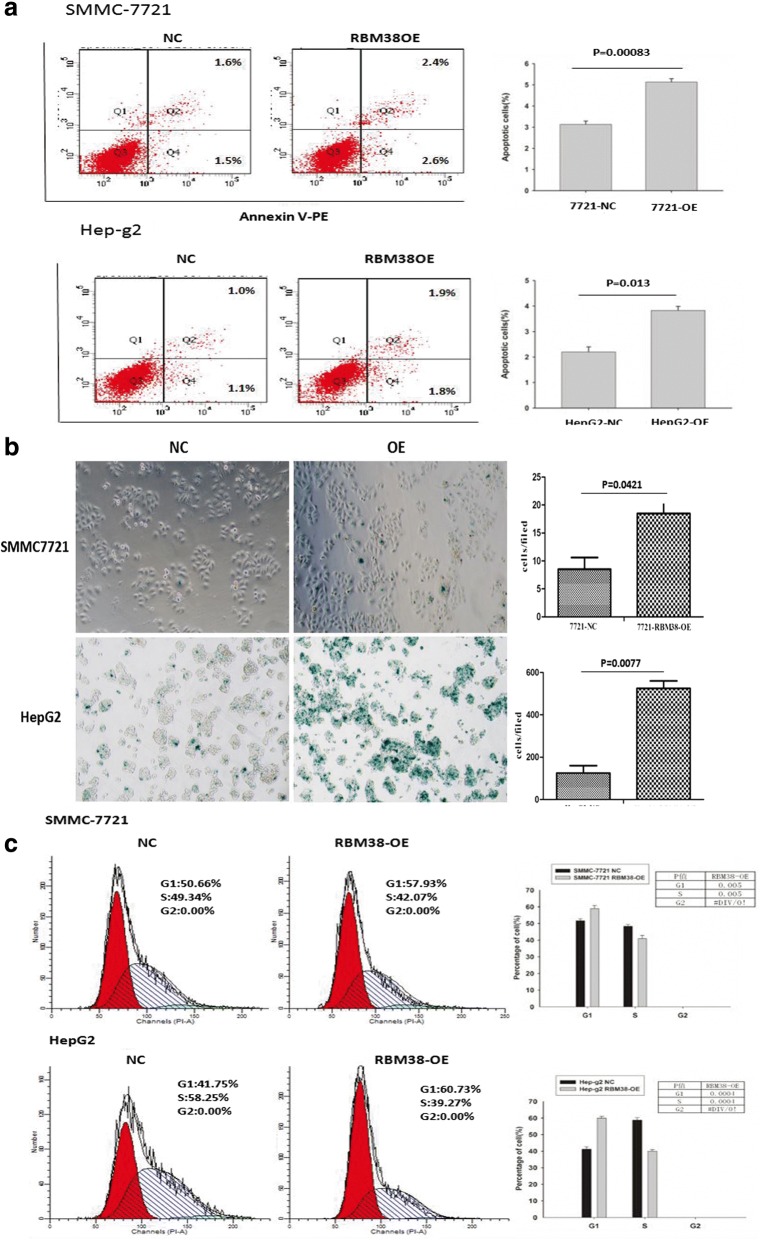
We observed RBM38 protein expression was commonly silenced coupled with increased mdm2 and decreased wild type (wt) p53 in liver cancer cells and HCC tissues compared to the corresponding normal liver cells and adjacent liver tissues. RBM38 mRNA level was significantly lower in HCC than adjacent liver tissues, whereas mdm2 and wtp53 mRNA levels were similar between HCC and adjacent liver tissues. This implied that deactivation of RBM38 could disrupt the p53-mdm2 loop and promote HCC, even though p53 and mdm2 transcript amounts were stable. Then, we generated stable liver cancer cell lines with overexpressed RBM38 (RBM38-OE) and found that up-regulation of RBM38 could inhibit mdm2 and restore wtp53 expression. Luciferase assay shown that RBM38 destabilized the mdm2 transcript through binding to multiple AU-/U-rich elements in mdm2 3'-UTR. Furthermore, functional assays showed that ectopic expression of RBM38 could induce liver cancer cell apoptosis and senescence, inhibit proliferation and colony growth, and suppress migration and invasion in vitro. Lastly, RBM38 could suppress HCC tumorigenicity in vivo.
Our findings suggested that RBM38 may be a core contributor in stabilizing the p53-mdm2 loop function to prevent HCC, and a potential novel target to provide a therapeutic strategy for HCC by inhibiting mdm2 and rescuing p53 from inactivation.
p53-mdm2 循环功能失调是促进肝细胞癌(HCC)的主要机制。RBM38 是 RNA 结合蛋白(RBPs)中 RNA 识别基序(RRM)家族的成员,在基因表达的转录后调控和人类肿瘤的调节功能中发挥着基本作用。已经证明了一种新的 RBM38-p53-mdm2 自动反馈调节环。然而,其在 HCC 中的机制作用尚不清楚。
在本研究中,我们通过 Western blot 和定量 RT-PCR 研究了 RBM38 在 HCC 中对 p53-mdm2 循环功能失调的作用和分子机制。首先,我们研究了肝癌细胞和 HCC 组织中 RBM38 活性与 p53-mdm2 循环功能之间的相关性。然后,我们进行了功能测定,以研究 RBM38 在体外抑制肝癌细胞侵袭性和体内抑制肿瘤发生中的分子作用。
与相应的正常肝细胞和相邻肝组织相比,我们观察到肝癌细胞和 HCC 组织中 RBM38 蛋白表达普遍受到抑制,而 mdm2 和野生型(wt)p53 则增加。与相邻肝组织相比,HCC 中的 RBM38 mRNA 水平明显降低,而 mdm2 和 wtp53 mRNA 水平在 HCC 和相邻肝组织之间相似。这意味着 RBM38 的失活可能会破坏 p53-mdm2 循环并促进 HCC,尽管 p53 和 mdm2 的转录水平保持稳定。然后,我们生成了过表达 RBM38 的稳定肝癌细胞系(RBM38-OE),并发现上调 RBM38 可以抑制 mdm2 并恢复 wtp53 表达。荧光素酶测定表明,RBM38 通过结合 mdm2 3'-UTR 中的多个 AU-/U-丰富元件使 mdm2 转录物不稳定。此外,功能测定表明,异位表达 RBM38 可诱导肝癌细胞凋亡和衰老,抑制增殖和集落生长,并抑制体外迁移和侵袭。最后,RBM38 可以抑制体内 HCC 肿瘤发生。
我们的研究结果表明,RBM38 可能是稳定 p53-mdm2 循环功能以预防 HCC 的核心贡献者,并且是通过抑制 mdm2 和使 p53 从失活中恢复来抑制 HCC 的潜在新靶点。