Lee Eun Hye, Yang Hye Ran, Lee Hye Seung
Department of Pediatrics, Nowon Eulji Medical Center, Seoul, Korea.
Department of Pediatrics, Eulji University College of Medicine, Daejeon, Korea.
J Neurogastroenterol Motil. 2018 Oct 1;24(4):614-627. doi: 10.5056/jnm18050.
BACKGROUND/AIMS: Although functional abdominal pain disorders (FAPDs) are common in children, the accurate pathogenesis of FAPDs is not known yet. Micro-inflammation, particularly tissue eosinophilia of gastrointestinal (GI) tract, has been suggested as the pathophysiology observed in several GI disorders. We aimed to evaluate eosinophilic infiltration throughout the entire GI tract in children with FAPDs, compared to those with inflammatory bowel diseases (IBD) and to normal reference values.
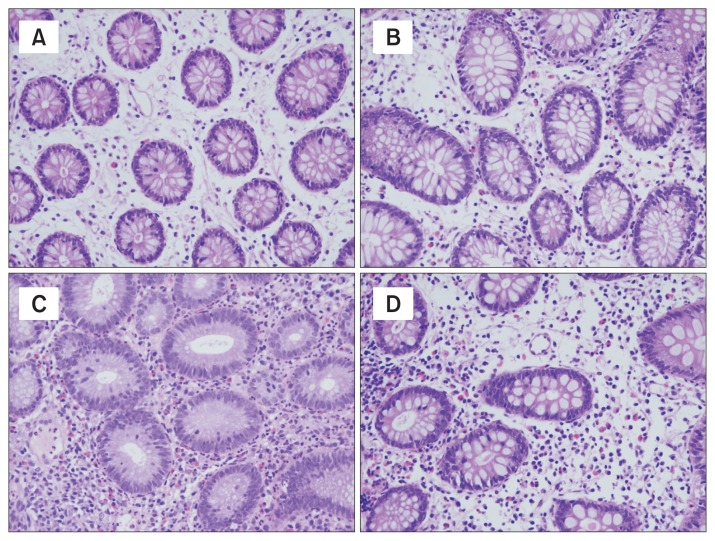
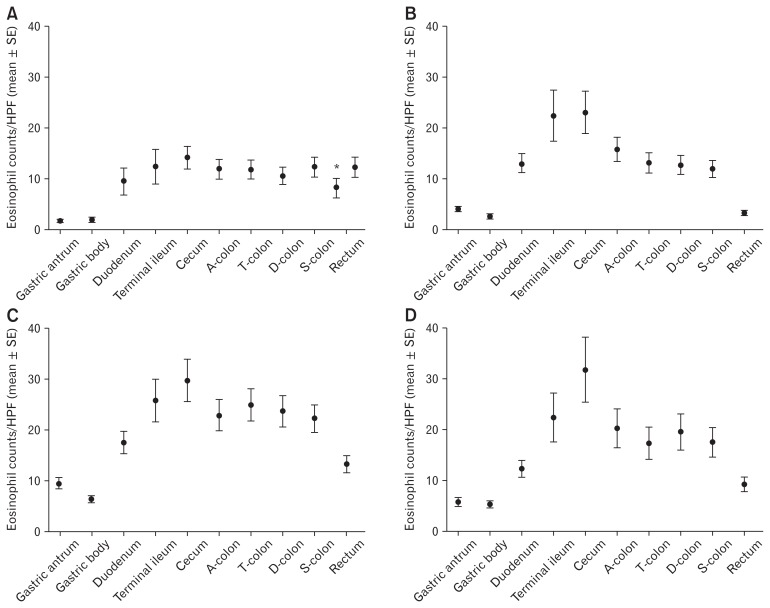
We included 56 children with FAPDs, 52 children with Crohn's disease, and 23 children with ulcerative colitis. All subjects underwent esophagogastroduodenoscopic and colonoscopic examination with biopsies. Tissue eosinophil counts were assessed in 10 regions throughout the GI tract.
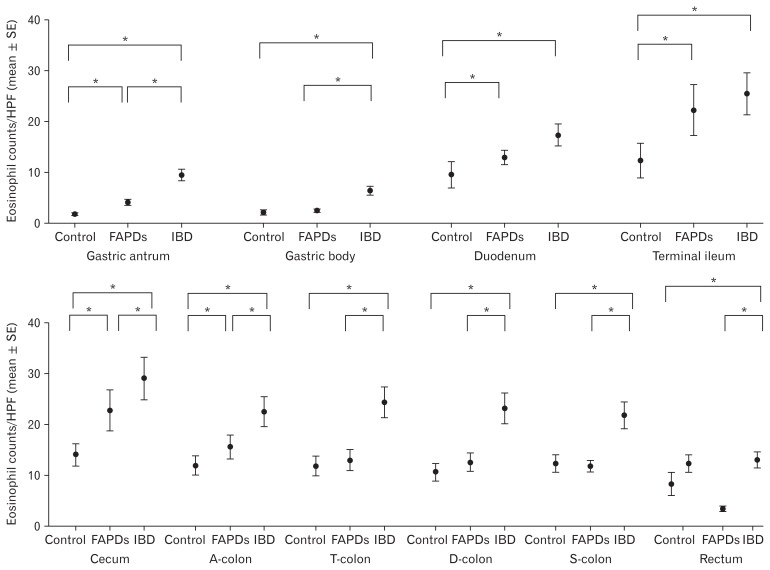
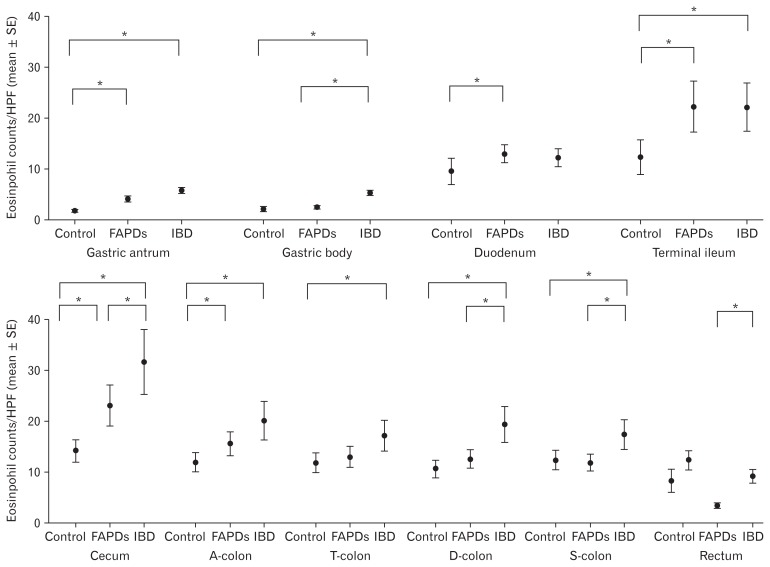
Eosinophil counts of the gastric antrum, duodenum, terminal ileum, cecum, and ascending colon were significantly higher in children with FAPDs compared to normal reference values. Eosinophil counts of the stomach and the entire colon were observed to be significantly higher in children with IBD than in those with FAPDs. Even after selecting macroscopically uninvolved GI segments on endoscopy in children with IBD, eosinophil counts of the gastric body, cecum, descending colon, sigmoid colon, and the rectum were also significantly higher in children with IBD than those with FAPDs.
Significantly high eosinophil counts of the stomach and colon were observed in the order of IBD, followed by FAPDs, and normal controls, regardless of endoscopically detected macroscopic IBD lesions in children. This suggests some contribution of GI tract eosinophils in the intrinsic pathogenesis of FAPDs in children.
背景/目的:尽管功能性腹痛障碍(FAPDs)在儿童中很常见,但FAPDs的确切发病机制尚不清楚。微炎症,尤其是胃肠道(GI)组织嗜酸性粒细胞增多,已被认为是几种胃肠道疾病中观察到的病理生理学现象。我们旨在评估FAPDs儿童整个胃肠道中的嗜酸性粒细胞浸润情况,并与炎症性肠病(IBD)儿童及正常参考值进行比较。
我们纳入了56例FAPDs儿童、52例克罗恩病儿童和23例溃疡性结肠炎儿童。所有受试者均接受了食管胃十二指肠镜和结肠镜检查及活检。在胃肠道的10个区域评估组织嗜酸性粒细胞计数。
与正常参考值相比,FAPDs儿童胃窦、十二指肠、回肠末端、盲肠和升结肠的嗜酸性粒细胞计数显著更高。IBD儿童胃和整个结肠的嗜酸性粒细胞计数显著高于FAPDs儿童。即使在IBD儿童中在内镜检查时选择宏观上未受累的胃肠道节段后,IBD儿童胃体、盲肠、降结肠、乙状结肠和直肠的嗜酸性粒细胞计数也显著高于FAPDs儿童。
无论儿童内镜检查中是否发现宏观IBD病变,胃和结肠的嗜酸性粒细胞计数均按IBD、FAPDs和正常对照的顺序显著升高。这表明胃肠道嗜酸性粒细胞在儿童FAPDs的内在发病机制中起到了一定作用。