Instituto de Investigación Médica M y M Ferreyra - CONICET- Universidad Nacional de Córdoba, Córdoba, Argentina.
UNITEFA - CONICET, Pharmaceutical Sciences Department, School of Chemistry, National University of Córdoba, Córdoba, Argentina.
Sci Rep. 2018 Sep 5;8(1):13253. doi: 10.1038/s41598-018-31693-y.
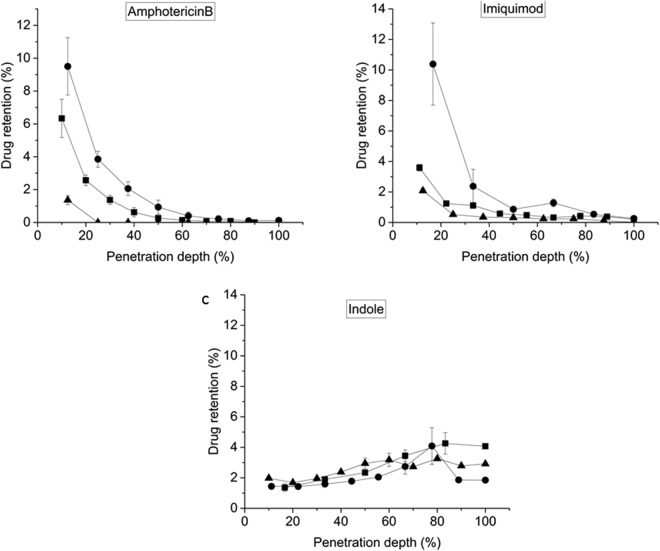
The adequate formulation of topical vehicles to treat skin diseases is particularly complex. A desirable formulation should enhance the accumulation of the active drugs in the target tissue (the skin), while avoiding the penetration enhancement to be so large that the drugs reach the systemic circulation in toxic amounts. We have evaluated the transcutaneous penetration of three drugs chosen for their widely variable physicochemical properties: Amphotericin B, Imiquimod and Indole. We incorporated the drugs in fluid or ultra-flexible liposomes. Ultra-flexible liposomes produced enhancement of drug penetration into/through human skin in all cases in comparison with fluid liposomes without detergent, regardless of drug molecular weight. At the same time, our results indicate that liposomes can impede the transcutaneous penetration of molecules, in particular small ones.
治疗皮肤病的局部药物制剂的配方特别复杂。理想的制剂应促进活性药物在靶组织(皮肤)中的积累,同时避免渗透增强过大,以致药物以有毒量到达全身循环。我们评估了三种药物的经皮渗透,这些药物因其广泛的物理化学性质而被选择:两性霉素 B、咪喹莫特和吲哚。我们将药物包裹在流体或超柔软脂质体中。与不含去污剂的流体脂质体相比,超柔软脂质体在所有情况下都能增强药物渗透进入/穿过人体皮肤,而与药物分子量无关。同时,我们的结果表明脂质体可以阻碍分子,特别是小分子的经皮渗透。