Viardot Alexander, Purtell Louise, Nguyen Tuan V, Campbell Lesley V
Diabetes and Metabolism Division, Garvan Institute of Medical Research, Darlinghurst, NSW, Australia.
Department of Endocrinology, St Vincent's Hospital Sydney, Darlinghurst, NSW, Australia.
Front Endocrinol (Lausanne). 2018 Aug 22;9:480. doi: 10.3389/fendo.2018.00480. eCollection 2018.
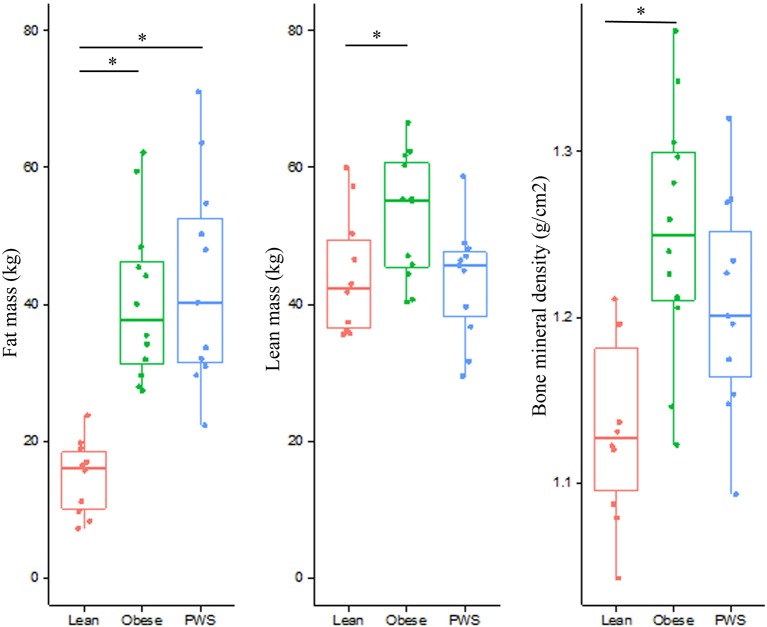
Low bone mineral density (BMD) is the most important risk factor for fragility fracture. Body weight is a simple screening predictor of difference in BMD between individuals. However, it is not clear which component of body weight, lean (LM), or fat mass (FM), is associated with BMD. People with the genetic disorder of Prader-Willi syndrome (PWS) uniquely have a reduced LM despite increased FM. We sought to define the individual impact of LM and FM on BMD by investigating subjects with and without PWS. This cross-sectional study was conducted at the Clinical Research Facility of the Garvan Institute of Medical Research, with PWS and control participants recruited from a specialized PWS clinic and from the general public by advertisement, respectively. The study involved 11 adults with PWS, who were age- and sex-matched with 12 obese individuals (Obese group) and 10 lean individuals (Lean group). Whole body BMD was measured by dual-energy X-ray absorptiometry. Total body FM and LM were derived from the whole body scan. Differences in BMD between groups were assessed by the analysis of covariance model, taking into account the effects of LM and FM. The PWS group had significantly shorter height than the lean and obese groups. As expected, there was no significant difference in FM between the Obese and PWS group, and no significant difference in LM between the Lean and PWS group. However, obese individuals had greater LM than lean individuals. BMD in lean individuals was significantly lower than in PWS individuals (1.13 g/cm vs. 1.21 g/cm, < 0.05) and obese individuals (1.13 g/cm vs. 1.25 g/cm, < 0.05). After adjusting for both LM and FM, there was no significant difference in BMD between groups, and the only significant predictor of BMD was LM. These data from the human genetic model Prader-Willi syndrome suggest that LM is a stronger determinant of BMD than fat mass.
低骨矿物质密度(BMD)是脆性骨折最重要的危险因素。体重是个体间BMD差异的一个简单筛查预测指标。然而,体重的哪个组成部分,即瘦体重(LM)或脂肪量(FM)与BMD相关尚不清楚。患有普拉德-威利综合征(PWS)这种遗传性疾病的人,尽管脂肪量增加,但瘦体重独特地减少。我们试图通过调查患有和未患有PWS的受试者来确定瘦体重和脂肪量对BMD的个体影响。这项横断面研究在加尔万医学研究所的临床研究设施进行,PWS参与者和对照参与者分别从一家专门的PWS诊所和通过广告从普通公众中招募。该研究纳入了11名患有PWS的成年人,他们在年龄和性别上与12名肥胖个体(肥胖组)和10名瘦个体(瘦组)相匹配。通过双能X线吸收法测量全身BMD。全身脂肪量和瘦体重来自全身扫描。考虑到瘦体重和脂肪量的影响,通过协方差分析模型评估组间BMD的差异。PWS组的身高明显低于瘦组和肥胖组。正如预期的那样,肥胖组和PWS组之间的脂肪量没有显著差异,瘦组和PWS组之间的瘦体重也没有显著差异。然而,肥胖个体的瘦体重比瘦个体更大。瘦个体的BMD显著低于PWS个体(1.13克/平方厘米对1.21克/平方厘米,<0.05)和肥胖个体(1.13克/平方厘米对1.25克/平方厘米,<0.05)。在对瘦体重和脂肪量进行调整后,组间BMD没有显著差异,BMD的唯一显著预测指标是瘦体重。这些来自人类遗传模型普拉德-威利综合征的数据表明,瘦体重比脂肪量是BMD更强的决定因素。