Mahidol-Oxford Tropical Medicine Research Unit, Faculty of Tropical Medicine, Mahidol University, Bangkok, Thailand.
Department of Medicine, Sunpasitthiprasong Hospital, Ubon Ratchathani, Thailand.
PLoS Negl Trop Dis. 2018 Sep 6;12(9):e0006765. doi: 10.1371/journal.pntd.0006765. eCollection 2018 Sep.
Melioidosis is an infection caused by Burkholderia pseudomallei, a Gram-negative bacillus found in soil and water. Diabetes mellitus is the most important risk factor for melioidosis. The recommendations for disease prevention include avoiding direct contact with soil and water, and drinking only boiled or bottled water.
A prospective intervention study was conducted to evaluate the feasibility and behavioural outcomes of a multifaceted prevention programme for melioidosis. Participants were diabetic adults in Ubon Ratchathani, northeast Thailand. Ten behavioural support groups consisting of 6 to 10 participants per group were conducted. Twelve behaviour change techniques were used: information about health consequences, credible source, adding objects to the environment, reconstructing the physical environment, instruction on how to perform a behaviour, demonstration of the behaviour, commitment, prompts/cues, self-monitoring of behaviour, goal setting, feedback on behaviour, and social support, and their feasibilities evaluated.
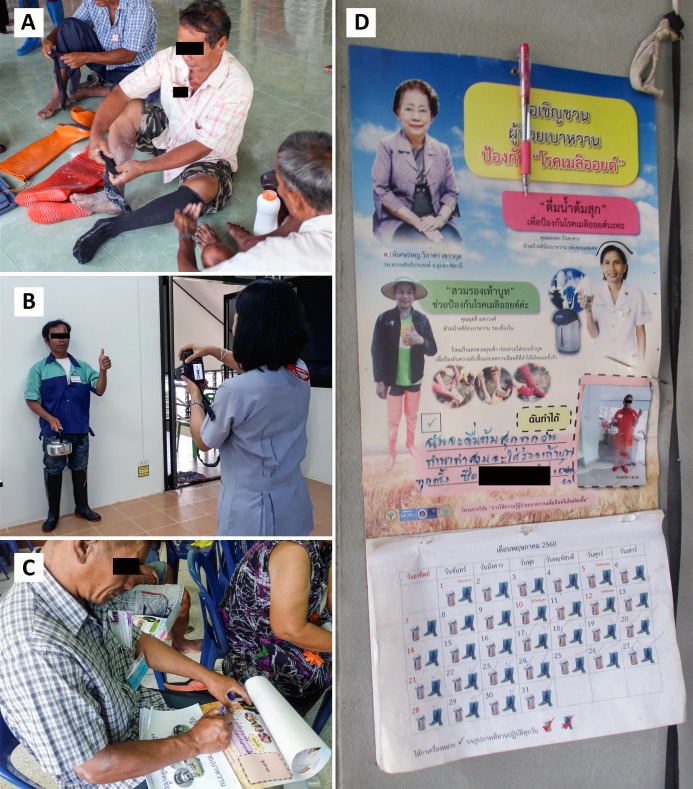
There were 70 participants, of median age 59 years and 52 (74%) were female. Participants found the intervention beneficial, interesting and engaging. Participants indicated that they liked to watch videos with information about melioidosis delivered by local doctors and patients who survived melioidosis, and videos showing use of over-the-knee boots by local farmers. Participants felt engaged in the sessions that trialed protective gear and that made calendars with individual photographs and self-pledges as a reminder tool. The proportions of participants reporting that they always wore boots while working in rice fields increased from 30% (10/33) to 77% (28/37, p = 0.04), and that they drank only boiled or bottle water increased from 43% (30/70) to 86% (59/69, p<0.001) at 6 months post intervention.
The programme is highly acceptable to participants, and can support behaviour change. Policy makers should consider implementing the programme in areas where melioidosis is endemic. Making calendars with individual photographs and self-pledges as a reminder tool could be powerful in behaviour change interventions, and further research on this component is needed.
类鼻疽病是由伯克霍尔德氏菌引起的感染,这种革兰氏阴性杆菌存在于土壤和水中。糖尿病是类鼻疽病最重要的危险因素。疾病预防的建议包括避免直接接触土壤和水,只饮用煮沸或瓶装水。
本前瞻性干预研究旨在评估针对泰国东北部乌汶叻差他尼的糖尿病成人的类鼻疽病多方面预防计划的可行性和行为结果。共纳入 70 名参与者,年龄中位数为 59 岁,52 名(74%)为女性。参与者发现干预措施有益、有趣且引人入胜。参与者表示,他们喜欢观看有关类鼻疽病的视频,这些视频由当地医生和幸存的类鼻疽病患者提供,以及展示当地农民使用过膝靴的视频。参与者觉得参与试用防护装备和制作带有个人照片和自我承诺的日历作为提醒工具的会议很有意义。干预 6 个月后,始终在稻田工作时穿鞋的参与者比例从 30%(33 人中的 10 人)增加到 77%(37 人中的 28 人,p=0.04),只饮用煮沸或瓶装水的参与者比例从 43%(70 人中的 30 人)增加到 86%(69 人中的 59 人,p<0.001)。
该方案受到参与者的高度认可,并能够支持行为改变。政策制定者应考虑在类鼻疽病流行地区实施该方案。制作带有个人照片和自我承诺的日历作为提醒工具可能在行为改变干预中具有强大作用,需要对此组件进行进一步研究。