Ahmed Zohair, Ahmed Umair, Walayat Saqib, Ren Jinma, Martin Daniel K, Moole Harsha, Koppe Sean, Yong Sherri, Dhillon Sonu
Department of Gastroenterology and Hepatology, University of Illinois, Chicago, IL, USA,
Department of Internal Medicine, University of Illinois College of Medicine, Peoria, IL, USA.
Clin Exp Gastroenterol. 2018 Aug 23;11:301-307. doi: 10.2147/CEG.S160537. eCollection 2018.
Many patients with liver disease come to medical attention once they have advanced cirrhosis or acute decompensation. Most often, patients are screened for liver disease via liver function tests (LFTs). There is very limited published data evaluating laboratory values with biopsy-proven stages of hepatic fibrosis. We set out to evaluate whether any correlation exists between routine LFTs and stages of hepatic fibrosis.
A large retrospective observational study on 771 liver biopsies was conducted for evaluating the stage of fibrosis with AST, ALT, INR, BUN, creatinine, platelets, alkaline phosphatase, bilirubin, and albumin. Mean and 95% confidence intervals were used to describe the distributions of serum markers in different fibrosis stages. Multivariable generalized linear models were used and a two-tailed -value was calculated.
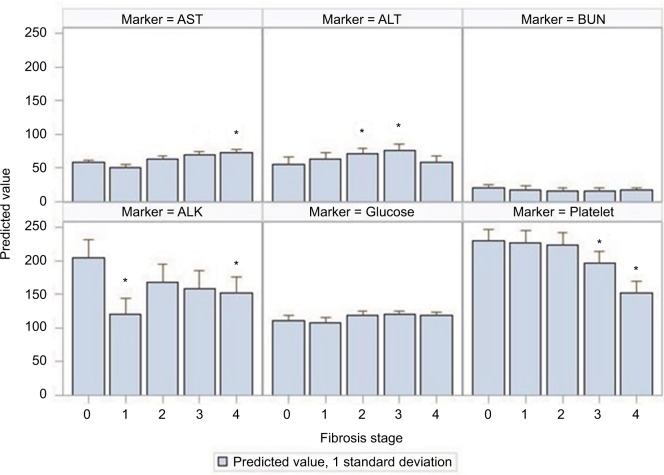
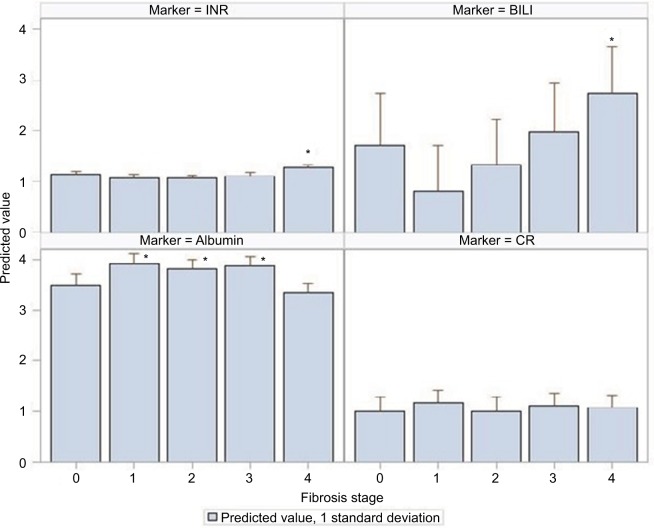
ALT was not statistically significant for any stage, and AST was statistically significant for stage 3 and 4 fibrosis. INR was statistically significant only in stage 4 disease but remained near the upper limit of normal range. Albumin failed to show a clinically relevant association. Platelets remained within normal laboratory range for all stages. The remaining laboratory values failed to show statistical and clinical significance.
The health care burden from chronic liver disease (CLD) will likely continue to rise, unless clinicians are made aware that normal or near normal laboratory findings may be seen in asymptomatic patients. Earlier identification of asymptomatic patients will allow for treatment with new promising modalities and decrease morbidity and mortality from CLD. Our study shows that laboratory values correlate poorly with liver disease.
许多肝病患者在出现晚期肝硬化或急性失代偿时才引起医疗关注。大多数情况下,患者通过肝功能检查(LFTs)来筛查肝病。关于经活检证实的肝纤维化阶段评估实验室值的已发表数据非常有限。我们着手评估常规LFTs与肝纤维化阶段之间是否存在任何相关性。
对771例肝活检进行了一项大型回顾性观察研究,以评估AST、ALT、INR、BUN、肌酐、血小板、碱性磷酸酶、胆红素和白蛋白与纤维化阶段的关系。采用均值和95%置信区间来描述不同纤维化阶段血清标志物的分布。使用多变量广义线性模型并计算双侧P值。
ALT在任何阶段均无统计学意义,AST在3期和4期纤维化中有统计学意义。INR仅在4期疾病中有统计学意义,但仍接近正常范围上限。白蛋白未显示出临床相关关联。血小板在所有阶段均保持在正常实验室范围内。其余实验室值未显示出统计学和临床意义。
除非临床医生意识到无症状患者可能出现正常或接近正常的实验室检查结果,否则慢性肝病(CLD)的医疗负担可能会持续上升。早期识别无症状患者将允许采用新的有前景的治疗方法,并降低CLD的发病率和死亡率。我们的研究表明,实验室值与肝病的相关性较差。