Albano Denise, Bilfinger Thomas, Nemesure Barbara
Department of Surgery, Health Sciences Center, Stony Brook Medicine, Stony Brook, NY, USA.
Department of Family, Population and Preventive Medicine, Health Sciences Center, Stony Brook Medicine, Stony Brook, NY, USA,
Lung Cancer (Auckl). 2018 Aug 24;9:65-71. doi: 10.2147/LCTT.S166320. eCollection 2018.
Lobectomy has traditionally been recommended for fit patients diagnosed with early-stage non-small-cell lung cancer (NSCLC). Recently, however, stereotactic body radiotherapy (SBRT) has been introduced as an alternative treatment option. The purpose of this investigation is to compare survival outcomes for individuals with stage I/II NSCLC treated with lobectomy vs SBRT.
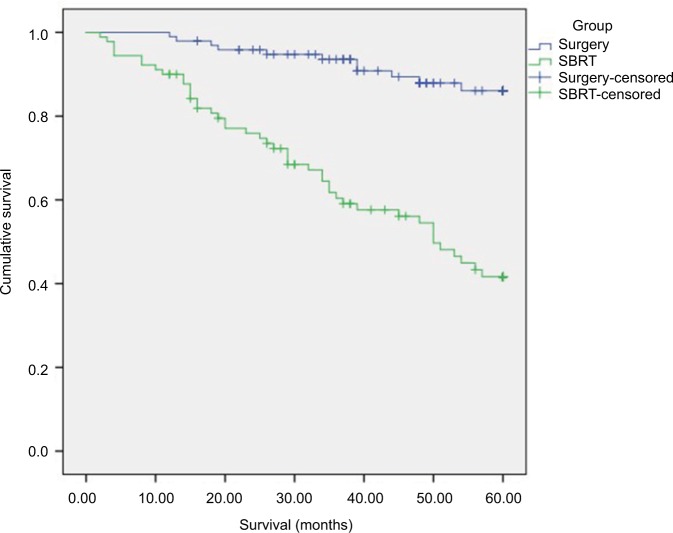
This retrospective study included 191 patients (100 surgery, 91 SBRT) identified through the Lung Cancer Evaluation Center, Stony Brook, NY, between 2008 and 2012. Survival and recurrence rates were compared using Kaplan-Meier curves, log-rank tests, and Cox proportional hazard models to adjust for possible confounders. A subset of cases was propensity-matched to address potential differences in health status between groups.
1-, 3-, and 5-year survival outcomes were significantly better among patients undergoing lobectomy vs SBRT. Survival rates at 3 years were 92.8% and 59.0% (<0.001) in the 2 groups, respectively. Propensity-matched analyses indicated similar findings. Recurrence rates were likewise lower among patients undergoing surgery (7.1% vs 21.0%, <0.01 at 3 years); however, statistical significance was not maintained in the propensity-matched analysis.
These findings add to a growing evidence base supporting the use of lobectomy vs SBRT in the treatment of lung cancer among healthy, early-stage NSCLC patients.
传统上,对于确诊为早期非小细胞肺癌(NSCLC)的合适患者,推荐行肺叶切除术。然而,近年来,立体定向体部放疗(SBRT)已被引入作为一种替代治疗选择。本研究的目的是比较接受肺叶切除术与SBRT治疗的I/II期NSCLC患者的生存结果。
这项回顾性研究纳入了2008年至2012年间在纽约州斯托尼布鲁克肺癌评估中心确定的191例患者(100例行手术,91例行SBRT)。使用Kaplan-Meier曲线、对数秩检验和Cox比例风险模型比较生存和复发率,以调整可能的混杂因素。对一部分病例进行倾向匹配,以解决组间健康状况的潜在差异。
接受肺叶切除术的患者1年、3年和5年生存结果显著优于接受SBRT的患者。两组3年生存率分别为92.8%和59.0%(<0.001)。倾向匹配分析显示了类似的结果。手术患者的复发率同样较低(7.1%对21.0%,3年时<0.01);然而,在倾向匹配分析中未保持统计学显著性。
这些发现为越来越多的证据提供了补充,支持在健康的早期NSCLC患者中使用肺叶切除术而非SBRT治疗肺癌。