Chen Wenji, Mo Shiyan, Luo Gui, Wang Yanyan, Deng Xiaohu, Zhu Jian, Zhao Wei
Department of Rheumatology, Hainan Branch of Chinese People's Liberation Army General Hospital, Haitang Bay, Sanya, China.
Pediatr Rheumatol Online J. 2018 Sep 10;16(1):55. doi: 10.1186/s12969-018-0272-7.
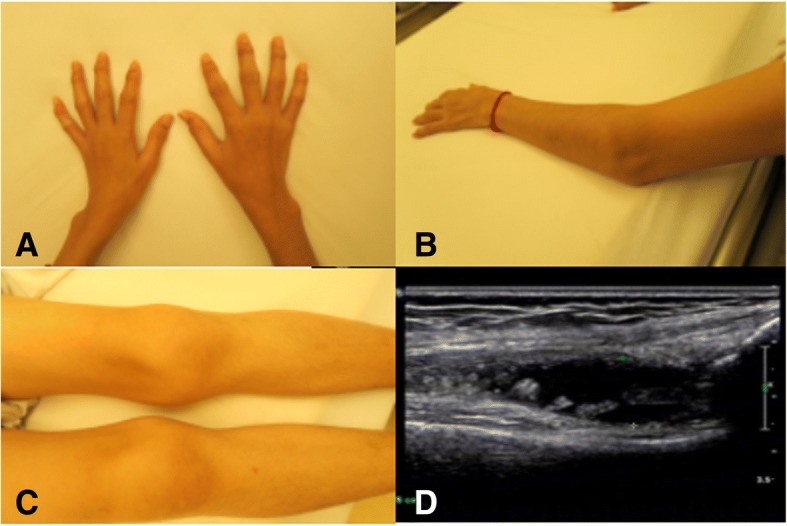
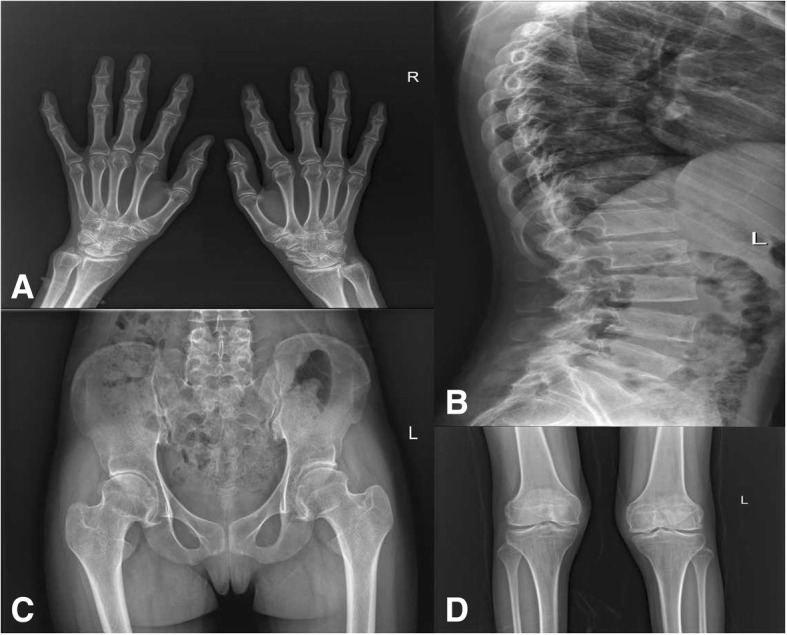
As one kind of osteochondrodysplasia, progressive pseudorheumatoid dysplasia (PPD) is also known as spondyloepiphyseal dysplasia tarda with progressive arthropathy or arthropathy progressive pseudorheumatoid of childhood. PPD is a very rare disease, especially in China, and has an estimated prevalence of 1/1000000 due to lacking definite prevalence survey. It is an autosomal recessive disorder caused by gene mutation of Wntl inducible signaling pathway protein 3 (WISP3). Its basic pathological change is persistent degeneration and loss of articular cartilage in multiple joints. Its clinical appearances include bone enlargement, platyspondyly, irregular endplate, secondary osteoarthritis, extensive osteoporosis, joint rigidity and function loss. Clinical diagnosis of PPD is made based on clinical appearance and imaging examinations, whereas its definite diagnosis depends on gene sequencing. PPD has no severe effect on life span, but causes high disability rate and very poor prognosis. There are only case reports with limited information in China.
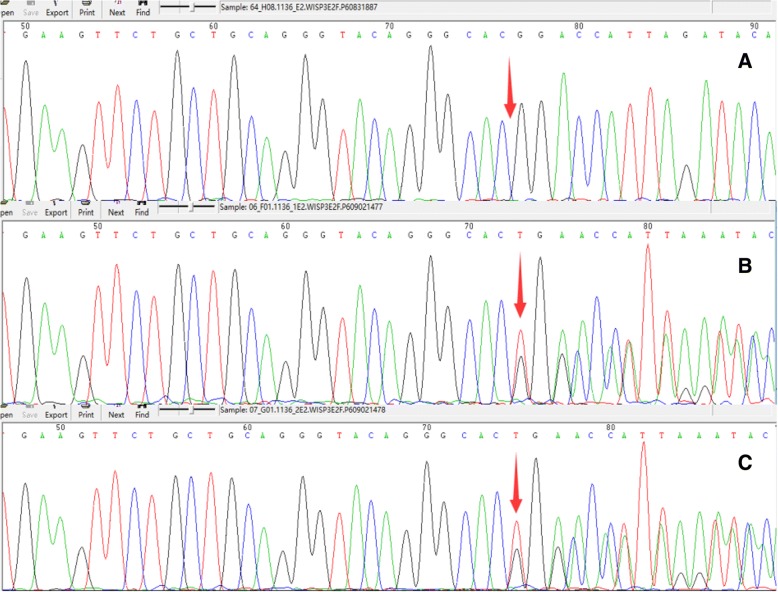
One female patient was diagnosed as PPD and secondary osteoarthritis. She had typical clinical appearance and imaging examinations, and received individualized therapeutic regimens. She had a gene mutation (c.72delT, p.T24TfsX4) of WISP3. This gene mutation has not been reported by previous literatures and included in Single Nucleotide Polymorphism Database.
As the first time, this paper reported a patient with PPD caused by new-found gene mutation (c.72delT, p.T24TfsX4) of WISP3.
进行性假类风湿发育异常(PPD)作为一种骨软骨发育异常,也被称为迟发性脊椎骨骺发育异常伴进行性关节病或儿童进行性假类风湿性关节病。PPD是一种非常罕见的疾病,在中国尤为如此,由于缺乏确切的患病率调查,估计患病率为1/1000000。它是一种常染色体隐性疾病,由Wntl诱导信号通路蛋白3(WISP3)基因突变引起。其基本病理变化是多个关节的关节软骨持续变性和丧失。其临床表现包括骨骼增大、椎体扁平、终板不规则、继发性骨关节炎、广泛骨质疏松、关节僵硬和功能丧失。PPD的临床诊断基于临床表现和影像学检查,而其确切诊断依赖于基因测序。PPD对寿命没有严重影响,但导致高致残率和非常差的预后。在中国仅有信息有限的病例报告。
一名女性患者被诊断为PPD和继发性骨关节炎。她有典型的临床表现和影像学检查结果,并接受了个体化治疗方案。她存在WISP3基因突变(c.72delT,p.T24TfsX4)。该基因突变此前未见文献报道,也未被收录于单核苷酸多态性数据库。
本文首次报道了一名由新发现的WISP3基因突变(c.72delT,p.T24TfsX4)引起的PPD患者。