Department of Veterans Affairs Medical Center, 1030 Jefferson Avenue, Memphis, TN, 38104, USA.
Department of Pharmacology, College of Medicine, The University of Tennessee Health Science Center, 874 Union Avenue, Memphis, TN, 38163, USA.
Biol Sex Differ. 2018 Sep 10;9(1):40. doi: 10.1186/s13293-018-0202-x.
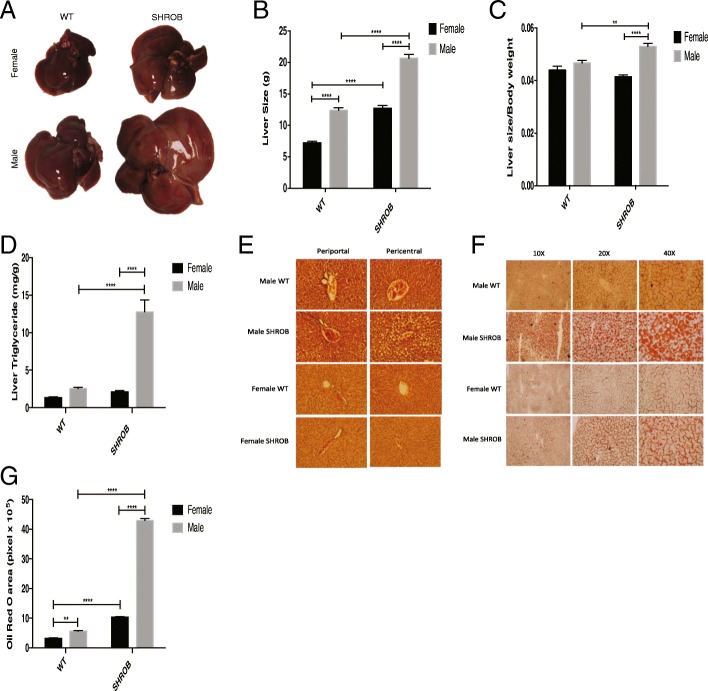
Patients with metabolic syndrome, who are characterized by co-existence of insulin resistance, hypertension, hyperlipidemia, and obesity, are also prone to develop non-alcoholic fatty liver disease (NAFLD). Although the prevalence and severity of NAFLD is significantly greater in men than women, the mechanisms by which gender modulates the pathogenesis of hepatic steatosis are poorly defined. The obese spontaneously hypertensive (SHROB) rats represent an attractive model of metabolic syndrome without overt type 2 diabetes. Although pathological manifestation caused by the absence of a functional leptin receptor has been extensively studied in SHROB rats, it is unknown whether these animals elicited sex-specific differences in the development of hepatic steatosis.
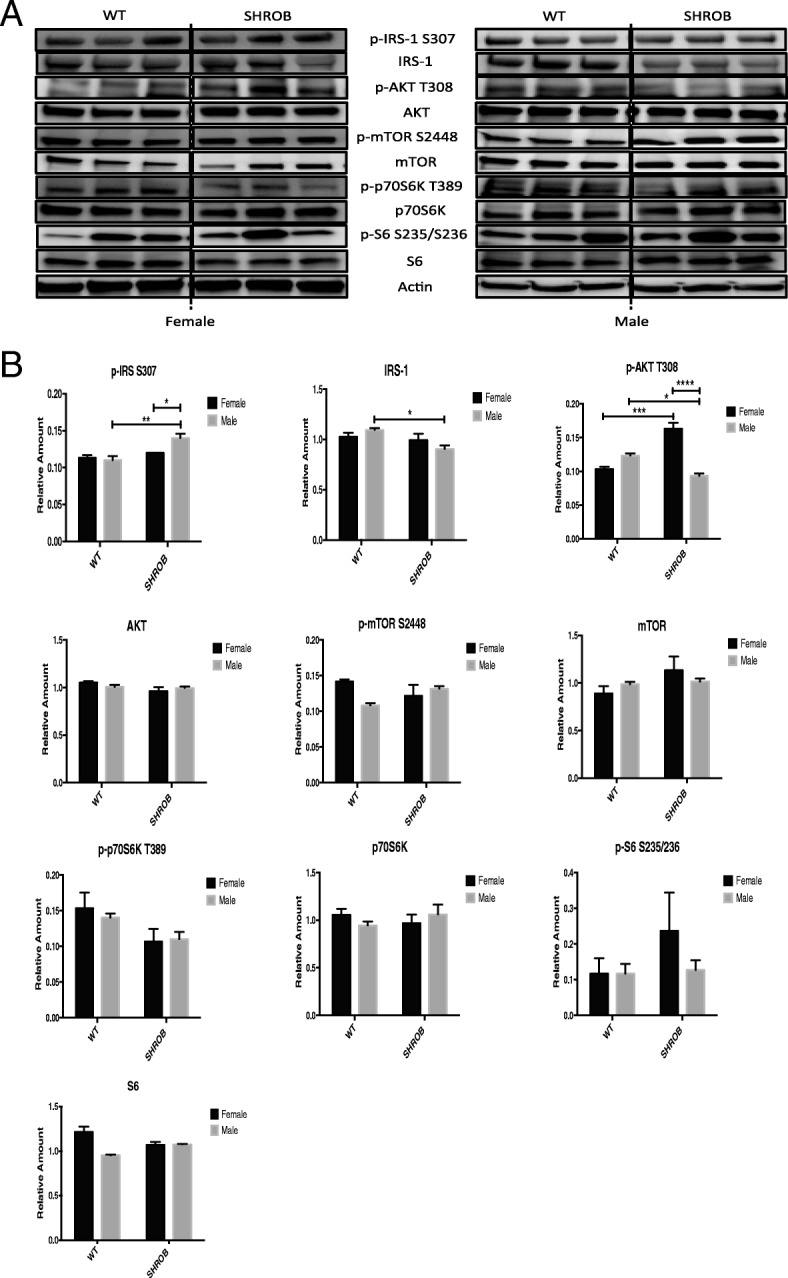
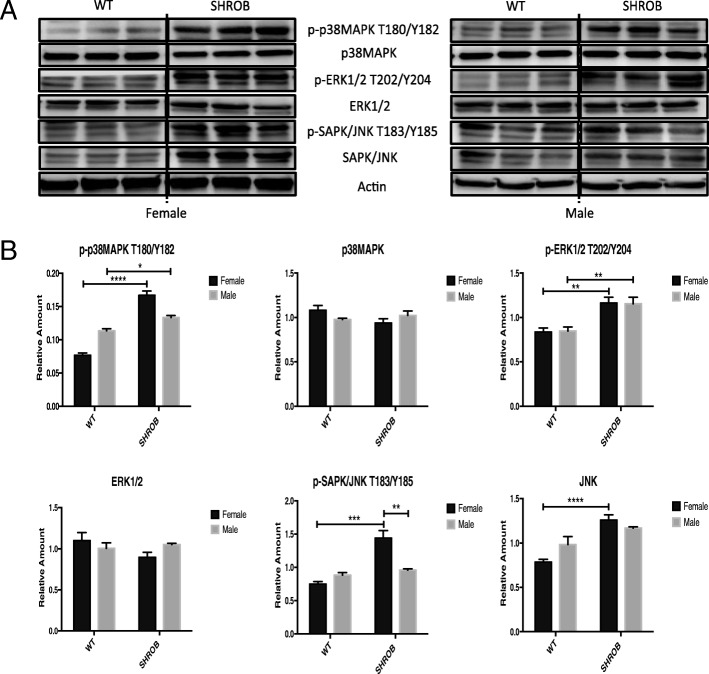
We compared hepatic pathology in male and female SHROB rats. Additionally, we examined key biochemical and molecular parameters of signaling pathways linked with hyperinsulinemia and hyperlipidemia. Finally, using methods of quantitative polymerase chain reaction (qPCR) and western blot analysis, we quantified expression of 45 genes related to lipid biosynthesis and metabolism in the livers of male and female SHROB rats.
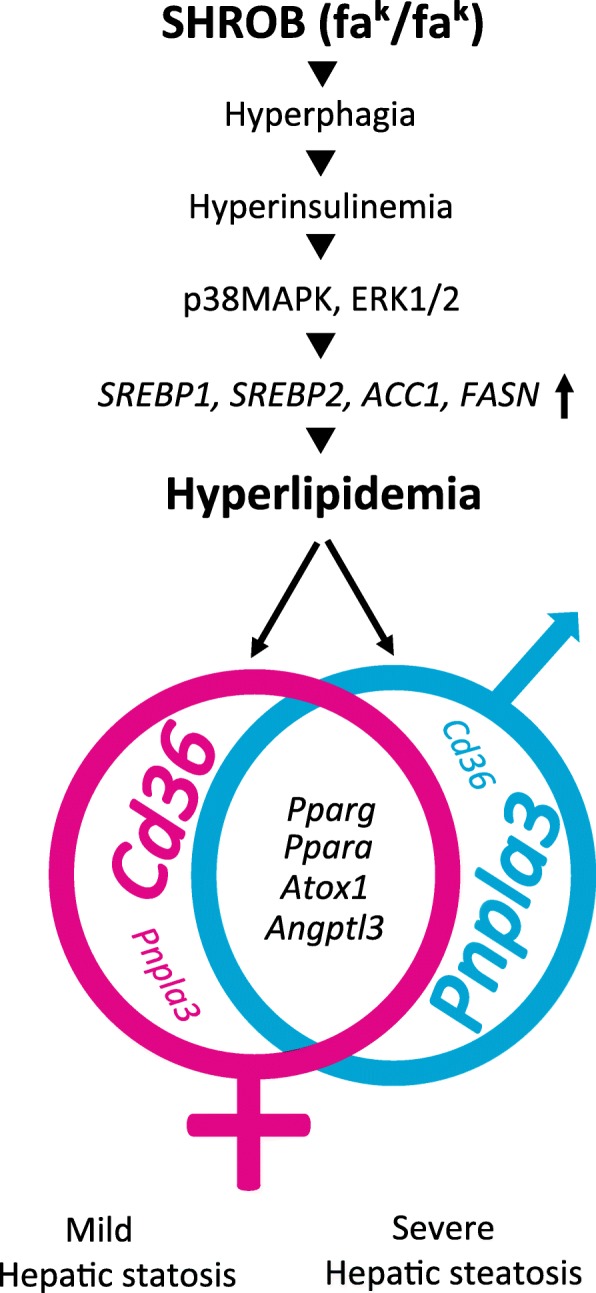
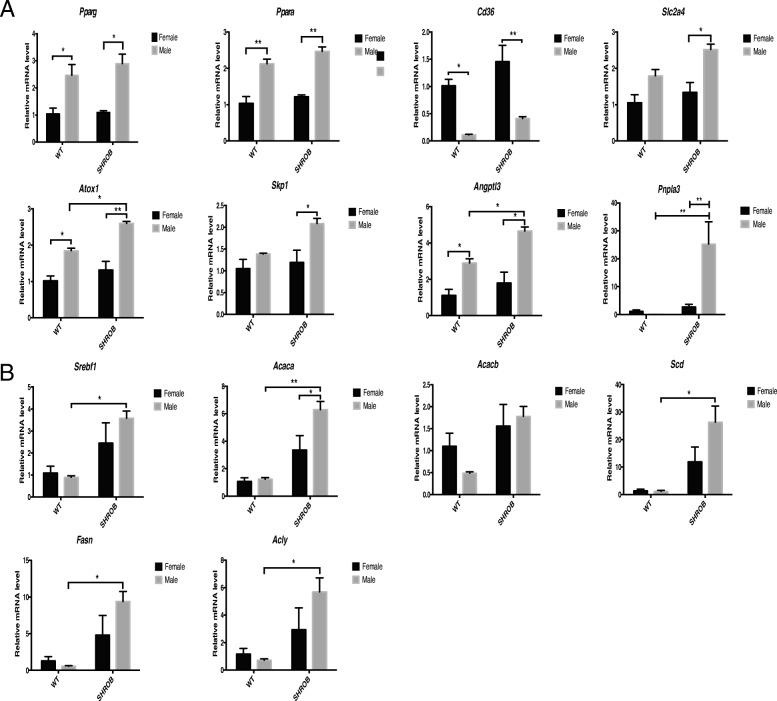
We show that all SHROB rats developed hepatic steatosis that was accompanied by enhanced expression of SREBP1, SREBP2, ACC1, and FASN proteins. The livers of male rats also elicited higher induction of Pparg, Ppara, Slc2a4, Atox1, Skp1, Angptl3, and Pnpla3 mRNAs. In contrast, the livers of female SHROB rats elicited constitutively higher levels of phosphorylated JNK and AMPK and enhanced expression of Cd36.
Based on these data, we conclude that the severity of hepatic steatosis in male and female SHROB rats was mainly driven by increased de novo lipogenesis. Moreover, male and female SHROB rats also elicited differential severity of hepatic steatosis that was coupled with sex-specific differences in fatty acid transport and esterification.
代谢综合征患者存在胰岛素抵抗、高血压、高血脂和肥胖等共存现象,也容易发生非酒精性脂肪肝(NAFLD)。尽管男性患者的 NAFLD 患病率和严重程度明显高于女性,但性别调节肝脂肪变性发病机制的机制尚不清楚。肥胖自发性高血压(SHROB)大鼠是一种没有明显 2 型糖尿病的代谢综合征的理想模型。尽管已经广泛研究了 SHROB 大鼠中瘦素受体功能缺失引起的病理表现,但尚不清楚这些动物在肝脂肪变性的发展中是否存在性别特异性差异。
我们比较了雄性和雌性 SHROB 大鼠的肝病理。此外,我们检查了与高胰岛素血症和高血脂相关的信号通路的关键生化和分子参数。最后,我们使用定量聚合酶链反应(qPCR)和 Western blot 分析方法,定量分析了雄性和雌性 SHROB 大鼠肝脏中与脂质生物合成和代谢相关的 45 个基因的表达。
我们发现所有 SHROB 大鼠均发生肝脂肪变性,伴有 SREBP1、SREBP2、ACC1 和 FASN 蛋白表达增强。雄性大鼠的肝脏还引起了更高的 Pparg、Ppara、Slc2a4、Atox1、Skp1、Angptl3 和 Pnpla3 mRNA 的诱导。相比之下,雌性 SHROB 大鼠的肝脏则持续表达更高水平的磷酸化 JNK 和 AMPK,并增强了 Cd36 的表达。
基于这些数据,我们得出结论,雄性和雌性 SHROB 大鼠肝脂肪变性的严重程度主要是由从头合成脂肪增加驱动的。此外,雄性和雌性 SHROB 大鼠还引起了肝脂肪变性的不同严重程度,这与脂肪酸转运和酯化的性别特异性差异有关。