Maimonides Biomedical Research Institute of Cordoba (IMIBIC), Cordoba, Spain.
Reina Sofia University Hospital, Cordoba, Spain.
PLoS One. 2018 Sep 12;13(9):e0202589. doi: 10.1371/journal.pone.0202589. eCollection 2018.
In pregnant women, the use of Mycophenolic acid (MPA) is associated with teratogenicity. Recently, the European Medicines Agency (EMEA) and the Spanish Agency of Medicine and Sanitary Products (AEMPS) warned about the potential teratogenic effects of MPA. These adverse events may occur even in children from males on treatment with MPA. However, evidence of malformations in offsprings of male kidney transplanted patients (KT) exposed to MPA is limited. Thus, the present study aimed to evaluate the incidence of offspring malformations in children of renal transplanted males under MPA.
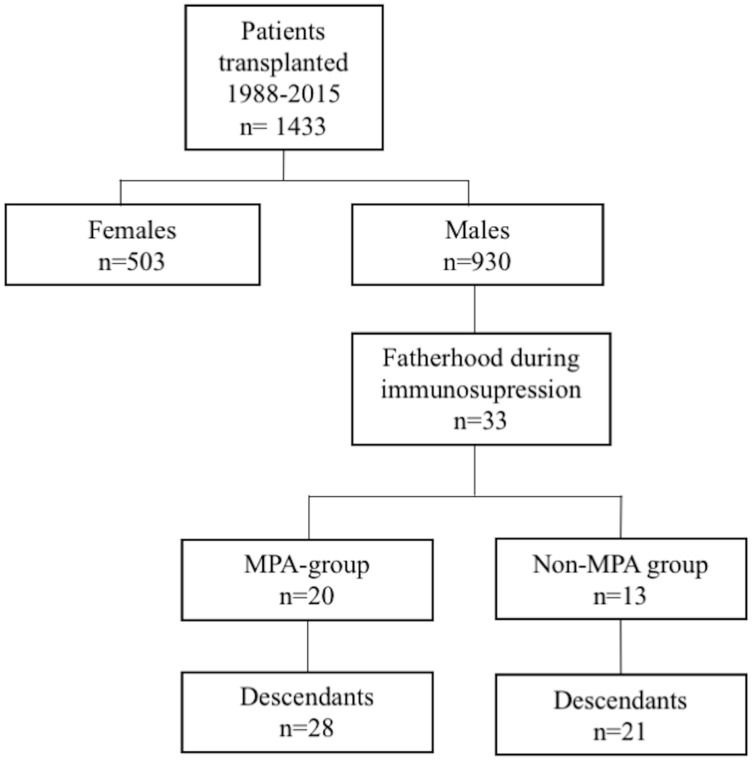
We conducted a retrospective study in which we evaluated the incidence of malformations in descendants from male recipients that were exposed or not to MPA before and at the time of conception. Two groups of patients were evaluated. Those exposed to MPA (MPA group, n = 20) and the non-MPA group (n = 13) that included patients that did not receive AZA (n = 5) and eight that did receive AZA (n = 8) at the time of conception.
A total of forty-nine post-transplant conceptions were identified from 33 different renal transplanted males. MPA was used as the immunosuppressant in 28 of the conceptions. Males from the non-MPA group fathered the other 21 children. Median time from grafting to conception was 6.1 (IQR 2.4-11.1) years, and it was similar between groups. There were eight miscarriage episodes, 2 in the non-MPA group and 6 in the MPA group although differences were not reached. After that, all patients had children without problems. No malformations were detected in any of the 49 regardless whether they were exposed or not to MPA.
No evidence of MPA-associated malformations was observed in descendants of kidney transplanted males on treatment with MPA. Further research is warranted to confirm our findings to properly advice transplanted males keen to procreate.
在孕妇中,使用霉酚酸(MPA)与致畸性有关。最近,欧洲药品管理局(EMEA)和西班牙药品和医疗产品管理局(AEMPS)警告 MPA 可能具有潜在的致畸作用。即使在接受 MPA 治疗的男性儿童中,也可能发生这些不良事件。然而,暴露于 MPA 的男性肾移植患者(KT)的后代出现畸形的证据有限。因此,本研究旨在评估暴露于 MPA 的男性肾移植受者后代畸形的发生率。
我们进行了一项回顾性研究,评估了暴露于 MPA 或未暴露于 MPA 的男性受者后代畸形的发生率。评估了两组患者。暴露于 MPA 的患者(MPA 组,n=20)和非 MPA 组(n=13),其中包括在受孕时未接受 AZA(n=5)和 8 例接受 AZA(n=8)的患者。
从 33 名不同的男性肾移植患者中确定了 49 例移植后受孕。28 例受孕中使用 MPA 作为免疫抑制剂。非 MPA 组的男性生育了另外 21 名儿童。从移植到受孕的中位时间为 6.1(IQR 2.4-11.1)年,两组之间相似。非 MPA 组有 2 例和 MPA 组有 6 例发生了 8 例流产,尽管差异未达到。之后,所有患者都生育了正常的孩子。无论是否暴露于 MPA,49 例儿童均未发现畸形。
在接受 MPA 治疗的男性肾移植患者的后代中,未观察到 MPA 相关畸形。需要进一步研究以证实我们的发现,以便为渴望生育的移植男性提供适当的建议。