Neuroepigenetics Laboratory-Navarrabiomed, Complejo Hospitalario de Navarra, Universidad Pública de Navarra (UPNA), IdiSNA (Navarra Institute for Health Research), C/ Irunlarrea, 3, 31008, Pamplona, Navarra, Spain.
Department of Neurology, Complejo Hospitalario de Navarra- IdiSNA (Navarra Institute for Health Research), C/ Irunlarrea, 3, 31008, Pamplona, Navarra, Spain.
Clin Epigenetics. 2018 Sep 12;10(1):116. doi: 10.1186/s13148-018-0547-3.
Whole-exome sequencing has revealed a rare missense variant in PLD3 gene (rs145999145) to be associated with late onset Alzheimer's disease (AD). Nevertheless, the association remains controversial and little is known about the role of PLD3 in AD. Interestingly, PLD3 encodes a phospholipase that may be involved in amyloid precursor protein (APP) processing. Our aim was to gain insight into the epigenetic mechanisms regulating PLD3 gene expression in the human hippocampus affected by AD.
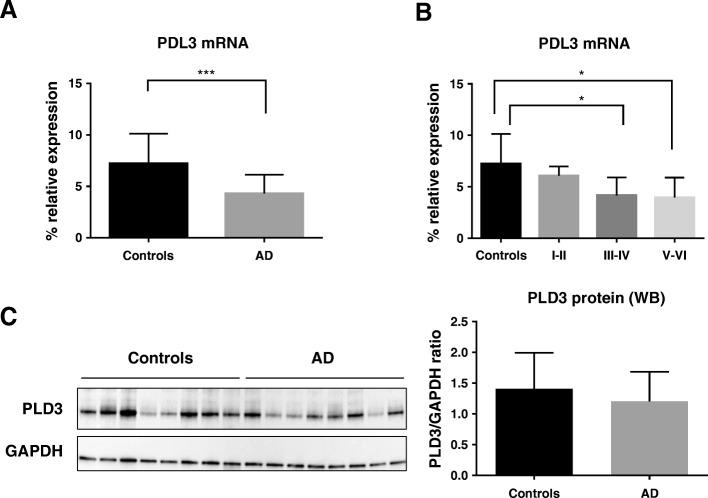
We assessed PLD3 mRNA expression by qPCR and protein levels by Western blot in frozen hippocampal samples from a cohort of neuropathologically confirmed pure AD cases and controls. Next, we profiled DNA methylation at cytosine-phosphate-guanine dinucleotide (CpG) site resolution by pyrosequencing and further validated results by bisulfite cloning sequencing in two promoter regions of the PLD3 gene. A 1.67-fold decrease in PLD3 mRNA levels (p value < 0.001) was observed in the hippocampus of AD cases compared to controls, and a slight decrease was also found by Western blot at protein level. Moreover, PLD3 mRNA levels inversely correlated with the average area of β-amyloid burden (tau-b = - 0,331; p value < 0.01) in the hippocampus. A differentially methylated region was identified within the alternative promoter of PLD3 gene showing higher DNA methylation levels in the AD hippocampus compared to controls (21.7 ± 4.7% vs. 18.3 ± 4.8%; p value < 0.05).
PLD3 gene is downregulated in the human hippocampus in AD cases compared to controls. Altered epigenetic mechanisms, such as differential DNA methylation within an alternative promoter of PLD3 gene, may be involved in the pathological processes of AD. Moreover, PLD3 mRNA expression inversely correlates with hippocampal β-amyloid burden, which adds evidence to the hypothesis that PLD3 protein may contribute to AD development by modifying APP processing.
全外显子组测序揭示了 PLD3 基因(rs145999145)中的一个罕见错义变体与晚发性阿尔茨海默病(AD)有关。然而,这种关联仍然存在争议,关于 PLD3 在 AD 中的作用知之甚少。有趣的是,PLD3 编码一种可能参与淀粉样前体蛋白(APP)加工的磷脂酶。我们的目的是深入了解 AD 影响的人类海马体中调节 PLD3 基因表达的表观遗传机制。
我们通过 qPCR 评估了冷冻海马组织中 PLD3 mRNA 的表达,并通过 Western blot 评估了 PLD3 蛋白水平,这些组织来自一组经过神经病理学证实的纯 AD 病例和对照组。接下来,我们通过焦磷酸测序以胞嘧啶-磷酸-鸟嘌呤二核苷酸(CpG)位点分辨率对 DNA 甲基化进行了分析,并在 PLD3 基因的两个启动子区域通过亚硫酸氢盐克隆测序进一步验证了结果。与对照组相比,AD 病例的海马体中 PLD3 mRNA 水平降低了 1.67 倍(p 值<0.001),Western blot 也发现了蛋白水平的轻微下降。此外,PLD3 mRNA 水平与海马体中β-淀粉样蛋白负担的平均面积呈负相关(tau-b=-0.331;p 值<0.01)。在 PLD3 基因的替代启动子内发现了一个差异甲基化区域,与对照组相比,AD 海马体中的 DNA 甲基化水平更高(21.7±4.7%比 18.3±4.8%;p 值<0.05)。
与对照组相比,AD 病例的人类海马体中 PLD3 基因下调。改变的表观遗传机制,如 PLD3 基因替代启动子内的差异 DNA 甲基化,可能参与 AD 的病理过程。此外,PLD3 mRNA 表达与海马体β-淀粉样蛋白负担呈负相关,这为 PLD3 蛋白通过改变 APP 加工而促进 AD 发展的假说提供了证据。