Department of Organismal Biology, Uppsala University, Uppsala, Sweden.
Department of Basic Neurosciences, University of Geneva, Geneva, Switzerland.
Front Neural Circuits. 2018 Aug 29;12:64. doi: 10.3389/fncir.2018.00064. eCollection 2018.
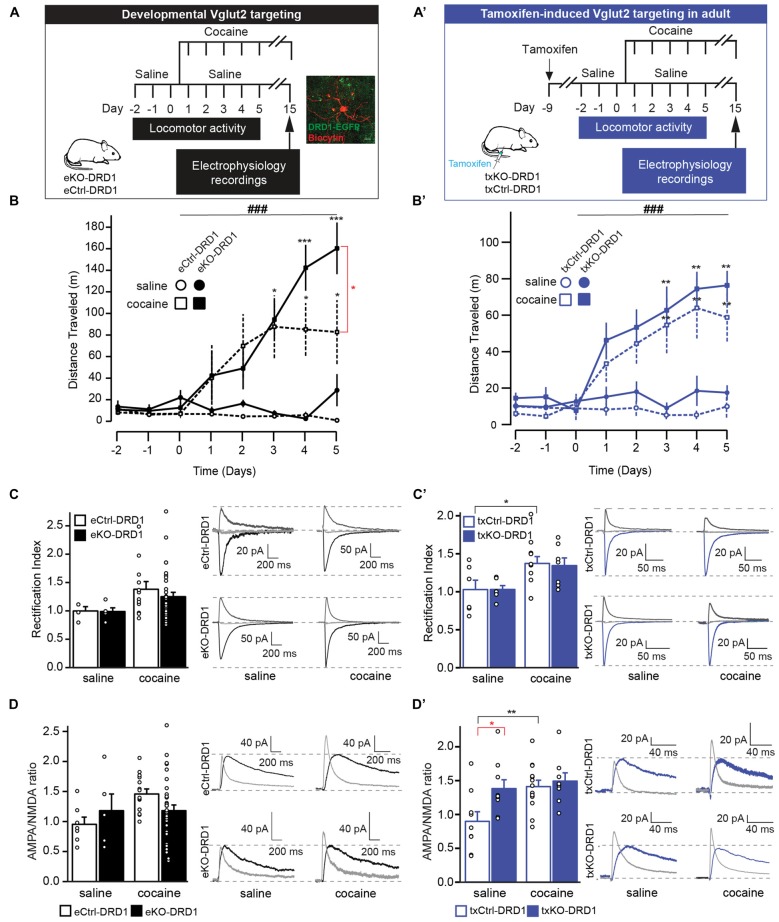
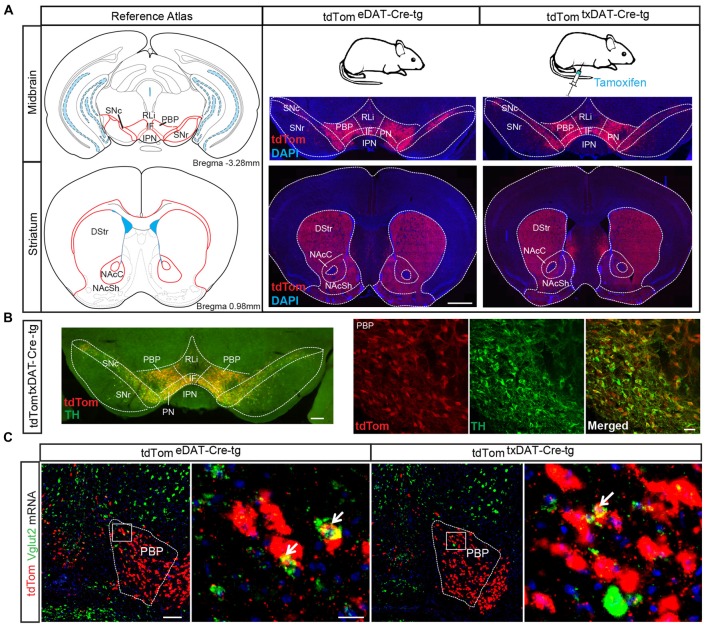
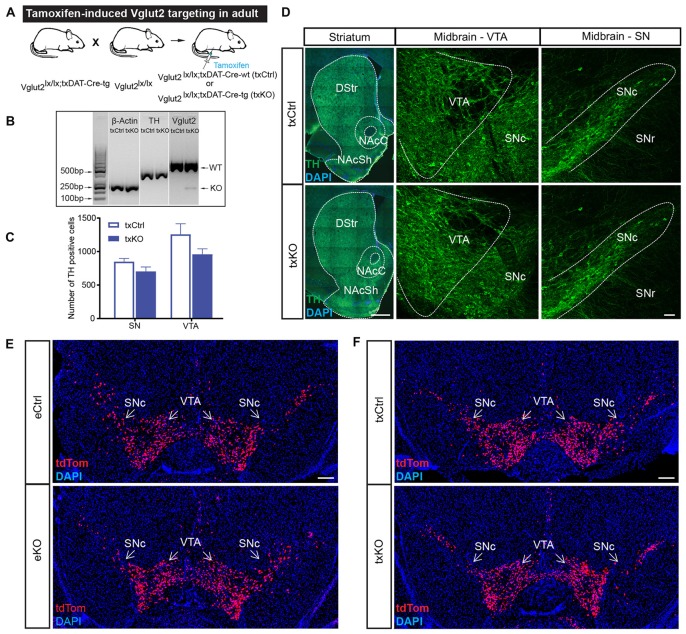
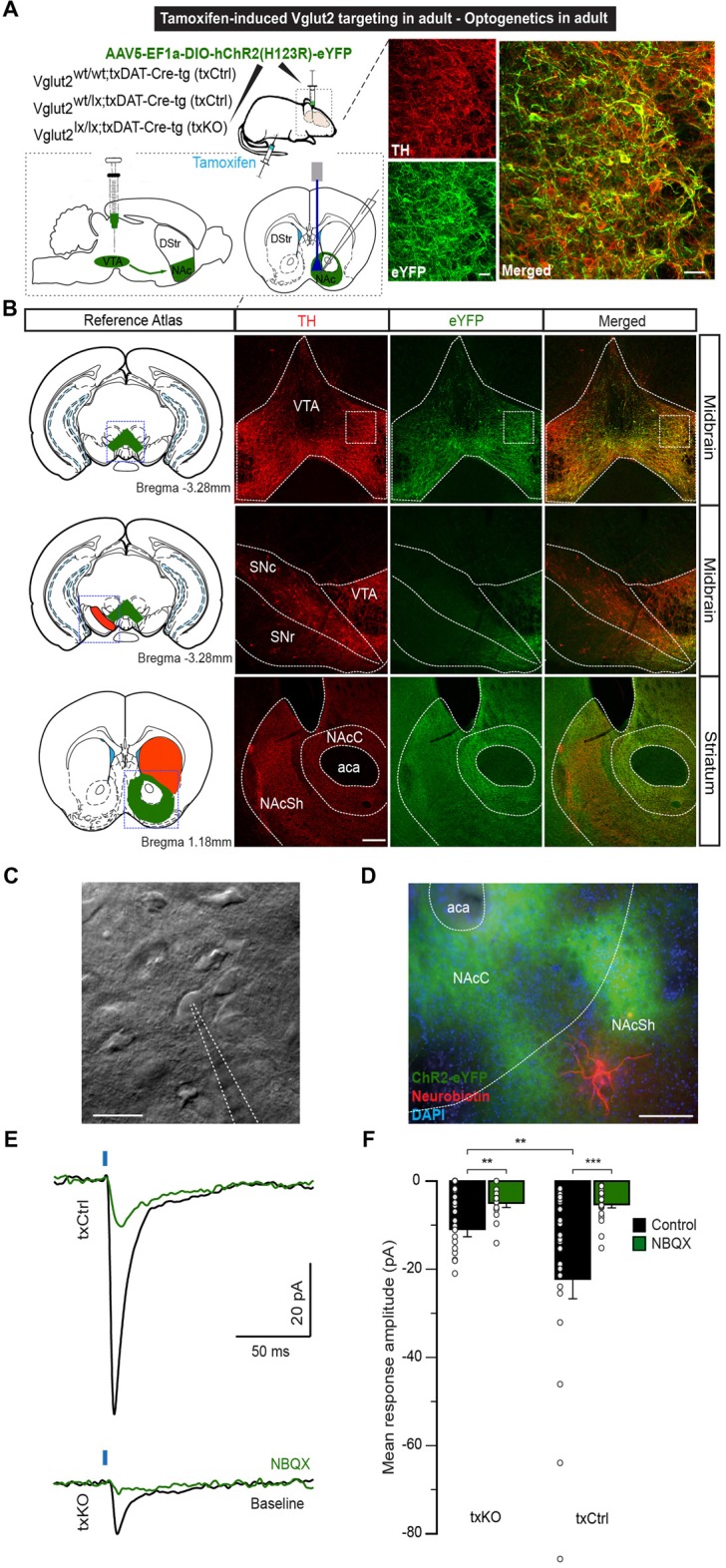
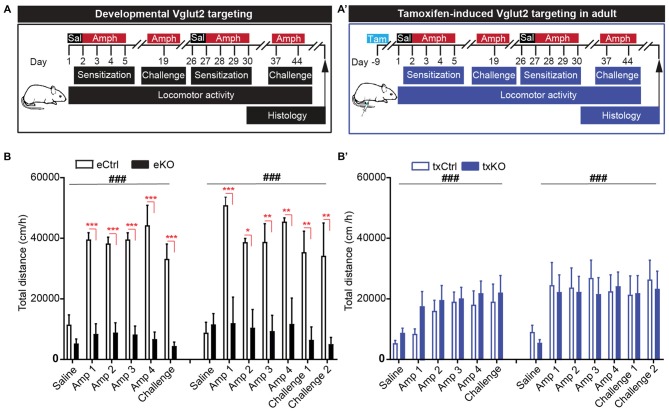
Expression of the gene encoding the Vesicular glutamate transporter 2 (VGLUT2) in midbrain dopamine (DA) neurons enables these neurons to co-release glutamate in the nucleus accumbens (NAc), a feature of putative importance to drug addiction. For example, it has been shown that conditional deletion of gene expression within developing DA neurons in mice causes altered locomotor sensitization to addictive drugs, such as amphetamine and cocaine, in adulthood. Alterations in DA neurotransmission in the mesoaccumbal pathway has been proposed to contribute to these behavioral alterations but the underlying molecular mechanism remains largely elusive. Repeated exposure to cocaine is known to cause lasting adaptations of excitatory synaptic transmission onto medium spiny neurons (MSNs) in the NAc, but the putative contribution of VGLUT2-mediated glutamate co-release from the mesoaccumbal projection has never been investigated. In this study, we implemented a tamoxifen-inducible Cre-LoxP strategy to selectively probe VGLUT2 in mature DA neurons of adult mice. Optogenetics-coupled patch clamp analysis in the NAc demonstrated a significant reduction of glutamatergic neurotransmission, whilst behavioral analysis revealed a normal locomotor sensitization to amphetamine and cocaine. When investigating if the reduced level of glutamate co-release from DA neurons caused a detectable post-synaptic effect on MSNs, patch clamp analysis identified an enhanced baseline AMPA/NMDA ratio in DA receptor subtype 1 (DRD1)-expressing accumbal MSNs which occluded the effect of cocaine on synaptic transmission. We conclude that VGLUT2 in mature DA neurons actively contributes to glutamatergic neurotransmission in the NAc, a finding which for the first time highlights VGLUT2-mediated glutamate co-release in the complex mechanisms of synaptic plasticity in drug addiction.
谷氨酸转运体 2(VGLUT2)基因的表达使中脑多巴胺(DA)神经元能够在伏隔核(NAc)中共释放谷氨酸,这一特征对于药物成瘾可能很重要。例如,已经表明,在小鼠中发育中的 DA 神经元中条件性删除 基因表达会导致成年后对成瘾药物(如安非他命和可卡因)的运动敏化改变。中脑伏隔核途径中的 DA 神经传递改变被认为导致了这些行为改变,但潜在的分子机制在很大程度上仍不清楚。已知可卡因的反复暴露会导致 NAc 中的中脑投射物中的兴奋性突触传递发生持久适应,但从未研究过 VGLUT2 介导的谷氨酸共释放的潜在贡献。在这项研究中,我们实施了一种他莫昔芬诱导的 Cre-LoxP 策略,以选择性探测成年小鼠成熟 DA 神经元中的 VGLUT2。NAc 中的光遗传学结合膜片钳分析显示谷氨酸能神经传递显著减少,而行为分析显示对安非他命和可卡因的运动敏化正常。当研究从 DA 神经元共释放的谷氨酸减少是否会对 MSN 产生可检测的突触后效应时,膜片钳分析确定在表达 DA 受体亚型 1(DRD1)的伏隔核 MSN 中 AMPA/NMDA 比值升高,这掩盖了可卡因对突触传递的影响。我们得出结论,成熟的 DA 神经元中的 VGLUT2 主动参与 NAc 中的谷氨酸能神经传递,这一发现首次强调了 VGLUT2 介导的谷氨酸共释放在药物成瘾的突触可塑性复杂机制中的作用。