Dzierzbicka-Glowacka Lidia, Lemieszek Anna, Kalarus Marcin, Griniene Evelina
Physical Oceanography Department, Ecohydrodynamics Laboratory, Institute of Oceanology of the Polish Academy of Sciences, Sopot, Poland.
Department of Ecology, Maritime Institute in Gdansk, Gdansk, Poland.
PeerJ. 2018 Sep 6;6:e5562. doi: 10.7717/peerj.5562. eCollection 2018.
Copepods are major secondary producers in the World Ocean. They represent an important link between phytoplankton, microzooplankton and higher trophic levels such as fish. They are an important source of food for many fish species but also a significant producer of detritus. In the terms of the role they play in the marine food web, it is important to know how environmental variability affects the population of copepods.
The study of the zooplankton community in the south-eastern Baltic Sea conducted during a 24-month survey (from January 2010 to November 2011) resulted in the identification of 24 invertebrate species (10 copepods, seven cladocerans, four rotifers, one ctenophore, one larvacean, and one amphipod). Data were collected at two stations located in the open sea waters of the Gulf of Gdansk: the Gdansk Deep (P1) (54°50'N, 19°19'E) and in the western, inner part of the Gulf of Gdansk (P2) (54°32'N, 18°48.2'E). The vertical hauls were carried out with the use of two kinds of plankton nets with a mesh size of 100 µm: a Copenhagen net (in 2010), and a WP-2 net (in 2011).
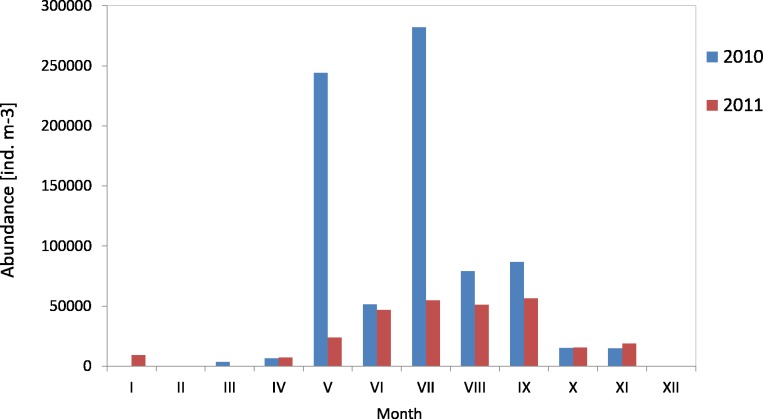
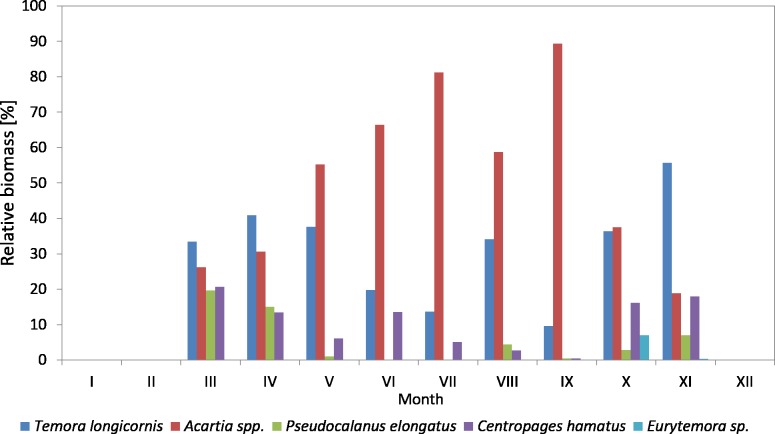
The paper describes the seasonal changes in the abundance and biomass of copepods, taking into account the main Baltic calanoid copepod taxa ( spp., and sp.). They have usually represented the main component of zooplankton. The average number of copepods at the P1 Station during the study period of 2010 was 3,913 ind m(SD 2,572) and their number ranged from 1,184 ind m (in winter) to 6,293 ind m(in spring). One year later, the average count of copepods was higher, at 11,723 ind m(SD 6,980), and it ranged from 2,351 ind m(in winter) to 18,307 ind m(in summer). Their average count at P2 Station in 2010 was 29,141 ind m, ranging from 3,330 ind m(in March) to 67,789 ind m(in May). The average count of copepods in 2011 was much lower at 17,883 ind m, and it ranged from 1,360 ind m (in April) to 39,559 ind m (in May).
The environmental conditions of the pelagic habitat change in terms of both depth and distance from the shore. Although the qualitative (taxonomic) structure of zooplankton is almost identical to that of the coastal waters, the quantitative structure (abundance and biomass) changes quite significantly. The maximum values of zooplankton abundance and biomass were observed in the summer season, both in the Gdansk Deep and in the inner part of the Gulf of Gdansk. Copepods dominated in the composition of zooplankton for almost the entire time of the research duration. Quantitative composition of copepods at the P1 Station differed from the one at P2 Station due to the high abundance of sp. which prefers colder, more saline waters.
桡足类是世界海洋中的主要次级生产者。它们是浮游植物、微型浮游动物与鱼类等较高营养级之间的重要纽带。它们是许多鱼类的重要食物来源,也是碎屑的重要生产者。就它们在海洋食物网中所起的作用而言,了解环境变化如何影响桡足类种群非常重要。
在一项为期24个月的调查(从2010年1月至2011年11月)中对波罗的海东南部的浮游动物群落进行了研究,共鉴定出24种无脊椎动物(10种桡足类、7种枝角类、4种轮虫、1种栉水母、1种幼形类和1种端足类)。数据在格但斯克湾公海水域的两个站点收集:格但斯克深海(P1)(北纬54°50′,东经19°:19′)和格但斯克湾西部内湾(P2)(北纬54°32′,东经18°48.2′)。垂直拖网使用两种网目尺寸为100微米的浮游生物网进行:2010年使用哥本哈根网,2011年使用WP - 2网。
本文描述了桡足类丰度和生物量的季节性变化,考虑了波罗的海主要的哲水蚤类桡足类分类单元( 属、 属和 种)。它们通常是浮游动物的主要组成部分。2010年研究期间P1站桡足类的平均数量为3913个/立方米(标准差2572),数量范围从冬季的1184个/立方米到春季的6293个/立方米。一年后,桡足类的平均数量更高,为11723个/立方米(标准差6980),范围从冬季的2351个/立方米到夏季的18307个/立方米。2010年P2站它们的平均数量为29141个/立方米,范围从3月的3330个/立方米到5月的67789个/立方米。2011年桡足类的平均数量低得多,为17883个/立方米,范围从4月的1360个/立方米到5月的39559个/立方米。
远洋栖息地的环境条件在深度和离岸距离方面都会发生变化。尽管浮游动物的定性(分类学)结构与沿海水域几乎相同,但定量结构(丰度和生物量)变化相当显著。在夏季,格但斯克深海和格但斯克湾内湾都观察到浮游动物丰度和生物量的最大值。在几乎整个研究期间,桡足类在浮游动物组成中占主导地位。P1站桡足类的定量组成与P2站不同,因为 种数量众多,该物种更喜欢较冷、盐度更高的水域。