Schannen Andrew, Cohen-Tanugi Samuel, Konigsberg Matthew, Noback Peter, Strauch Robert J
Department of Orthopaedic Surgery, Columbia University Medical Center, New York, NY.
J Am Acad Orthop Surg Glob Res Rev. 2017 Nov 15;1(8):e062. doi: 10.5435/JAAOSGlobal-D-17-00062. eCollection 2017 Nov.
The quadriga phenomenon results from excessive shortening of the flexor digitorum profundus (FDP) tendon to the middle, ring, or small finger.
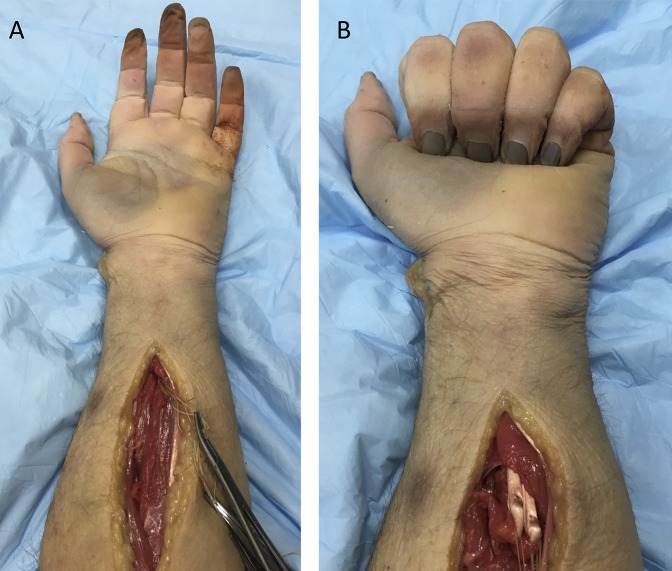
Five cadaveric specimens were used to create a model for quadriga. The FDP tendons to the middle, ring, and small fingers were shortened in 5-mm increments, and the tip-to-palm (TTP) distance of adjacent fingers was recorded.
Shortening of the middle finger FDP by 10 mm resulted in an average TTP distance of 6 mm in the ring finger and 5 mm in the small finger. Shortening the ring finger FDP by 10 mm produced an average TTP distance of 11 mm in the middle finger and 9 mm in the small finger. Shortening of the small finger FDP by 10 mm resulted in an average TTP distance of 14 mm in the middle finger and 10 mm in the ring finger.
Shortening the FDP by as little as 10 mm produced a significant quadriga effect, which was more pronounced with shortening of the small and ring FDP tendons compared to the middle finger.
四联指现象是由于指深屈肌腱(FDP)向中指、环指或小指过度缩短所致。
使用5个尸体标本建立四联指模型。将中指、环指和小指的FDP肌腱以5毫米的增量缩短,并记录相邻手指的指尖到手掌(TTP)距离。
中指FDP缩短10毫米导致环指平均TTP距离为6毫米,小指为5毫米。环指FDP缩短10毫米导致中指平均TTP距离为11毫米,小指为9毫米。小指FDP缩短10毫米导致中指平均TTP距离为14毫米,环指为10毫米。
FDP缩短仅10毫米就产生了显著的四联指效应,与中指相比,小指和环指FDP肌腱缩短时该效应更明显。