Instituto de Bioquímica Médica Leopoldo de Meis, Universidade Federal do Rio de Janeiro, Rio de Janeiro-RJ, Brazil.
Instituto Nacional de Ciência e Tecnologia em Entomologia Molecular-INCT-EM, Universidade Federal do Rio de Janeiro, Rio de Janeiro-RJ, Brazil.
PLoS Negl Trop Dis. 2018 Sep 13;12(9):e0006739. doi: 10.1371/journal.pntd.0006739. eCollection 2018 Sep.
Chagas disease is caused by the parasite Trypanosoma cruzi and is transmitted through triatomines (Hemiptera: Reduviidae). In the last year, many studies of triatomine gut microbiota have outlined its potential role in modulating vector competence. However, little is known about the microbiota present in the salivary glands of triatomines. Bacterial composition of salivary glands in selected triatomine species was investigated, as well as environmental influences on the acquisition of bacterial communities.
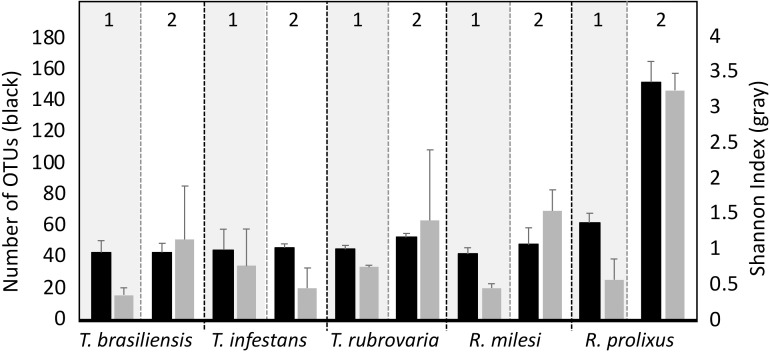
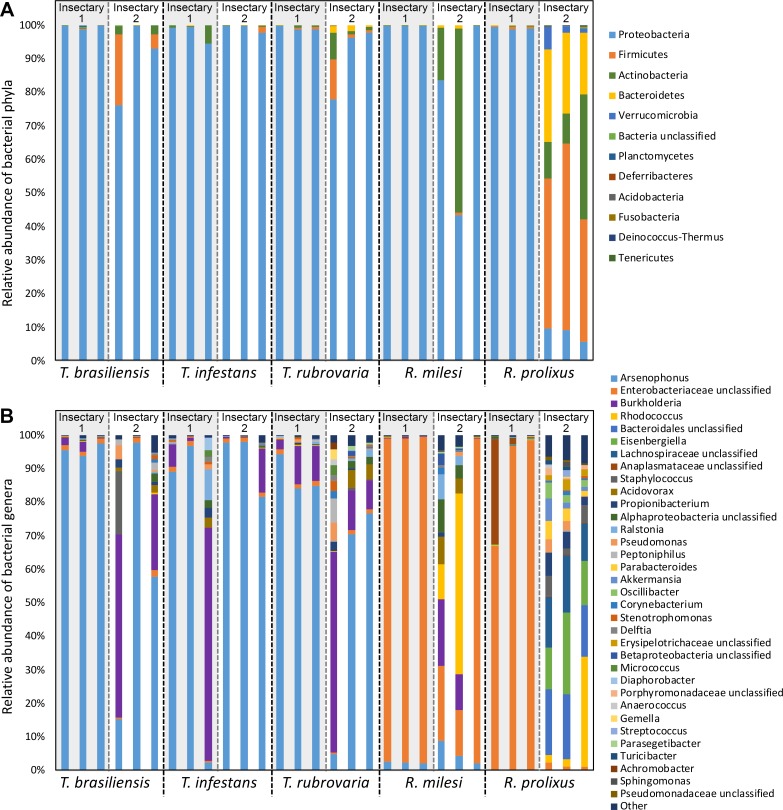
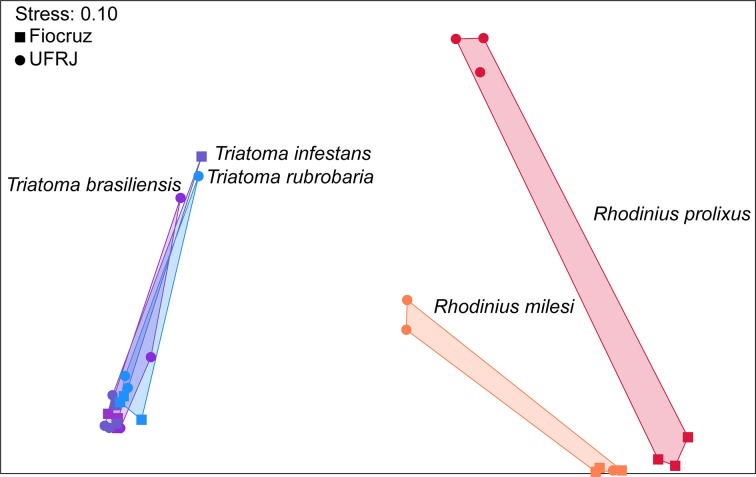
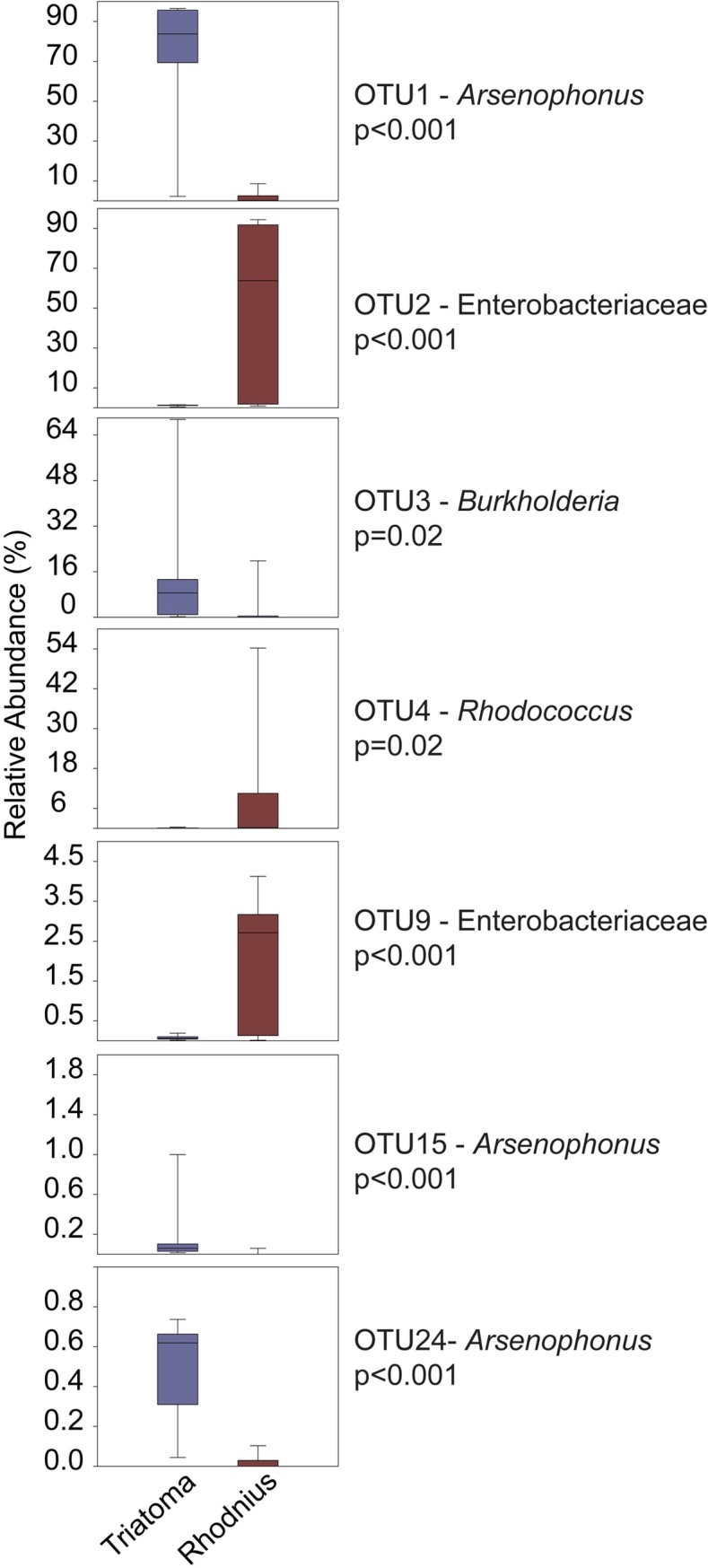
METHODOLOGY/PRINCIPAL FINDINGS: The diversity of the bacterial communities of 30 pairs of salivary glands of triatomines was studied by sequencing of the V1- V3 variable region of the 16S rRNA using the MiSeq platform (Illumina), and bacteria isolated from skin of three vertebrate hosts were identified based on 16S rRNA gene sequence analysis (targeting the V3-V5 region). In a comparative analysis of microbiota in the salivary glands of triatomine species, operational taxonomic units belonging to Arsenophonous appeared as dominant in Triatoma spp (74% of the total 16S coverage), while these units belonging to unclassified Enterobacteriaceae were dominant in the Rhodnius spp (57% of the total 16S coverage). Some intraspecific changes in the composition of the triatomine microbiota were observed, suggesting that some bacteria may have been acquired from the environment.
Our study revealed the presence of a low-diversity microbiota associated to the salivary glands of the evaluated triatomines. The predominant bacteria genera are associated with triatomine genera and the bacteria can be acquired in the environment in which the insects reside. Further studies are necessary to determine the influence of bacterial communities on vector competence.
恰加斯病由寄生虫克氏锥虫引起,通过锥蝽(半翅目:红蝽科)传播。在过去的一年中,许多关于锥蝽肠道微生物群的研究概述了其在调节媒介能力方面的潜在作用。然而,关于锥蝽唾液腺中存在的微生物群知之甚少。本研究调查了选定的锥蝽物种唾液腺中的细菌组成,以及环境对细菌群落获得的影响。
方法/主要发现:通过 MiSeq 平台(Illumina)对 16S rRNA 的 V1-V3 可变区进行测序,研究了 30 对唾液腺的细菌群落多样性,并基于 16S rRNA 基因序列分析(靶向 V3-V5 区)鉴定了从三种脊椎动物宿主皮肤中分离的细菌。在对锥蝽物种唾液腺微生物群的比较分析中,属于 Arsenophonous 的分类操作单元在 Triatoma spp 中表现为优势(占总 16S 覆盖的 74%),而属于未分类肠杆菌科的这些单元在 Rhodnius spp 中占优势(占总 16S 覆盖的 57%)。观察到一些锥蝽微生物群组成的种内变化,表明一些细菌可能是从环境中获得的。
本研究揭示了与评估的锥蝽唾液腺相关的低多样性微生物群的存在。主要细菌属与锥蝽属有关,细菌可以在昆虫栖息的环境中获得。需要进一步研究来确定细菌群落对媒介能力的影响。