ISGlobal-Hospital Clínic, Universitat de Barcelona, Barcelona, Spain.
Department of Global Health and Development, London School of Hygiene and Tropical Medicine, London, United Kingdom.
PLoS Negl Trop Dis. 2018 Sep 17;12(9):e0006797. doi: 10.1371/journal.pntd.0006797. eCollection 2018 Sep.
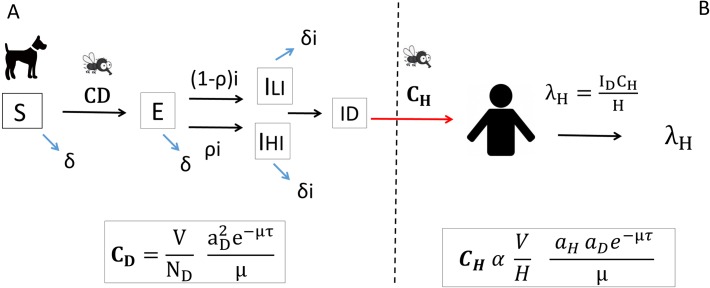
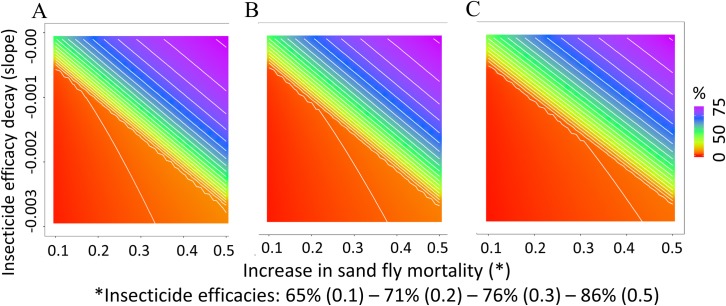
Systemic insecticides in dogs have been suggested as a public health intervention to prevent human cases of Zoonotic Visceral Leishmaniasis (ZVL). But, currently there are no systemic insecticides for dogs registered against zoo-anthropophilic pool blood feeding phlebotomine flies. We predict the impact of community-wide use of systemic insecticide in dog populations as a public health measure to control transmission of Leishmania infantum to humans using a mathematical model. We developed a Susceptible-Exposed-Infected (SEI) compartmental model to describe L. infantum transmission dynamics in dogs, with a vectorial capacity term to represent transmission between L. infantum-hosting dogs via phlebotomine flies. For Infected (I) dogs two levels of infectiousness were modelled, high infectiousness and low infectiousness. Human incidence was estimated through its relationship to infection in the dog population. We evaluated outcomes from a wide range of scenarios comprising different combinations of initial insecticide efficacy, duration of insecticide efficacy over time, and proportion of the dog population treated (60%, 70% & 80%). The same reduction in human infection incidence can be achieved via different combinations of insecticide efficacy, duration and dog coverage. For example, a systemic insecticide with an initial efficacy of 80% and 6 months above 65% efficacy would require treating at least 70% of the dogs to reduce the human infection incidence by 50%. Sensitivity analysis showed that the model outcome was most sensitive to baseline values of phlebotomine fly daily survival rate and insecticide coverage. Community-wide use of systemic insecticides applied to the "L. infantum canine reservoir" can significantly reduce human incidence of L. infantum infection. The results of this mathematical model can help defining the insecticide target product profile and how the insecticide should be applied to maximise effectiveness.
已有人提议在狗中使用全身杀虫剂作为公共卫生干预措施,以预防人类内脏利什曼病(ZVL)病例。但是,目前还没有针对动物嗜血性池血食性刺蝇的注册的狗用全身杀虫剂。我们使用数学模型预测在狗群中广泛使用全身杀虫剂作为公共卫生措施来控制利什曼原虫向人类传播的影响。我们开发了一个易感-暴露-感染(SEI) compartmental 模型来描述狗中的利什曼原虫传播动力学,其中矢量能力项代表通过刺蝇在利什曼原虫宿主狗之间的传播。对于感染(I)狗,我们模拟了两种感染水平,高感染水平和低感染水平。通过其与狗群中感染的关系来估计人类发病率。我们评估了各种方案的结果,这些方案包括不同初始杀虫剂功效、杀虫剂功效随时间的持续时间以及治疗的狗群比例(60%、70%和 80%)的组合。可以通过不同的杀虫剂功效、持续时间和狗群覆盖率组合来实现相同的人类感染发病率降低。例如,具有初始功效 80%和 6 个月以上 65%功效的全身杀虫剂需要至少治疗 70%的狗,才能将人类感染发病率降低 50%。敏感性分析表明,模型结果对刺蝇每日存活率和杀虫剂覆盖率的基线值最为敏感。在“利什曼原虫犬 reservoir”中广泛使用全身杀虫剂可以显著降低人类感染利什曼原虫的发病率。该数学模型的结果可以帮助定义杀虫剂目标产品概况以及如何应用杀虫剂以最大程度地提高效果。