Clinic of Nephrology and Hypertension, Diabetes and Endocrinology, Otto-von-Guericke-University Magdeburg, Leipziger Str. 44, 39120, Magdeburg, Germany.
Division of Nephrology and Hypertension, 1st Department of Internal Medicine, AHEPA Hospital, School of Medicine, Aristotle University of Thessaloniki, Thessaloniki, Greece.
Sci Rep. 2018 Sep 18;8(1):13964. doi: 10.1038/s41598-018-31889-2.
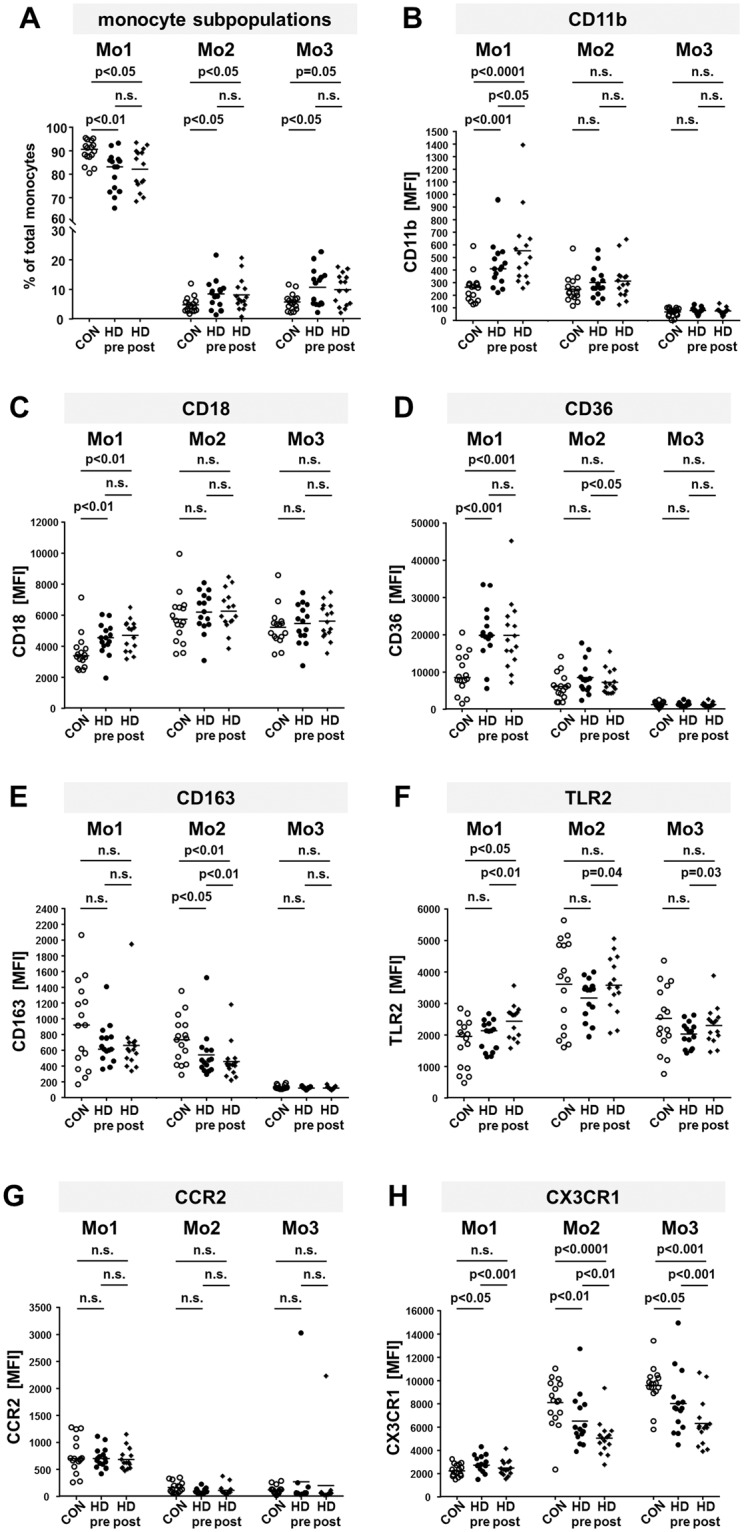
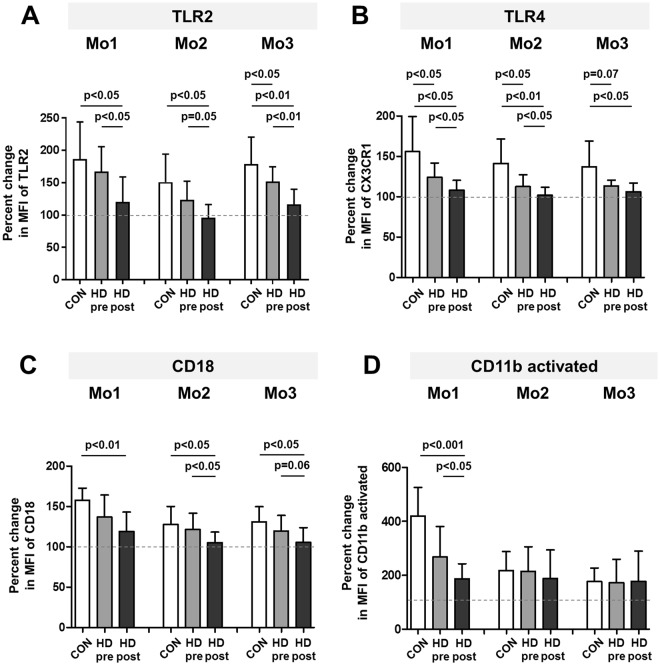
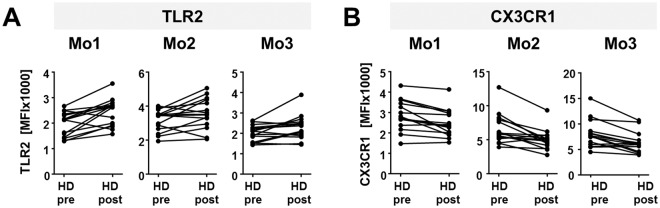
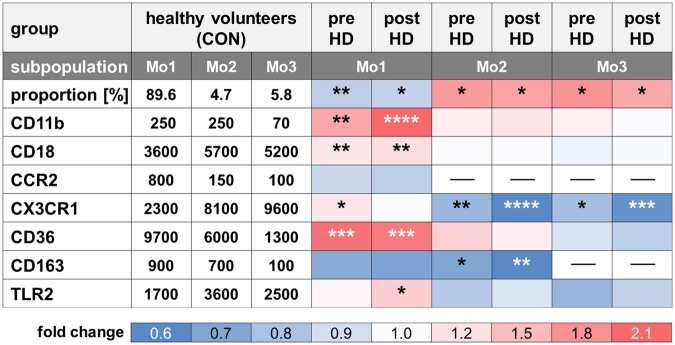
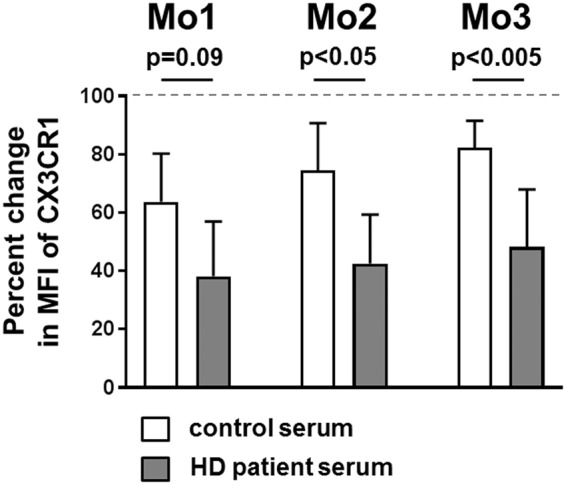
Hemodialysis (HD) patients exhibit chronic inflammation and leukocyte activation. We investigated the surface-marker profile of monocytes by flow cytometry to assess the chronic effect of uremia and the acute effect of dialysis on their phenotypical and functional features in 16 healthy controls (CON) and 15 HD patients before and after a polysulfone-based dialysis session. Median fluorescence intensities were analyzed indicating expression of CD14, CD16, integrins (CD11b, CD18), chemokine receptors (CCR2, CX3CR1), scavenger receptors (CD36, CD163) and Toll-like receptor-2 (TLR2). Before and after dialysis, HD patients harbour 0.9-fold less CD14CD16 (Mo1), 1.8-fold more CD14CD16 (Mo2) and CD14CD16 (Mo3) monocytes than CON. HD patients' Mo1 showed elevated expression of CD11b (1.7-fold), CD18 (1.2-fold) and CD36 (2.1-fold), whereas CD163 expression was reduced in Mo1 and Mo2 (0.6-fold) compared to CON. These markers remained unaffected by dialysis. CX3CR1 expression on Mo2 and Mo3 was lower in HD patients before (0.8-fold) and further diminished after dialysis (0.6-fold). Stimulation of monocytes resulted in diminished responses in HD patients compared to CON. In conclusion, a systematic analysis of the expression of particular surface markers on distinct monocyte subsets may help to distinguish between uremia and/or dialysis induced effects and to evaluate the functionality of monocytes and biocompatibility of HD.
血液透析 (HD) 患者表现出慢性炎症和白细胞激活。我们通过流式细胞术研究了单核细胞的表面标志物谱,以评估尿毒症的慢性影响以及透析对其表型和功能特征的急性影响,共纳入 16 名健康对照 (CON) 和 15 名 HD 患者,分别在透析前后进行检测。分析了中荧光强度,以表明 CD14、CD16、整合素 (CD11b、CD18)、趋化因子受体 (CCR2、CX3CR1)、清道夫受体 (CD36、CD163) 和 Toll 样受体-2 (TLR2) 的表达。在透析前后,HD 患者的 Mo1 中 CD14CD16 细胞减少了 0.9 倍,Mo2 和 Mo3 中 CD14CD16 细胞增加了 1.8 倍,比 CON 多。HD 患者的 Mo1 中 CD11b (1.7 倍)、CD18 (1.2 倍) 和 CD36 (2.1 倍) 的表达增加,而 Mo1 和 Mo2 中的 CD163 表达减少 (0.6 倍)。这些标志物不受透析影响。Mo2 和 Mo3 上的 CX3CR1 表达在透析前 (0.8 倍) 和透析后 (0.6 倍) 均降低。与 CON 相比,HD 患者的单核细胞刺激反应减弱。总之,对特定单核细胞亚群上特定表面标志物的表达进行系统分析,可能有助于区分尿毒症和/或透析引起的影响,并评估单核细胞的功能和血液透析的生物相容性。