
骨扫描能否指导二氯化镭-223治疗前列腺癌骨转移?
Can bone scans guide therapy with radium-223 dichloride for prostate cancer bone metastases?
作者信息
Gayed Isis, Salama Vivian, Dawood Lydia, Canfield Steven, Wan David, Cai Chunyan, Joseph Usha, Amato Robert
机构信息
Nuclear Medicine Section, Department of Diagnostic and Interventional Imaging, University of Texas Health Science Center at Houston,
Graduate School of Biomedical Sciences, University of Texas MD Anderson Cancer Center.
出版信息
Cancer Manag Res. 2018 Sep 7;10:3317-3324. doi: 10.2147/CMAR.S166218. eCollection 2018.
BACKGROUND
Radium-223 dichloride (Ra-223 Xofigo) has recently been approved as an addition to the host of available therapies in the USA as a treatment option for metastatic castrate-resistant prostate cancer (mCRPC) with bone metastases. This study describes our initial experience in patients treated with Ra-223 dichloride. It attempts to optimize patients' selection for the best outcome from Ra-223 dichloride therapy.
METHODS
Consecutive patients who were referred for treatment with Ra-223 dichloride were prospectively followed. Patients' demographics, functional status per the Eastern Cooperative Oncology Group (ECOG) performance score, pain level per the numeric rating score (NRS), prostate-specific antigen (PSA), creatinine, and hematological values were compared at baseline and at the end of therapy. Patients also had a bone scan before starting therapy and at the end of therapy. Patients were divided into the favorable response (FR) group if their pain and/or functional status improved and the unfavorable response (UR) group if they did not improve, deteriorated, or deceased. Bone scan findings before and after Ra-223 dichloride therapy were compared in both the FR and UR groups.
RESULTS
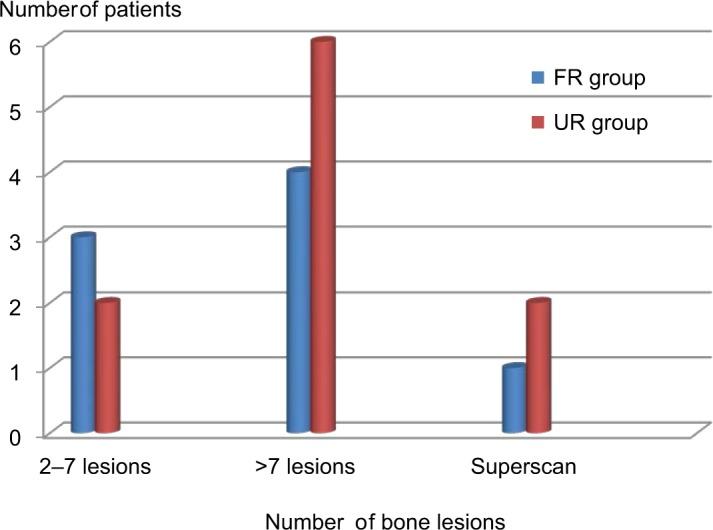
Twenty patients were treated with Ra-223 dichloride. Twelve patients had innumerable bone metastases, three patients had super scans, and three patients had two to seven bone lesions. Two patients were lost to follow-up after the first injection. There were eight patients in the FR group and 10 patients in the UR group. Patients with UR had mean ECOG and NRS pain scores of 1.3 and 5.0 versus 0.8 and 4.4 in the FR group. The mean PSA and creatinine levels in the UR group were 445.2 ng/mL and 1.2 mg/dL versus 22.7 ng/mL and 1.1 mg/dL in the FR group. The mean hemoglobin, platelets, and absolute neutrophil values were 11.2 g/dL, 314.9 K/cmm, and 7.3 K/cmm in the UR group versus 11.6 g/dL, 207.0 K/cmm, and 6.2 K/cmm in the FR group. Seven of the eight patients with FR had a bone scan at the end of therapy showing improvement in five patients, a mixed response in one patient, and progression in another patient. Five patients in the UR group completed five or six injections and had bone scans showing flare of bone metastases in three patients, progression in one patient, and improvement in the fifth patient. Three patients in the UR group died after the first or second injections. Two of these patients had baseline super scans and the third one had widespread bone metastases.
CONCLUSION
mCRPC patients with lower PSA levels at baseline and fewer bone lesions are more likely to respond favorably to Ra-223 dichloride therapy.
背景
二氯化镭 - 223(镭 - 223,商品名Xofigo)最近在美国被批准作为转移性去势抵抗性前列腺癌(mCRPC)伴骨转移的现有治疗方案的补充治疗选择。本研究描述了我们使用二氯化镭 - 223治疗患者的初步经验。旨在优化患者选择,以从二氯化镭 - 223治疗中获得最佳疗效。
方法
对连续转诊接受二氯化镭 - 223治疗的患者进行前瞻性随访。在基线和治疗结束时比较患者的人口统计学特征、根据东部肿瘤协作组(ECOG)表现评分的功能状态、根据数字评分量表(NRS)的疼痛水平、前列腺特异性抗原(PSA)、肌酐和血液学值。患者在开始治疗前和治疗结束时也进行了骨扫描。如果患者的疼痛和/或功能状态改善,则分为良好反应(FR)组;如果未改善、恶化或死亡,则分为不良反应(UR)组。比较FR组和UR组在二氯化镭 - 223治疗前后的骨扫描结果。
结果
20例患者接受了二氯化镭 - 223治疗。12例患者有无数骨转移,3例患者为超级骨显像,3例患者有2至7个骨病变。2例患者在首次注射后失访。FR组有8例患者,UR组有10例患者。UR组患者的ECOG平均评分为1.3,NRS疼痛评分为5.0,而FR组分别为0.8和4.4。UR组的PSA和肌酐平均水平分别为445.2 ng/mL和1.2 mg/dL,FR组分别为22.7 ng/mL和1.1 mg/dL。UR组的血红蛋白、血小板和绝对中性粒细胞平均值分别为11.2 g/dL、314.9 K/cmm和7.3 K/cmm,FR组分别为11.6 g/dL、207.0 K/cmm和6.2 K/cmm。8例FR组患者中有7例在治疗结束时进行了骨扫描,其中5例显示改善,1例为混合反应,1例进展。UR组的5例患者完成了5或6次注射,骨扫描显示3例患者骨转移灶出现闪烁,1例进展,第5例改善。UR组的3例患者在首次或第二次注射后死亡。其中2例患者基线时为超级骨显像,第3例有广泛骨转移。
结论
基线时PSA水平较低且骨病变较少的mCRPC患者更有可能对二氯化镭 - 223治疗产生良好反应。



 Zotero 插件