Grygiel-Górniak Bogna, Rogacka Natalia, Puszczewicz Mariusz
Department of Rheumatology and Internal Medicine, Poznań University of Medical Sciences, Poland.
Reumatologia. 2018;56(4):243-248. doi: 10.5114/reum.2018.77976. Epub 2018 Aug 31.
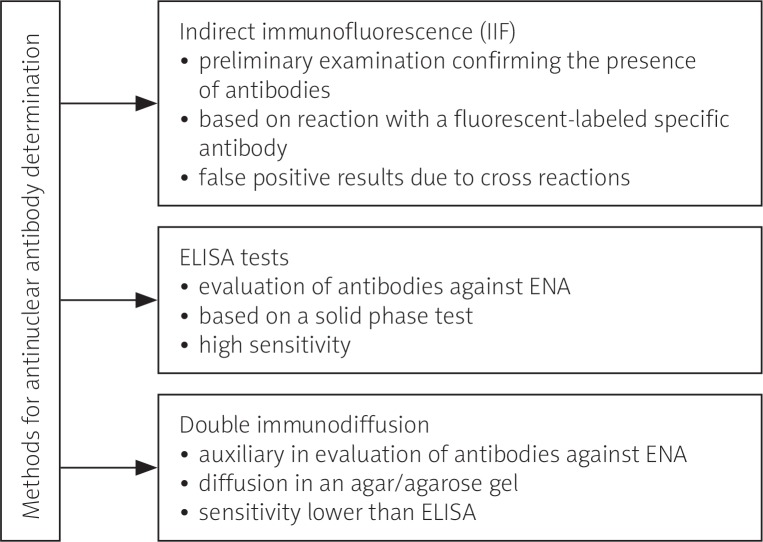
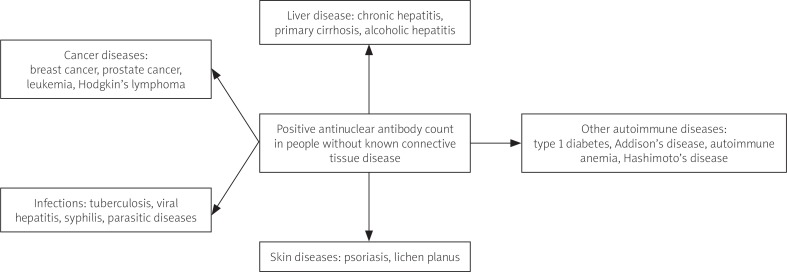
The presence of antinuclear antibodies (ANA) is mainly associated with connective tissue diseases (CTD). In addition, their presence is found in healthy people. These antibodies are more common in women and the elderly. Some drugs and xenobiotics are also important for the development of autoimmunity and ANA synthesis. Moreover, the deficiency of vitamin D in the body of patients correlates with occurrence of these antibodies. Unlike the healthy group, a positive ANA count was observed in patients with atopic dermatitis (AD) and in people with immune disorders. Antinuclear antibodies in low counts are also found in the course of chronic bacterial or viral infection and in patients with hematological malignancies. Also the possibility of false positive results, which may be caused by the choice of method used to determine antibodies, should be borne in mind. Taking into account all these factors, it is concluded that the ANA result itself has no diagnostic value.
抗核抗体(ANA)的存在主要与结缔组织病(CTD)相关。此外,在健康人群中也能发现其存在。这些抗体在女性和老年人中更为常见。一些药物和外源性物质对自身免疫的发展和ANA的合成也很重要。此外,患者体内维生素D缺乏与这些抗体的出现相关。与健康组不同,特应性皮炎(AD)患者和免疫功能紊乱者中观察到ANA计数呈阳性。在慢性细菌或病毒感染过程中以及血液系统恶性肿瘤患者中也发现了低计数的抗核抗体。还应记住,可能由于用于检测抗体的方法选择导致假阳性结果的可能性。考虑到所有这些因素,可以得出结论,ANA结果本身没有诊断价值。