Cancer Center, Renmin Hospital of Wuhan University, Wuhan, China.
Cancer Med. 2018 Oct;7(10):5015-5026. doi: 10.1002/cam4.1776. Epub 2018 Sep 21.
The survival advantage of radiotherapy (RT) for patients with stage IV non-small cell lung cancer (NSCLC) has not been adequately evaluated.
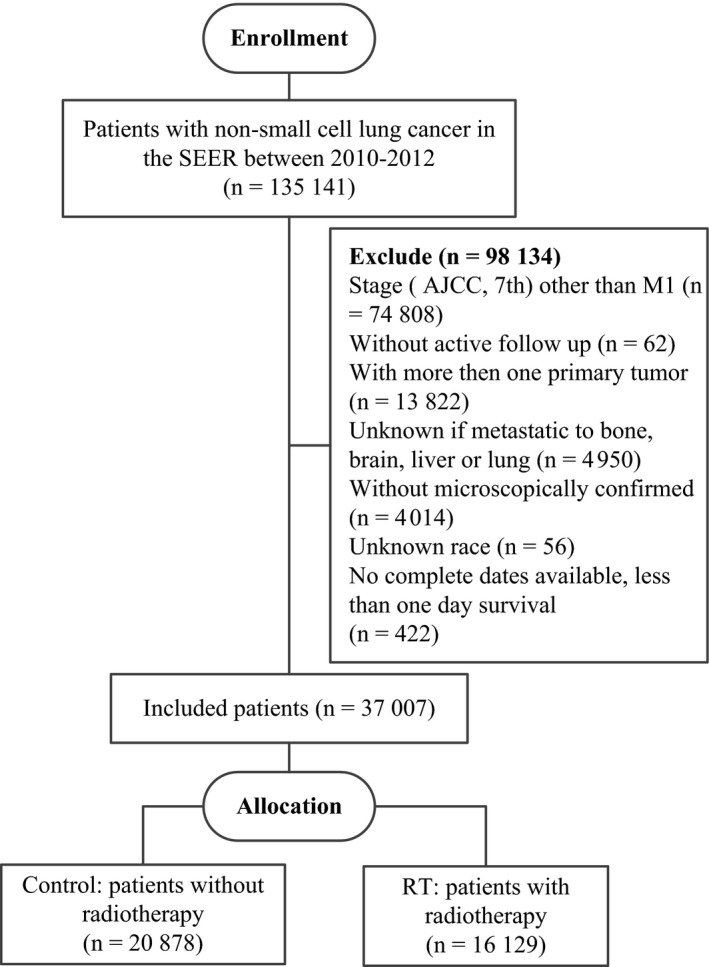
We analyzed stage IV NSCLC patients enrolled from the Surveillance, Epidemiology, and End Results (SEER) registry through January 2010 to December 2012. Propensity score (PS) analysis with 1:1 nearest neighbor matching method was used to ensure well-balanced characteristics of all comparison groups by histological types and metastatic sites. Kaplan-Meier and Cox proportional hazardous model were used to evaluate the overall survival (OS), cancer-specific survival (CSS), and corresponding 95% confidence interval (95%CI).
Generally speaking, there was a trend toward improved OS and CSS for using RT to stage IV NSCLC patients for any metastatic sites and for any histological types except adenocarcinoma (AD). Radiotherapy significantly improved the survival of NSCLC patients with metastasis to brain (P < 0.001), especially for AD (P < 0.001). For stage IV lung cancer patients with squamous cell carcinoma (SQC), RT for any metastatic sites could universally improve the OS (P < 0.001) and CSS (P < 0.001). In particular, RT was also associated with improving OS (P < 0.001) and CSS (P = 0.012) for stage IV patients with metastases of two or more sites, ie, polymetastatic disease. Furthermore, for those stage IV SQC patients without metastasis, RT, most likely to the primary site, also significantly improved the survival (P < 0.001).
The results support that RT might improve the survival of patients with metastatic NSCLC in a PS-matched patient cohort from the large SEER database. It is prudent to carefully select patients for RT in metastatic NSCLC.
放疗(RT)对 IV 期非小细胞肺癌(NSCLC)患者的生存优势尚未得到充分评估。
我们分析了 2010 年 1 月至 2012 年 12 月期间从监测、流行病学和最终结果(SEER)登记处招募的 IV 期 NSCLC 患者。采用倾向评分(PS)分析,采用 1:1 最近邻匹配方法,通过组织学类型和转移部位,确保所有比较组的特征均衡。采用 Kaplan-Meier 和 Cox 比例风险模型评估总生存期(OS)、癌症特异性生存期(CSS)和相应的 95%置信区间(95%CI)。
总体而言,对于任何转移部位和任何组织学类型(除腺癌(AD)外)的 IV 期 NSCLC 患者,使用 RT 治疗有改善 OS 和 CSS 的趋势。RT 显著改善了脑转移(P<0.001),尤其是 AD(P<0.001)的 NSCLC 患者的生存。对于任何转移部位的 IV 期肺鳞癌(SQC)患者,RT 均可普遍改善 OS(P<0.001)和 CSS(P<0.001)。特别是,RT 也与改善两个或多个部位转移(即多灶性疾病)的 IV 期患者的 OS(P<0.001)和 CSS(P=0.012)相关。此外,对于无转移的 IV 期 SQC 患者,RT (最有可能是原发部位)也显著改善了生存(P<0.001)。
这些结果支持 RT 可能会在来自大型 SEER 数据库的 PS 匹配患者队列中改善转移性 NSCLC 患者的生存。在转移性 NSCLC 中,对 RT 进行仔细选择患者是谨慎的。