
一元论社会学中的社会结构、权力与抵抗:(新)唯物主义见解
Social structures, power and resistance in monist sociology: (New) materialist insights.
作者信息
Fox Nick J, Alldred Pam
机构信息
University of Sheffield, UK.
Brunel University London, UK.
出版信息
J Sociol (Melb). 2018 Sep;54(3):315-330. doi: 10.1177/1440783317730615. Epub 2017 Sep 11.
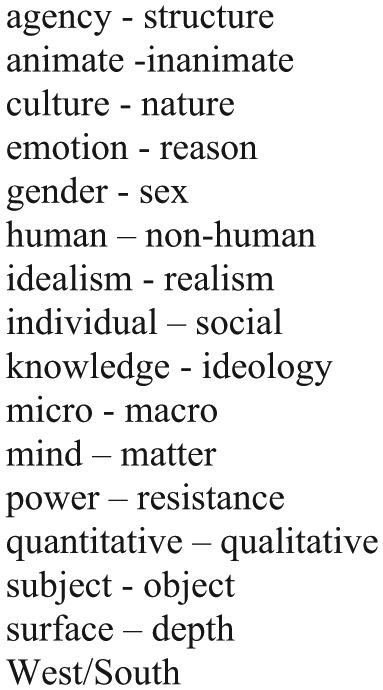
Though mainstream sociological theory has been founded within dualisms such as structure/agency, nature/culture, and mind/matter, a thread within sociology dating back to Spencer and Tarde favoured a monist ontology that cut across such dualistic categories. This thread has been reinvigorated by recent developments in social theory, including the new materialisms, posthumanism and affect theories. Here we assess what a monist or 'flat' ontology means for sociological understanding of key concepts such as structures and systems, power and resistance. We examine two monistic sociologies: Bruno Latour's 'sociology of associations' and DeLanda's ontology of assemblages. Understandings of social processes in terms of structures, systems or mechanisms are replaced with a focus upon the micropolitics of events and interactions. Power is a flux of forces or 'affects' fully immanent within events, while resistance is similarly an affective flow in events producing micropolitical effects contrary to power or control.
尽管主流社会学理论建立在诸如结构/能动性、自然/文化以及心灵/物质等二元论基础之上,但社会学中一条可追溯至斯宾塞和塔尔德的脉络则倾向于一种跨越此类二元范畴的一元论本体论。近期社会理论的发展,包括新唯物主义、后人类主义和情感理论,使这一脉络得以复兴。在此,我们评估一元论或“扁平”本体论对于社会学理解诸如结构与系统、权力与抵抗等关键概念意味着什么。我们考察两种一元论社会学:布鲁诺·拉图尔的“关联社会学”以及德兰达的组合体本体论。从结构、系统或机制角度对社会过程的理解,被对事件和互动的微观政治的关注所取代。权力是完全内在于事件之中的一股力量流或“情感”,而抵抗同样是事件中产生与权力或控制相反的微观政治效应的情感流。
 Zotero 插件