• 文献检索
  • 文档翻译
  • 深度研究
  • 学术资讯
  • Suppr Zotero 插件Zotero 插件
  • 邀请有礼
  • 套餐&价格
  • 历史记录
应用&插件
Suppr Zotero 插件Zotero 插件浏览器插件Mac 客户端Windows 客户端微信小程序
定价
高级版会员购买积分包购买API积分包
服务
文献检索文档翻译深度研究API 文档MCP 服务
关于我们
关于 Suppr公司介绍联系我们用户协议隐私条款
关注我们

Suppr 超能文献

核心技术专利:CN118964589B侵权必究
粤ICP备2023148730 号-1Suppr @ 2026

文献检索

告别复杂PubMed语法,用中文像聊天一样搜索,搜遍4000万医学文献。AI智能推荐,让科研检索更轻松。

立即免费搜索

文件翻译

保留排版,准确专业,支持PDF/Word/PPT等文件格式,支持 12+语言互译。

免费翻译文档

深度研究

AI帮你快速写综述,25分钟生成高质量综述,智能提取关键信息,辅助科研写作。

立即免费体验

将国家早期预警评分与可溶性尿激酶型纤溶酶原激活物受体 (suPAR) 相结合可改善急性内科患者的风险预测:一项基于登记的队列研究。

Combining National Early Warning Score With Soluble Urokinase Plasminogen Activator Receptor (suPAR) Improves Risk Prediction in Acute Medical Patients: A Registry-Based Cohort Study.

机构信息

Clinical Research Centre, Copenhagen University Hospital Amager and Hvidovre, Hvidovre, Denmark.

The Acute Medical Unit, The Emergency Department, Copenhagen University Hospital Amager and Hvidovre, Hvidovre, Denmark.

出版信息

Crit Care Med. 2018 Dec;46(12):1961-1968. doi: 10.1097/CCM.0000000000003441.

DOI:10.1097/CCM.0000000000003441
PMID:30247244
原文链接:https://pmc.ncbi.nlm.nih.gov/articles/PMC6250248/
Abstract

OBJECTIVES

Soluble urokinase plasminogen activator receptor is a prognostic biomarker associated with critical illness, disease progression, and risk of mortality. We aimed to evaluate whether soluble urokinase plasminogen activator receptor adds prognostic value to a vital sign-based score for clinical monitoring of patient risk (National Early Warning Score) in acute medical patients.

DESIGN

Registry-based observational cohort study of consecutively admitted acute medical patients.

SETTING

The Acute Medical Unit, Copenhagen University Hospital Amager and Hvidovre, Hvidovre, Denmark.

PATIENTS

Acute medical patients admitted between November 18, 2013, and September 30, 2015.

INTERVENTIONS

None.

MEASUREMENTS AND MAIN RESULTS

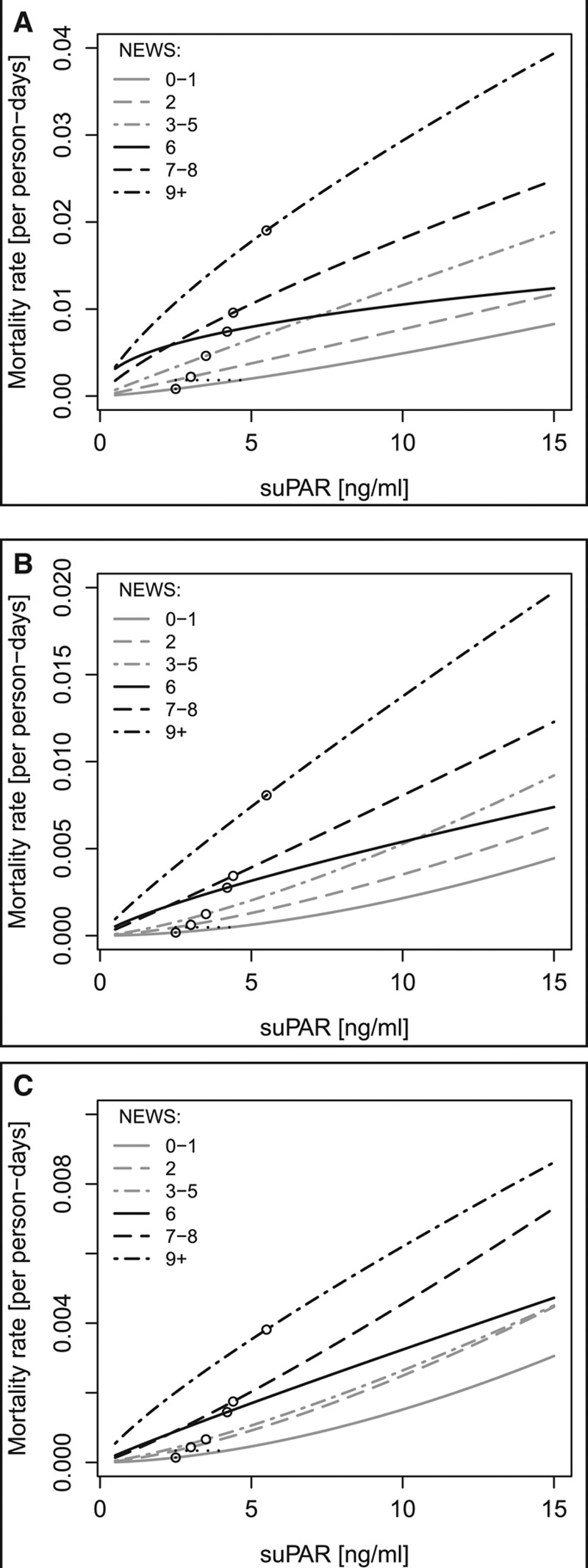
Of 17,312 included patients, admission National Early Warning Score was available for 16,244 (93.8%). During follow-up, 587 patients (3.4%) died in-hospital, 859 (5.0%) within 30 days, and 1,367 (7.9%) within 90 days. High soluble urokinase plasminogen activator receptor was significantly associated with in-hospital-, 30-day-, and 90-day mortality within all National Early Warning Score groups, in particular in patients with a low National Early Warning Score; for 30-day mortality, mortality rate ratios ranged from 3.45 (95% CI, 2.91-4.10) for patients with National Early Warning Score 0-1, to 1.86 (95% CI, 1.47-2.34) for patients with National Early Warning Score greater than or equal to 9 for every doubling in soluble urokinase plasminogen activator receptor (log2-transformed). Combining National Early Warning Score, age, and sex with soluble urokinase plasminogen activator receptor improved prediction of in-hospital-, 30-day-, and 90-day mortality, increasing the area under the curve (95% CI) for 30-day mortality from 0.86 (0.85-0.87) to 0.90 (0.89-0.91), p value of less than 0.0001, with a negative predictive value of 99.0%.

CONCLUSIONS

The addition of soluble urokinase plasminogen activator receptor to National Early Warning Score significantly improved risk prediction of both low- and high-risk acute medical patients. Patients with low National Early Warning Score but elevated soluble urokinase plasminogen activator receptor had mortality risks comparable to that of patients with higher National Early Warning Score.

摘要

目的

可溶性尿激酶型纤溶酶原激活物受体是与危重病、疾病进展和死亡风险相关的预后生物标志物。我们旨在评估可溶性尿激酶型纤溶酶原激活物受体是否为急性内科患者临床监测风险的生命体征为基础的评分(国家早期预警评分)提供了额外的预后价值。

设计

连续收治的急性内科患者的基于登记的观察性队列研究。

地点

丹麦哥本哈根大学阿马格尔和维德霍夫医院的急性内科病房。

患者

2013 年 11 月 18 日至 2015 年 9 月 30 日期间收治的急性内科患者。

干预措施

无。

测量和主要结果

在纳入的 17312 例患者中,16244 例(93.8%)可获得入院时的国家早期预警评分。在随访期间,587 例(3.4%)患者住院期间死亡,859 例(5.0%)在 30 天内死亡,1367 例(7.9%)在 90 天内死亡。可溶性尿激酶型纤溶酶原激活物受体水平高与所有国家早期预警评分组的院内、30 天和 90 天死亡率显著相关,尤其是在国家早期预警评分较低的患者中;对于 30 天死亡率,死亡率比值范围从国家早期预警评分 0-1 的患者为 3.45(95%可信区间,2.91-4.10)到国家早期预警评分大于或等于 9 的患者为 1.86(95%可信区间,1.47-2.34)可溶性尿激酶型纤溶酶原激活物受体每增加一倍(对数 2 转换)。将国家早期预警评分、年龄和性别与可溶性尿激酶型纤溶酶原激活物受体结合,可改善院内、30 天和 90 天死亡率的预测,将 30 天死亡率的曲线下面积(95%可信区间)从 0.86(0.85-0.87)提高到 0.90(0.89-0.91),p 值小于 0.0001,阴性预测值为 99.0%。

结论

可溶性尿激酶型纤溶酶原激活物受体与国家早期预警评分相结合,显著改善了低危和高危急性内科患者的风险预测。国家早期预警评分较低但可溶性尿激酶型纤溶酶原激活物受体升高的患者的死亡率风险与国家早期预警评分较高的患者相当。
https://cdn.ncbi.nlm.nih.gov/pmc/blobs/8c8a/6250248/5ad6b6a2cdaf/ccm-46-01961-g003.jpg

相似文献

1
Combining National Early Warning Score With Soluble Urokinase Plasminogen Activator Receptor (suPAR) Improves Risk Prediction in Acute Medical Patients: A Registry-Based Cohort Study.将国家早期预警评分与可溶性尿激酶型纤溶酶原激活物受体 (suPAR) 相结合可改善急性内科患者的风险预测:一项基于登记的队列研究。
Crit Care Med. 2018 Dec;46(12):1961-1968. doi: 10.1097/CCM.0000000000003441.
2
Soluble urokinase plasminogen activator receptor (suPAR) in acute care: a strong marker of disease presence and severity, readmission and mortality. A retrospective cohort study.急性护理中的可溶性尿激酶型纤溶酶原激活物受体(suPAR):疾病存在、严重程度、再入院和死亡率的有力标志物。一项回顾性队列研究。
Emerg Med J. 2016 Nov;33(11):769-775. doi: 10.1136/emermed-2015-205444. Epub 2016 Sep 2.
3
suPAR is associated with risk of future acute surgery and post-operative mortality in acutely admitted medical patients.可溶性尿激酶型纤溶酶原激活物受体(suPAR)与急性入院的内科患者未来急性手术风险和术后死亡率相关。
Scand J Trauma Resusc Emerg Med. 2018 Feb 1;26(1):11. doi: 10.1186/s13049-018-0478-1.
4
The predictive value of soluble urokinase plasminogen activator receptor (SuPAR) regarding 90-day mortality and 12-month neurological outcome in critically ill patients after out-of-hospital cardiac arrest. Data from the prospective FINNRESUSCI study.可溶性尿激酶型纤溶酶原激活物受体(SuPAR)对院外心脏骤停后重症患者90天死亡率和12个月神经功能结局的预测价值。来自前瞻性FINNRESUSCI研究的数据。
Resuscitation. 2014 Nov;85(11):1562-7. doi: 10.1016/j.resuscitation.2014.08.017. Epub 2014 Sep 2.
5
Soluble urokinase plasminogen activator receptor predicts mortality in exacerbated COPD.可溶性尿激酶型纤溶酶原激活物受体可预测 COPD 恶化患者的死亡率。
Respir Res. 2018 May 21;19(1):97. doi: 10.1186/s12931-018-0803-2.
6
Soluble urokinase plasminogen activator receptor associates with higher risk, advanced disease severity as well as inflammation, and might serve as a prognostic biomarker of severe acute pancreatitis.可溶性尿激酶型纤溶酶原激活物受体与更高的风险、更严重的疾病严重程度以及炎症有关,可能是重症急性胰腺炎的预后生物标志物。
J Clin Lab Anal. 2020 Mar;34(3):e23097. doi: 10.1002/jcla.23097. Epub 2019 Nov 27.
7
Soluble urokinase plasminogen activator receptor (suPAR) is lower in disease-free patients but cannot rule out incident disease in patients with suspected cancer.可溶性尿激酶型纤溶酶原激活物受体 (suPAR) 在无疾病患者中较低,但不能排除疑似癌症患者的疾病发生。
Clin Biochem. 2020 Oct;84:31-37. doi: 10.1016/j.clinbiochem.2020.06.001. Epub 2020 Jun 3.
8
Soluble Urokinase Plasminogen Activator Receptor (suPAR) as an Added Predictor to Existing Preoperative Risk Assessments.可溶性尿激酶型纤溶酶原激活物受体(suPAR)作为现有术前风险评估的补充预测指标。
World J Surg. 2019 Mar;43(3):780-790. doi: 10.1007/s00268-018-4841-1.
9
Predictive value of soluble urokinase-type plasminogen activator receptor for mortality in patients with suspected myocardial infarction.可溶性尿激酶型纤溶酶原激活物受体对疑似心肌梗死患者死亡率的预测价值。
Clin Res Cardiol. 2019 Dec;108(12):1386-1393. doi: 10.1007/s00392-019-01475-1. Epub 2019 Apr 16.
10
Soluble urokinase plasminogen activator receptor levels are predictive of COVID-19 severity in Afro-Caribbean patients.可溶性尿激酶型纤溶酶原激活物受体水平可预测 Afro-Caribbean 患者 COVID-19 的严重程度。
Biomark Med. 2022 Feb;16(3):169-177. doi: 10.2217/bmm-2021-0669. Epub 2022 Jan 27.

引用本文的文献

1
Soluble Urokinase Plasminogen Activator Receptor: A Promising Biomarker for Mortality Prediction Among Critical ED Patients.可溶性尿激酶型纤溶酶原激活物受体:急诊重症患者死亡率预测的一种有前景的生物标志物。
Int J Mol Sci. 2025 Feb 13;26(4):1609. doi: 10.3390/ijms26041609.
2
Soluble Urokinase Plasminogen Activator Receptor: A Useful Marker for Predicting Mortality in COVID-19 Patients.可溶性尿激酶型纤溶酶原激活物受体:预测COVID-19患者死亡率的有用标志物。
Cureus. 2024 Nov 25;16(11):e74438. doi: 10.7759/cureus.74438. eCollection 2024 Nov.
3
qSOFA combined with suPAR for early risk detection and guidance of antibiotic treatment in the emergency department: a randomized controlled trial.

本文引用的文献

1
Prevalence and overlap of Disease Management Program diseases in older hospitalized patients.老年住院患者疾病管理项目疾病的患病率及重叠情况。
Eur J Ageing. 2017 Feb 4;14(3):283-293. doi: 10.1007/s10433-017-0412-9. eCollection 2017 Sep.
2
The intriguing role of soluble urokinase receptor in inflammatory diseases.可溶性尿激酶受体在炎症性疾病中的作用令人关注。
Crit Rev Clin Lab Sci. 2017 Mar;54(2):117-133. doi: 10.1080/10408363.2016.1269310. Epub 2017 Jan 13.
3
Soluble urokinase-type plasminogen activator receptor (suPAR) in patients with acute pancreatitis (AP) - Progress in prediction of AP severity.
qSOFA 联合 suPAR 用于急诊科早期风险检测和抗生素治疗指导:一项随机对照试验。
Crit Care. 2024 Feb 6;28(1):42. doi: 10.1186/s13054-024-04825-2.
4
Role of Formyl Peptide Receptors and β-Arrestin-1 in suPAR Signal Transduction in Mouse Podocytes: Interactions with αVβ3-Integrin.形式肽受体和β-arrestin-1 在小鼠足细胞中 suPAR 信号转导中的作用:与 αVβ3-整合素的相互作用。
Cells. 2024 Jan 17;13(2):172. doi: 10.3390/cells13020172.
5
Risk Prediction Models for Hospital Mortality in General Medical Patients: A Systematic Review.普通内科患者医院死亡率的风险预测模型:一项系统评价。
Am J Med Open. 2023 Dec;10. doi: 10.1016/j.ajmo.2023.100044. Epub 2023 Jun 5.
6
Soluble urokinase Plasminogen Activator Receptor (suPAR) mediates the effect of a lower education level on adverse outcomes in patients with coronary artery disease.可溶性尿激酶型纤溶酶原激活物受体(suPAR)介导受教育程度较低对冠心病患者不良结局的影响。
Eur J Prev Cardiol. 2024 Mar 27;31(5):521-528. doi: 10.1093/eurjpc/zwad311.
7
Predicting acute clinical deterioration with interpretable machine learning to support emergency care decision making.利用可解释机器学习预测急性临床恶化,以支持急救护理决策。
Sci Rep. 2023 Aug 21;13(1):13563. doi: 10.1038/s41598-023-40661-0.
8
The predictive value of modified soluble urokinase plasminogen activator receptor (suPAR) with National Early Warning Score (NEWS) for mortality in emergency elderly patients in Japan: a prospective pilot study.改良可溶性尿激酶型纤溶酶原激活物受体(suPAR)联合国家早期预警评分(NEWS)对日本老年急诊患者死亡率的预测价值:一项前瞻性试点研究。
Acute Med Surg. 2023 May 30;10(1):e840. doi: 10.1002/ams2.840. eCollection 2023 Jan-Dec.
9
Challenges facing the clinical adoption of a new prognostic biomarker: a case study.新型预后生物标志物临床应用面临的挑战:一项案例研究
Biosocieties. 2023 Jan 21:1-23. doi: 10.1057/s41292-022-00296-2.
10
Soluble urokinase plasminogen activator receptor (suPAR) in the emergency department: An update.急诊科中的可溶性尿激酶型纤溶酶原激活物受体(suPAR):最新进展
Caspian J Intern Med. 2022 Fall;13(4):650-665. doi: 10.22088/cjim.13.4.650.
急性胰腺炎(AP)患者中的可溶性尿激酶型纤溶酶原激活物受体(suPAR)——AP严重程度预测的进展
Pancreatology. 2017 Jan-Feb;17(1):24-29. doi: 10.1016/j.pan.2016.11.005. Epub 2016 Nov 25.
4
Soluble urokinase plasminogen activator receptor (suPAR) in acute care: a strong marker of disease presence and severity, readmission and mortality. A retrospective cohort study.急性护理中的可溶性尿激酶型纤溶酶原激活物受体(suPAR):疾病存在、严重程度、再入院和死亡率的有力标志物。一项回顾性队列研究。
Emerg Med J. 2016 Nov;33(11):769-775. doi: 10.1136/emermed-2015-205444. Epub 2016 Sep 2.
5
Predictive value of the National Early Warning Score-Lactate for mortality and the need for critical care among general emergency department patients.国家早期预警评分-乳酸水平对普通急诊科患者死亡率及重症监护需求的预测价值。
J Crit Care. 2016 Dec;36:60-68. doi: 10.1016/j.jcrc.2016.06.016. Epub 2016 Jun 29.
6
A single-centre cohort study of National Early Warning Score (NEWS) and near patient testing in acute medical admissions.一项关于国家早期预警评分(NEWS)和急性内科就诊时床边检测的单中心队列研究。
Eur J Intern Med. 2016 Nov;35:78-82. doi: 10.1016/j.ejim.2016.06.014. Epub 2016 Jun 23.
7
Combined use of the National Early Warning Score and D-dimer levels to predict 30-day and 365-day mortality in medical patients.联合使用国家早期预警评分和D-二聚体水平预测内科患者30天和365天死亡率。
Resuscitation. 2016 Sep;106:49-52. doi: 10.1016/j.resuscitation.2016.06.012. Epub 2016 Jun 20.
8
Temperature measurements with a temporal scanner: systematic review and meta-analysis.使用颞部扫描仪进行体温测量:系统评价与荟萃分析。
BMJ Open. 2016 Mar 31;6(3):e009509. doi: 10.1136/bmjopen-2015-009509.
9
Soluble Urokinase Receptor and Chronic Kidney Disease.可溶性尿激酶受体与慢性肾脏病
N Engl J Med. 2015 Nov 12;373(20):1916-25. doi: 10.1056/NEJMoa1506362. Epub 2015 Nov 5.
10
suPAR as a biomarker for risk of readmission and mortality in the acute medical setting.可溶性尿激酶型纤溶酶原激活物受体作为急性内科环境中再入院风险和死亡率的生物标志物。
Dan Med J. 2015 Oct;62(10):A5146.