Department of Epidemiology, Brown University School of Public Health, Box G-S121-2, 121 South Main Street, Providence, RI 02912 USA.
Department of Behavioral and Social Sciences, Brown University School of Public Health, Box G-S121-4, 121 South Main Street, Providence, RI 02912 USA.
Drug Alcohol Depend. 2018 Nov 1;192:125-128. doi: 10.1016/j.drugalcdep.2018.07.038. Epub 2018 Sep 13.
HIV-positive persons who use stimulants such as methamphetamine experience greater difficulties in navigating the HIV care continuum. In the era of HIV treatment as prevention (TasP), little is known about the prevalence and correlates of success along the HIV care continuum among people who use stimulants.
San Francisco, California USA METHODS: Cross-sectional study that enrolled 129 HIV-positive men who have sex with men (MSM) from 2013 through 2017 who had biologically confirmed, recent methamphetamine use. Multivariable logistic regressions were built to identify correlates of success across the HIV care continuum.
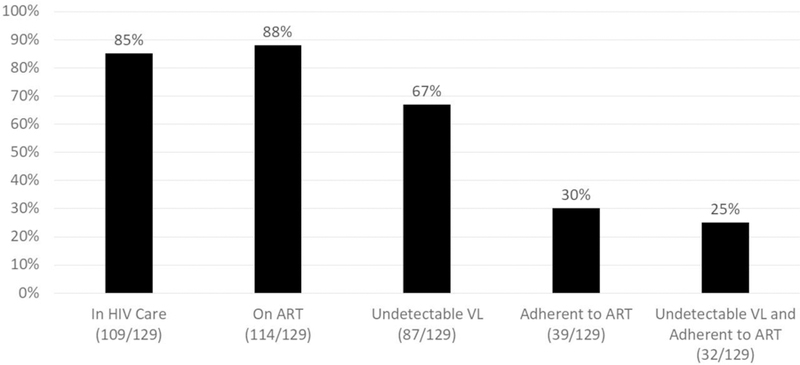
Although two-thirds (87/129) of participants had undetectable HIV viral load (<40 copies/mL), only one-in-four (32/129) reported taking at least 90% of their antiretroviral therapy (ART). Those who were homeless in the past year (adjusted odds ratio [aOR] = 0.20; 95% CI = 0.06-0.65) had 80% lower odds of being undetectable and adherent to ART. Substance use disorder treatment was associated with 77% lower odds of being engaged in HIV care (aOR = 0.23; 95% CI = 0.06-0.84) but also close to 3-fold greater odds of being adherent to ART (aOR = 2.91; 95% CI = 1.12-7.60).
Despite the fact that many HIV-positive, methamphetamine-using MSM are able to achieve undetectable viral load in this sample, difficulties with ART adherence threaten to undermine the clinical and public health benefits of TasP. Expanded efforts to boost the effectiveness of TasP in this population should focus on meeting the unique needs of homeless individuals, optimizing ART adherence, and facilitating the integration of HIV care with substance use disorder treatment.
感染 HIV 的人若使用安非他命等兴奋剂,在接受 HIV 护理时会遇到更多困难。在 HIV 治疗即预防(TasP)时代,人们对使用兴奋剂的人在 HIV 护理连续体中取得成功的比例及其相关因素知之甚少。
美国加利福尼亚州旧金山
这是一项横断面研究,2013 年至 2017 年间共纳入 129 名 HIV 阳性男男性行为者(MSM),他们最近有过生物确证的安非他命使用史。建立多变量逻辑回归模型,以确定 HIV 护理连续体中取得成功的相关因素。
尽管有三分之二(87/129)的参与者 HIV 病毒载量未检出(<40 拷贝/ml),但仅有四分之一(32/129)的人报告至少服用了 90%的抗逆转录病毒治疗药物(ART)。过去一年无家可归者(调整后的优势比[aOR] = 0.20;95%置信区间[CI] = 0.06-0.65),HIV 未检出和 ART 依从性的可能性降低 80%。药物使用障碍治疗与 HIV 护理参与的可能性降低 77%相关(aOR = 0.23;95% CI = 0.06-0.84),但与 ART 依从性增加近 3 倍相关(aOR = 2.91;95% CI = 1.12-7.60)。
尽管在这个样本中,许多 HIV 阳性、使用安非他命的 MSM 能够实现病毒载量未检出,但抗逆转录病毒治疗药物的依从性困难可能会破坏 TasP 的临床和公共卫生效益。扩大努力以提高该人群中 TasP 的效果应侧重于满足无家可归者的独特需求,优化 ART 依从性,并促进 HIV 护理与药物使用障碍治疗的整合。