Department of Reproduction and Genetics, the First Affiliated Hospital of Kunming Medical University, No. 295 Xi Chang road, Kunming, 650032, China.
Department of Neurology, the First Affiliated Hospital of Kunming Medical University, Kunming, 650032, China.
Reprod Biol Endocrinol. 2018 Sep 24;16(1):92. doi: 10.1186/s12958-018-0410-6.
Evidence suggests that subclinical hypothyroidism (SCH) and thyroid autoimmunity (TAI) are associated with adverse pregnancy outcomes. This systematic review and meta-analysis was conducted to determine whether levothyroxine (LT4) supplementation would improve pregnancy outcomes among infertile women with SCH and/or TAI who underwent in vitro fertilization (IVF) or intracytoplastic sperm injection (ICSI).
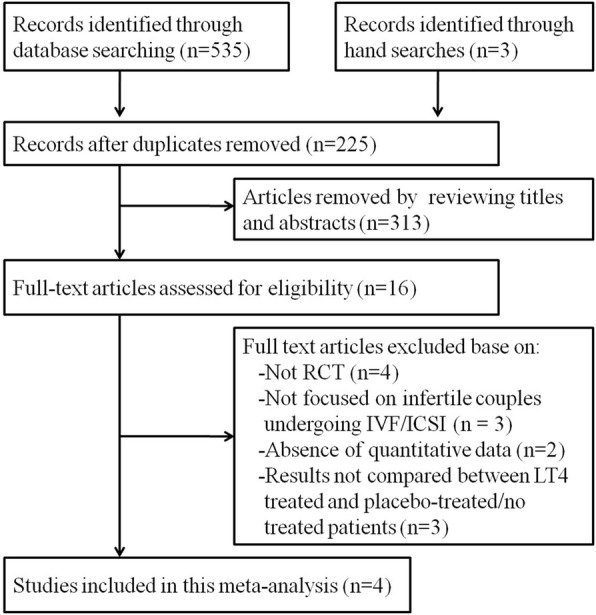
We searched databases of PubMed, EMBASE, Web of Science, Cochrane Controlled Trials Register databases, and Clinicaltrials.gov up to April 2018 to identify eligible studies. Studies that focused on the treatment effect of LT4 on pregnancy outcomes of women with SCH and/or TAI who underwent IVF/ICSI were included in the data synthesis. We only included randomized controlled trials (RCTs). Relative risks (RR) and 95% confidence intervals (CI) were calculated using a random-effects model to assess the results of pregnancy outcomes, including clinical pregnancy rate, miscarriage rate, live birth rate and preterm birth rate.
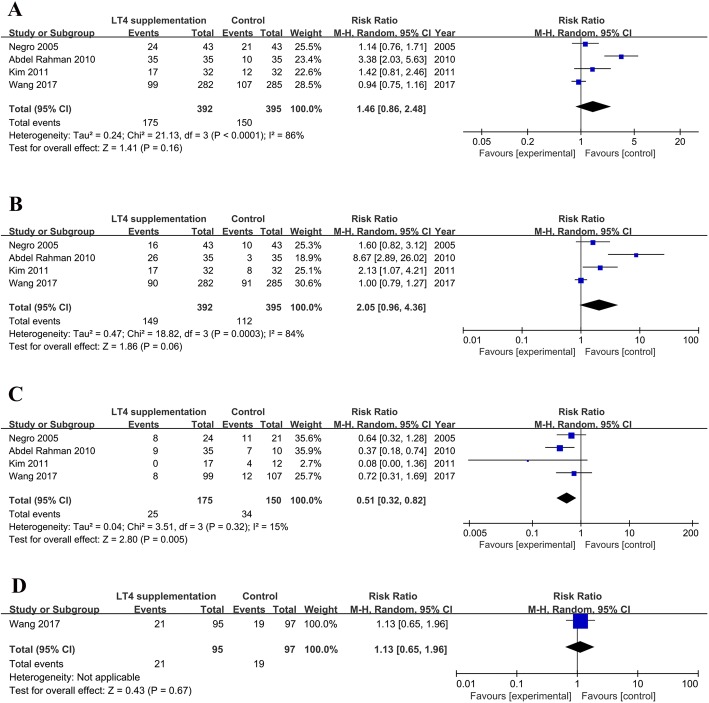
Four published RCTs including 787 infertile couples undergoing IVF/ICSI were included in this meta-analysis. Notably, the study observed no significant associations of LT4 treatment with the clinical pregnancy rate (RR = 1.46, 95% CI: 0.86-2.48), live birth rate (RR = 2.05, 95% CI: 0.96-4.36), or preterm birth rate (RR = 1.13, 95% CI: 0.65-1.96). However, patients receiving LT4 supplementation had a significantly decreased miscarriage rate relative to those receiving a placebo or no treatment (RR = 0.51, 95% CI: 0.32-0.82). A further sub-group analysis showed that LT4 supplementation did not improve the miscarriage rates among patients with SCH (RR = 0.67, 95% CI: 0.39-1.15) or TAI (RR = 0.28, 95% CI: 0.07-1.06).
Given its potential to reduce the miscarriage rate, LT4 supplementation is recommended for infertile women with SCH and/or TAI who are undergoing IVF/ICSI. However, additional population-based RCTs are needed to confirm this recommendation.
有证据表明,亚临床甲状腺功能减退症(SCH)和甲状腺自身免疫(TAI)与不良妊娠结局有关。本系统评价和荟萃分析旨在确定甲状腺素(LT4)补充是否会改善接受体外受精(IVF)或胞浆内精子注射(ICSI)的 SCH 和/或 TAI 不孕妇女的妊娠结局。
我们检索了 PubMed、EMBASE、Web of Science、Cochrane 对照试验注册数据库和 Clinicaltrials.gov 数据库,截至 2018 年 4 月,以确定合格的研究。纳入的研究集中于 LT4 对接受 IVF/ICSI 的 SCH 和/或 TAI 妇女妊娠结局的治疗效果。我们只纳入了随机对照试验(RCT)。使用随机效应模型计算相对风险(RR)和 95%置信区间(CI),以评估妊娠结局的结果,包括临床妊娠率、流产率、活产率和早产率。
本荟萃分析纳入了 4 项已发表的 RCT,共 787 对接受 IVF/ICSI 的不孕夫妇。值得注意的是,LT4 治疗与临床妊娠率(RR=1.46,95%CI:0.86-2.48)、活产率(RR=2.05,95%CI:0.96-4.36)或早产率(RR=1.13,95%CI:0.65-1.96)均无显著相关性。然而,与接受安慰剂或未治疗的患者相比,接受 LT4 补充的患者流产率显著降低(RR=0.51,95%CI:0.32-0.82)。进一步的亚组分析表明,LT4 补充并不能提高 SCH 患者(RR=0.67,95%CI:0.39-1.15)或 TAI 患者(RR=0.28,95%CI:0.07-1.06)的流产率。
鉴于 LT4 补充可能降低流产率,建议对接受 IVF/ICSI 的 SCH 和/或 TAI 不孕妇女进行 LT4 补充。然而,需要更多基于人群的 RCT 来证实这一建议。