Department of Experimental Therapeutics.
Department of Leukemia.
Blood. 2018 Nov 22;132(21):2249-2259. doi: 10.1182/blood-2018-06-860593. Epub 2018 Sep 25.
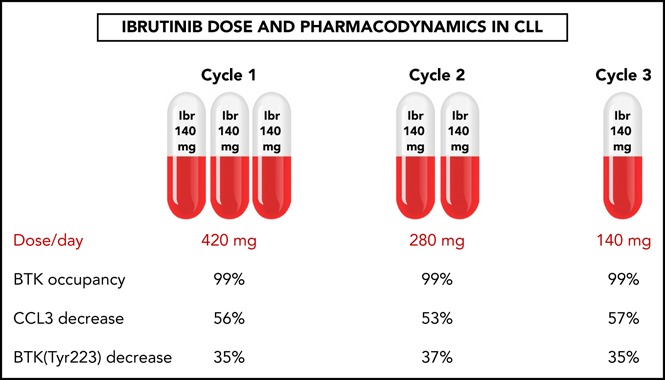
Ibrutinib is highly efficacious and used at 420 mg/d for treatment of chronic lymphocytic leukemia (CLL). We previously demonstrated a decline in Bruton's tyrosine kinase (BTK) protein levels in CLL cells after 1 cycle of ibrutinib, suggesting ibrutinib dose could be lowered after the first cycle without loss of biological effect. To test this postulate, a pilot study (NCT02801578) was designed to systematically reduce ibrutinib dosing within the same patient with CLL over the course of three 28-day cycles. After an initial cycle of 420 mg/d, the dose was reduced to 280 mg/d in cycle 2, and then to 140 mg/d in cycle 3. Eleven patients began study treatment, and 9 completed the 3 cycles. Plasma and intracellular pharmacokinetics (PK), BTK occupancy, and pharmacodynamic (PD) response at different doses of ibrutinib were compared. Plasma and intracellular levels of ibrutinib were dose-dependent, and even the lowest dose was sufficient to occupy, on average, more than 95% of BTK protein. In concert, BTK downstream signaling inhibition was maintained with 140 mg/d ibrutinib in cycle 3, and there were comparable reductions in total and phospho-BTK (Tyr223) protein levels across 3 cycles. Reductions of plasma chemokine CCL3 and CCL4 levels, considered to be biomarkers of ibrutinib response, were similar during the 3 cycles. These PK/PD data demonstrate that after 1 cycle of ibrutinib at the standard 420 mg/d dose, the dose can be reduced without losing biological activity. Clinical efficacy of lower doses needs to be systematically evaluated. Such dose reductions would lower drug cost, lessen untoward toxicity, and facilitate rationale-based combinations. This trial was registered at www.clinicaltrials.gov as #NCT02801578.
伊布替尼在治疗慢性淋巴细胞白血病(CLL)时的有效剂量为 420mg/d。我们之前的研究表明,伊布替尼治疗一个疗程后,CLL 细胞中的布鲁顿酪氨酸激酶(BTK)蛋白水平下降,提示在第一个疗程后可以降低伊布替尼的剂量,而不会失去生物学效应。为了验证这一假设,我们设计了一项试点研究(NCT02801578),旨在在同一 CLL 患者的三个 28 天疗程中系统地降低伊布替尼的剂量。在初始的 420mg/d 周期后,在第 2 周期将剂量减少至 280mg/d,在第 3 周期减少至 140mg/d。11 名患者开始接受研究治疗,其中 9 名完成了 3 个周期的治疗。比较了不同剂量伊布替尼的血浆和细胞内药代动力学(PK)、BTK 占有率和药效学(PD)反应。伊布替尼的血浆和细胞内水平与剂量呈依赖性,即使是最低剂量也足以平均占据超过 95%的 BTK 蛋白。同时,第 3 周期伊布替尼 140mg/d 时 BTK 下游信号抑制保持不变,并且 3 个周期中总 BTK 和磷酸化 BTK(Tyr223)蛋白水平均有类似的降低。3 个周期中,作为伊布替尼反应生物标志物的血浆趋化因子 CCL3 和 CCL4 水平的降低也相似。这些 PK/PD 数据表明,在标准剂量 420mg/d 的伊布替尼治疗 1 个周期后,可以在不丧失生物活性的情况下降低剂量。需要系统评估较低剂量的临床疗效。这种剂量降低将降低药物成本,减少不良毒性,并促进基于合理的联合治疗。本试验在 www.clinicaltrials.gov 上注册为 #NCT02801578。