de Wijkerslooth Elisabeth M L, van den Boom Anne Loes, Wijnhoven Bas P L
Department of Surgery, Suite Na-2117, Erasmus MC - University Medical Centre, PO Box 2040, 3000 CA, Rotterdam, The Netherlands.
World J Surg. 2019 Feb;43(2):439-446. doi: 10.1007/s00268-018-4806-4.
Data on common practice in the management of patients with complex appendicitis are scarce, especially for the adult population. Variation in the definition of complex appendicitis, indications for and the type of prolonged antibiotic prophylaxis have not been well studied yet. The aim of this study was to document current practice of the classification and postoperative management of complex appendicitis on an international level.
An online survey was dispersed among practicing surgeons and surgical residents. Survey questions pertained to the definition of a complex appendicitis, indications for antibiotic prophylaxis after appendectomy, the duration, route of administration and antibiotic agents used.
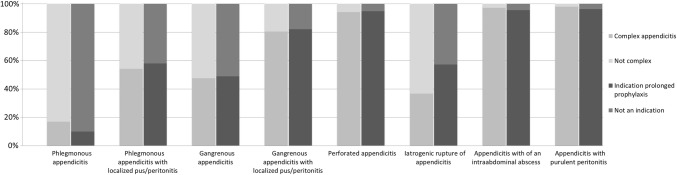
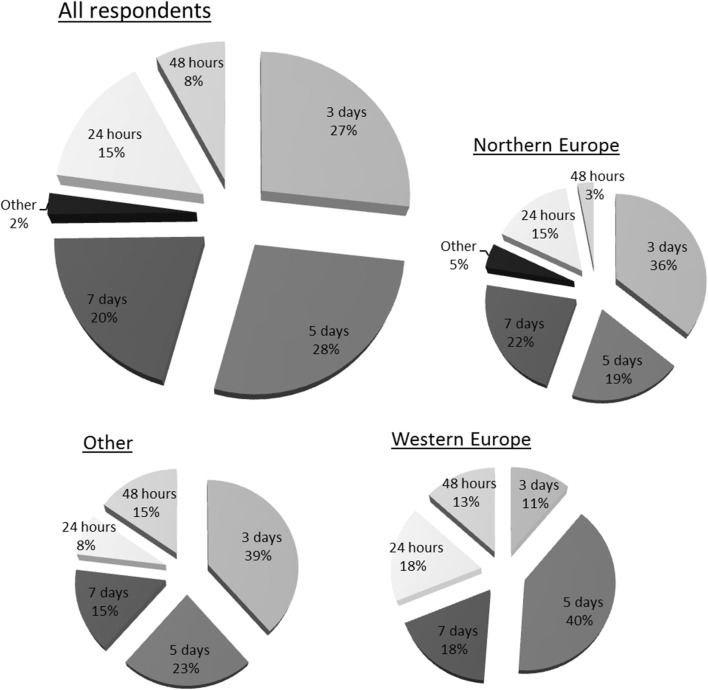
A total of 137 survey responses were eligible for analysis. Most respondents were from Northern or Western Europe and were specialized in gastrointestinal surgery. Opinion varied substantially regarding the management of appendicitis, in particular for phlegmonous appendicitis with localized pus, gangrenous appendicitis and iatrogenic rupture of appendicitis. The most common duration of postoperative antibiotics was evenly spread over <3, 3, 5 and 7 days. Whereas most respondents indicated a combined intravenous and oral route of administration was common practice, 28% answered a completely intravenous route of administration was standard practice.
Current practice patterns in the classification and postoperative management of complex appendicitis are highly variable.
关于复杂性阑尾炎患者管理的常见做法的数据稀缺,尤其是在成年人群中。复杂性阑尾炎的定义、延长抗生素预防的指征和类型的差异尚未得到充分研究。本研究的目的是记录国际上复杂性阑尾炎分类和术后管理的当前做法。
一项在线调查在执业外科医生和外科住院医师中展开。调查问题涉及复杂性阑尾炎的定义、阑尾切除术后抗生素预防的指征、持续时间、给药途径和使用的抗生素药物。
共有137份调查问卷回复符合分析条件。大多数受访者来自北欧或西欧,专长于胃肠外科。关于阑尾炎的管理,特别是对于伴有局限性脓液的蜂窝织炎性阑尾炎、坏疽性阑尾炎和医源性阑尾炎破裂,意见差异很大。术后抗生素最常见的持续时间平均分布在<3天、3天、5天和7天。虽然大多数受访者表示联合静脉和口服给药途径是常见做法,但28%的受访者回答完全静脉给药途径是标准做法。
复杂性阑尾炎分类和术后管理的当前实践模式高度可变。