Department of Human Movement Sciences, Faculty of Behavioral and Movement Sciences, Vrije Universiteit Amsterdam, Van der Boechorststraat 9, 1081 BT, Amsterdam, The Netherlands.
Department of Research and Development, Heliomare Rehabilitation, Wijk aan Zee, the Netherlands.
J Neuroeng Rehabil. 2018 Sep 5;15(Suppl 1):76. doi: 10.1186/s12984-018-0404-9.
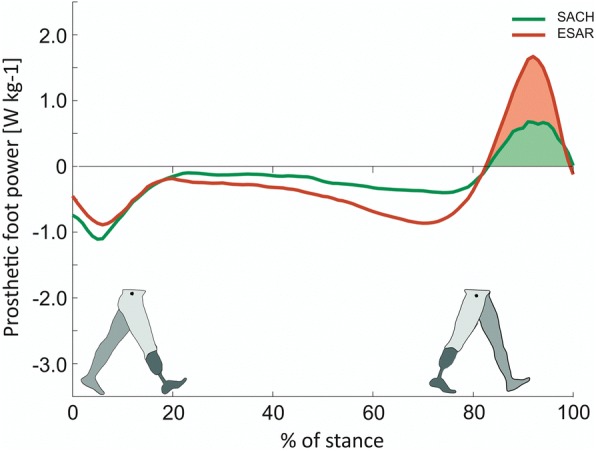
Energy storing and return (ESAR) feet are generally preferred over solid ankle cushioned heel (SACH) feet by people with a lower limb amputation. While ESAR feet have been shown to have only limited effect on gait economy, other functional benefits should account for this preference. A simple biomechanical model suggests that enhanced gait stability and gait symmetry could prove to explain part of the difference in the subjective preference between both feet.
To investigate whether increased push-off power with ESAR feet increases center of mass velocity at push off and enhance intact step length and step length symmetry while preserving the margin of stability during walking in people with a transtibial prosthesis.
Fifteen people with a unilateral transtibial amputation walked with their prescribed ESAR foot and a SACH foot at a fixed walking speed (1.2 m/s) over a level walkway while kinematic and kinetic data were collected. Push-off work generated by the foot, center of mass velocity, step length, step length symmetry and backward margin of stability were assessed and compared between feet.
Push-off work was significantly higher when using the ESAR foot compared to the SACH foot. Simultaneously, center of mass velocity at toe-off was higher with ESAR compared to SACH, and intact step length and step length symmetry increased without reducing the backward margin of stability.
Compared to the SACH foot, the ESAR foot allowed an improvement of step length symmetry while preserving the backward margin of stability at community ambulation speed. These benefits may possibly contribute to the subjective preference for ESAR feet in people with a lower limb amputation.
下肢截肢者通常更喜欢储能和回弹(ESAR)脚,而不是实心踝垫脚跟(SACH)脚。虽然 ESAR 脚对步态经济性的影响有限,但其他功能益处应该可以解释这种偏好。一个简单的生物力学模型表明,增强的步态稳定性和步态对称性可以证明在解释两种脚之间的主观偏好差异方面起到一定作用。
研究在胫骨假肢佩戴者行走时,ESAR 脚是否可以增加推离力,从而增加质心速度,增加完整步长和步长对称性,同时保持行走时的稳定性边界。
15 名单侧胫骨截肢者以固定行走速度(1.2m/s)在水平步道上分别使用其规定的 ESAR 脚和 SACH 脚行走,同时收集运动学和动力学数据。评估并比较了双脚的推离功、质心速度、步长、步长对称性和向后稳定性边界。
与 SACH 脚相比,ESAR 脚的推离功显著更高。同时,ESAR 脚的质心速度在脚趾离地时更高,完整步长和步长对称性增加,而不减少向后稳定性边界。
与 SACH 脚相比,ESAR 脚允许在社区步行速度下提高步长对称性,同时保持向后稳定性边界。这些益处可能有助于解释下肢截肢者对 ESAR 脚的主观偏好。