Zhang Yun, Mao Xiang, Lin Ruhui, Li Zuanfang, Lin Jing
Clinical Medicine Department, Fujian Health College, Fuzhou, China.
Acupuncture Department, Chongqing Traditional Chinese Medicine Hospital, Chongqing, China.
Acupunct Med. 2018 Dec;36(6):401-407. doi: 10.1136/acupmed-2016-011353. Epub 2018 Sep 26.
The hippocampus is vulnerable to severe damage after cerebral ischaemia-reperfusion (I/R) injury. This study aimed to explore the effect of electroacupuncture (EA) on cognitive impairment and its relationship with Caneurotoxicity in a rat model of I/R injury induced by middle cerebral artery occlusion (MCAO).
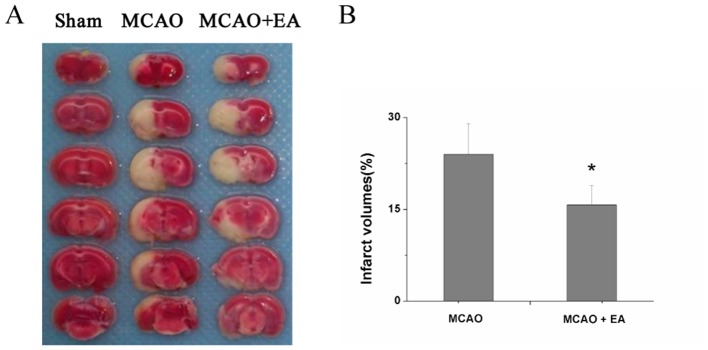
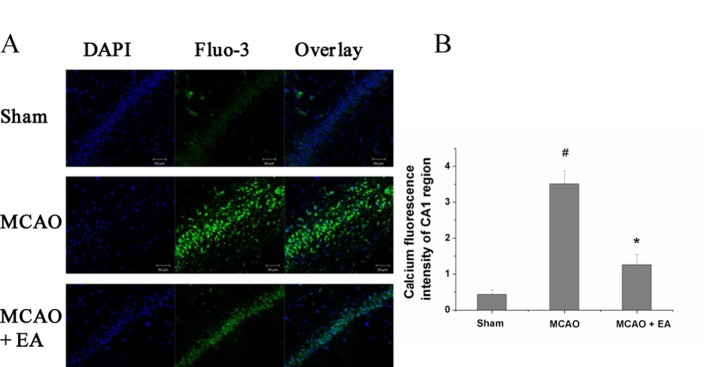
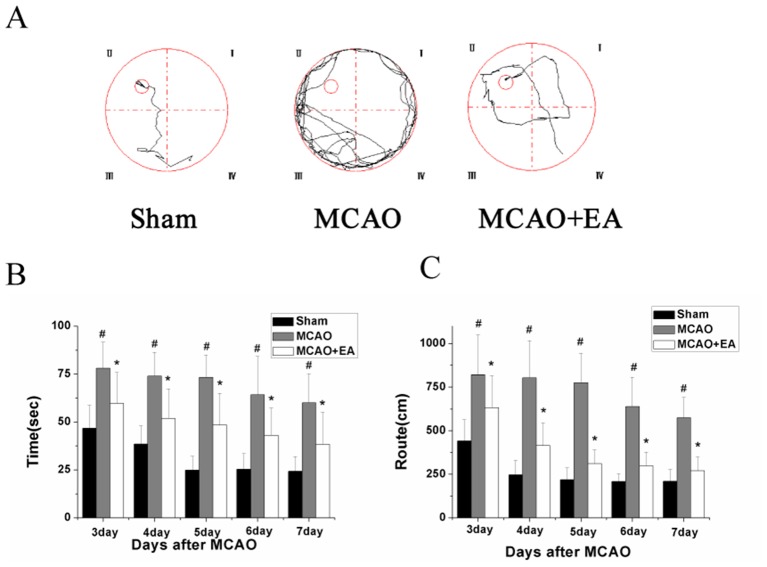
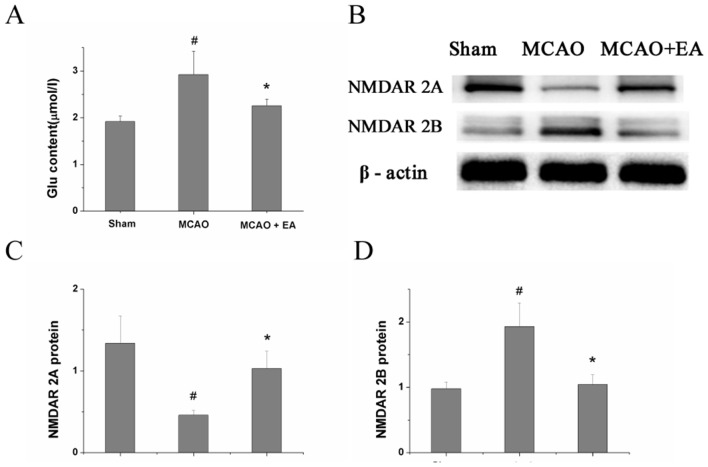
60 adult male Sprague-Dawley rats were randomly divided into three groups: control (sham surgery) group, untreated MCAO group and EA-treated MCAO+EA group. Rats in the MCAO and MCAO+EA groups underwent modelling of poststroke cognitive impairment by MCAO surgery. EA was performed for 30 min daily at GV20 and GV24 (1-20 Hz) for 1 week. The Morris water maze experiment was used to assess cognitive function. 2,3,5-triphenyl tetrazolium chloride staining was used to measure infarct volume. The intracellular Cacontent in the Cornu Ammonis (CA)1 area of the hippocampus was assessed by laser confocal scanning microscopy. ELISA was performed to evaluate the concentration of glutamate (Glu) in the hippocampus, and the protein expression of two Glu receptors (N-methyl-D-aspartic acid receptor (NMDAR) 2A and NMDAR2B) were analysed by Western blotting.
Compared with the untreated MCAO group, EA effectively ameliorated cognitive impairment (P=0.01) and shrunk the infarct volume (P=0.032). The content of intracellular Ca, Glu and NMDAR2B in the hippocampus was significantly raised by MCAO (P=0.031-0.043), while EA abrogated these effects. NMDAR2A was decreased by MCAO (P=0.015) but increased by EA (P=0.033).
EA had a beneficial effect on cognitive repair after cerebral I/R, and its mechanism of action likely involves a reduction of Cainflux via inhibition of Glu neurotoxicity and downregulation of NMDAR2B expression.
海马体在脑缺血再灌注(I/R)损伤后易受到严重损害。本研究旨在探讨电针(EA)对大脑中动脉闭塞(MCAO)诱导的I/R损伤大鼠模型认知功能障碍的影响及其与钙神经毒性的关系。
将60只成年雄性Sprague-Dawley大鼠随机分为三组:对照组(假手术)、未治疗的MCAO组和电针治疗的MCAO+EA组。MCAO组和MCAO+EA组大鼠通过MCAO手术建立中风后认知功能障碍模型。每天在GV20和GV24(1-20Hz)进行30分钟电针治疗,持续1周。采用Morris水迷宫实验评估认知功能。用2,3,5-三苯基氯化四氮唑染色测量梗死体积。通过激光共聚焦扫描显微镜评估海马体角回(CA)1区细胞内钙含量。采用酶联免疫吸附测定法(ELISA)评估海马体中谷氨酸(Glu)浓度,并通过蛋白质印迹法分析两种Glu受体(N-甲基-D-天冬氨酸受体(NMDAR)2A和NMDAR2B)的蛋白表达。
与未治疗的MCAO组相比,电针有效改善了认知功能障碍(P=0.01)并缩小了梗死体积(P=0.032)。MCAO使海马体中细胞内钙、Glu和NMDAR2B含量显著升高(P=0.031-0.043),而电针消除了这些影响。MCAO使NMDAR2A降低(P=0.015),但电针使其升高(P=0.033)。
电针对脑I/R后的认知修复具有有益作用,其作用机制可能涉及通过抑制Glu神经毒性和下调NMDAR2B表达来减少钙内流。