Department of Microbial Sciences, University of Surrey, Guildford, United Kingdom.
Centre for Research in Agricultural Genomics, Barcelona, Catalonia, Spain.
J Virol. 2018 Nov 12;92(23). doi: 10.1128/JVI.01374-18. Print 2018 Dec 1.
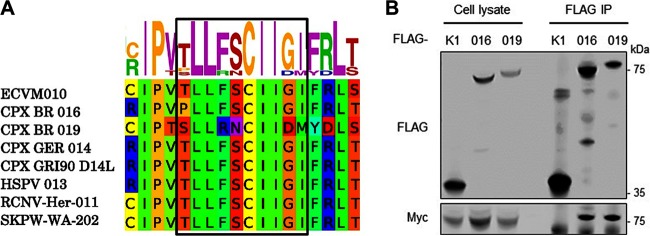
Ankyrin repeat (ANK) domains are among the most abundant motifs in eukaryotic proteins. ANK proteins are rare amongst viruses, with the exception of poxviruses, which presumably acquired them from the host via horizontal gene transfer. The architecture of poxvirus ANK proteins is, however, different from that of their cellular counterparts, and this precludes a direct acquisition event. Here we combine bioinformatics analysis and quantitative proteomics to discover a new class of viral ANK proteins with a domain organization that relates to cellular ANK proteins. These noncanonical viral ANK proteins, termed ANK/BC, interact with host Cullin-2 via a C-terminal BC box resembling that of cellular Cullin-2 substrate adaptors such as the von Hippel-Lindau protein. Mutagenesis of the BC box-like sequence abrogates binding to Cullin-2, whereas fusion of this motif to an ANK-only protein confers Cullin-2 association. We demonstrated that these viral ANK/BC proteins are potent immunomodulatory proteins suppressing the activation of the proinflammatory transcription factors NF-κB and interferon (IFN)-responsive factor 3 (IRF-3) and the production of cytokines and chemokines, including interferon, and that association with Cullin-2 is required for optimal inhibitory activity. ANK/BC proteins exist in several orthopoxviruses and cluster into 2 closely related orthologue groups in a phylogenetic lineage that is separate from that of canonical ANK/F-box proteins. Given the existence of cellular proteins with similar architecture, viral ANK/BC proteins may be closely related to the original ANK gene acquired by an ancestral orthopoxvirus. These findings uncover a novel viral strategy to antagonize innate immunity and shed light on the origin of the poxviral ANK protein family. Viruses encode multiple proteins aimed at modulating cellular homeostasis and antagonizing the host antiviral response. Most of these genes were originally acquired from the host and subsequently adapted to benefit the virus. ANK proteins are common in eukaryotes but are unusual amongst viruses, with the exception of poxviruses, where they represent one of the largest protein families. We report here the existence of a new class of viral ANK proteins, termed ANK/BC, that provide new insights into the origin of poxvirus ANK proteins. ANK/BC proteins target the host E3 ubiquitin ligase Cullin-2 via a C-terminal BC box domain and are potent suppressors of the production of inflammatory cytokines, including interferon. The existence of cellular ANK proteins whose architecture is similar suggests the acquisition of a host ANK/BC gene by an ancestral orthopoxvirus and its subsequent duplication and adaptation to widen the repertoire of immune evasion strategies.
锚蛋白重复(ANK)结构域是真核蛋白中最丰富的结构域之一。ANK 蛋白在病毒中很少见,除了痘病毒,痘病毒可能通过水平基因转移从宿主中获得它们。然而,痘病毒 ANK 蛋白的结构与它们的细胞对应物不同,这排除了直接获得的可能性。在这里,我们结合生物信息学分析和定量蛋白质组学发现了一类具有与细胞 ANK 蛋白相关结构域组织的新型病毒 ANK 蛋白。这些非典型的病毒 ANK/BC 蛋白通过类似于细胞 Cullin-2 底物适配器(如 von Hippel-Lindau 蛋白)的 C 端 BC 盒与宿主 Cullin-2 相互作用。BC 盒样序列的突变会破坏与 Cullin-2 的结合,而将该基序融合到仅具有 ANK 的蛋白上则赋予 Cullin-2 结合。我们证明这些病毒 ANK/BC 蛋白是有效的免疫调节蛋白,可抑制促炎转录因子 NF-κB 和干扰素(IFN)反应因子 3(IRF-3)的激活以及细胞因子和趋化因子(包括干扰素)的产生,并且与 Cullin-2 的关联是最佳抑制活性所必需的。ANK/BC 蛋白存在于几种正痘病毒中,并在与经典 ANK/F-box 蛋白不同的系统发育谱系中聚类为 2 个密切相关的直系同源物群。鉴于存在具有类似结构的细胞蛋白,病毒 ANK/BC 蛋白可能与祖先正痘病毒获得的原始 ANK 基因密切相关。这些发现揭示了一种新型病毒拮抗先天免疫的策略,并阐明了痘病毒 ANK 蛋白家族的起源。病毒编码多种旨在调节细胞内稳态和拮抗宿主抗病毒反应的蛋白质。这些基因中的大多数最初是从宿主中获得的,随后被适应以有利于病毒。ANK 蛋白在真核生物中很常见,但在病毒中却很少见,除了痘病毒,痘病毒是最大的蛋白质家族之一。我们在这里报告了一类新型的病毒 ANK 蛋白,称为 ANK/BC,这为痘病毒 ANK 蛋白的起源提供了新的见解。ANK/BC 蛋白通过 C 端 BC 盒结构域靶向宿主 E3 泛素连接酶 Cullin-2,并强烈抑制包括干扰素在内的炎症细胞因子的产生。存在结构相似的细胞 ANK 蛋白表明,祖先正痘病毒获得了宿主的 ANK/BC 基因,随后进行了复制和适应,以扩大免疫逃避策略的范围。