Department of Microbiology, Institute for Immunology and Immunological Disease, Brain Korea 21 PLUS Project for Medical Science, Yonsei University College of Medicine, Seoul, South Korea.
Advanced Radiation Technology Institute, Korea Atomic Energy Research Institute, Jeongeup, South Korea.
Sci Rep. 2018 Sep 26;8(1):14411. doi: 10.1038/s41598-018-32799-z.
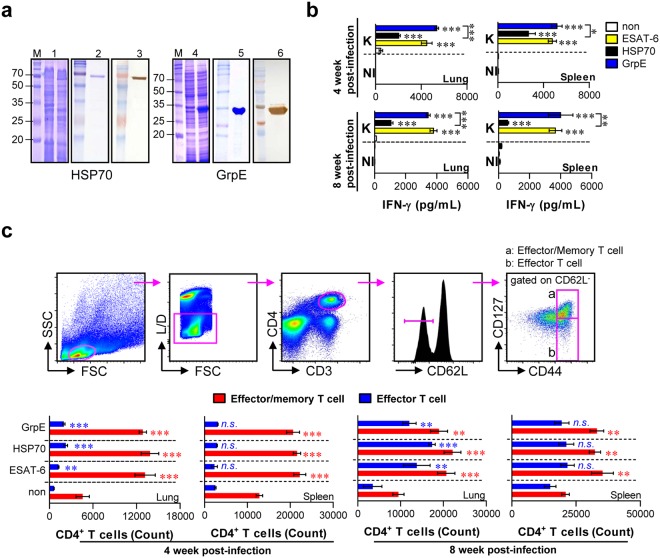
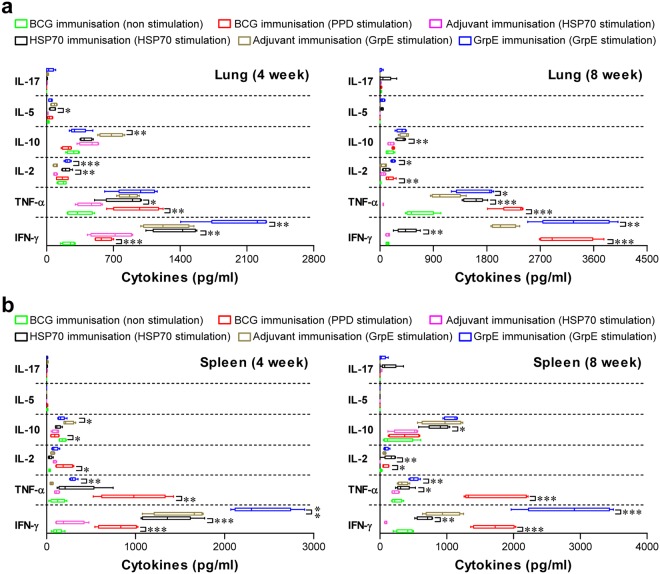
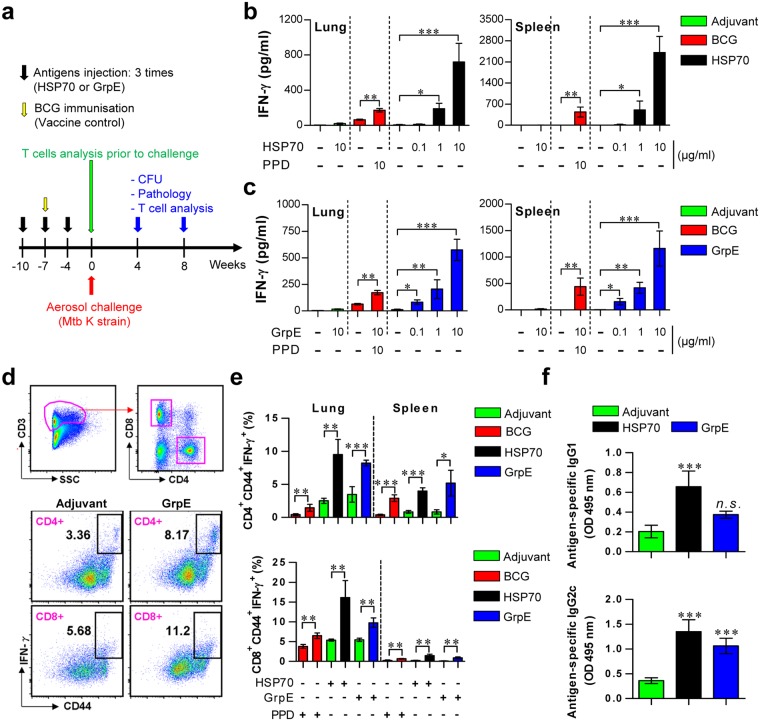
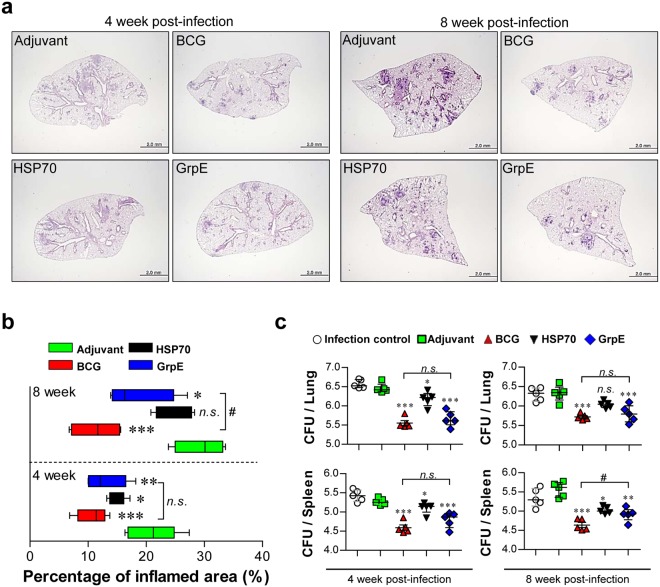
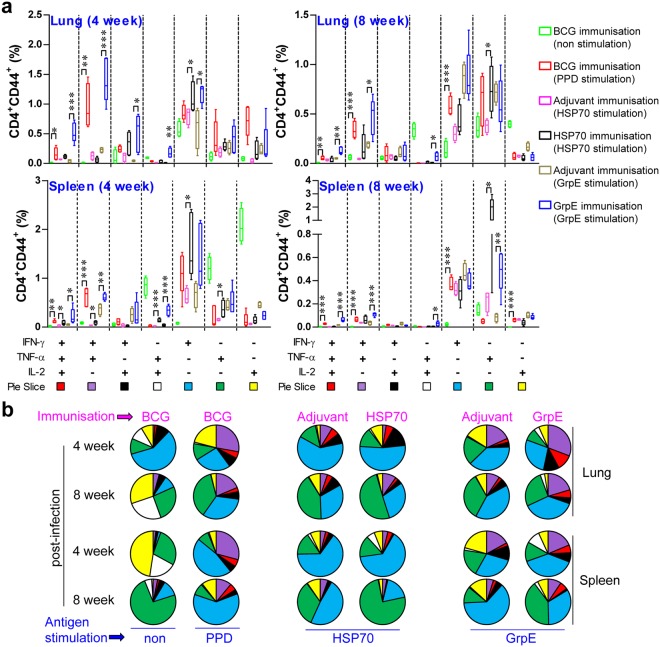
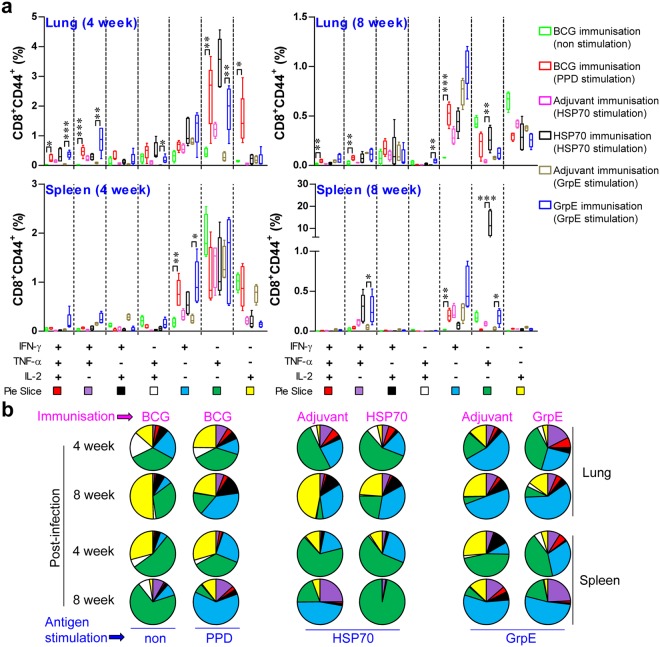
Antigens (Ags) in Mycobacterium tuberculosis (Mtb) that are constitutively expressed, overexpressed during growth, essential for survival, and highly conserved may be good vaccine targets if they induce the appropriate anti-Mtb Th1 immune response. In this context, stress response-related antigens of Mtb might serve as attractive targets for vaccine development as they are rapidly expressed and are up-regulated during Mtb infection in vivo. Our group recently demonstrated that GrpE, encoded by rv0351 as a cofactor of heat-shock protein 70 (HSP70) in the DnaK operon, is a novel immune activator that interacts with DCs to generate Th1-biased memory T cells in an antigen-specific manner. In this study, GrpE was evaluated as a subunit vaccine in comparison with the well-known HSP70 against the hyper-virulent Mtb Beijing K-strain. Both HSP70- and GrpE-specific effector/memory T cells expanded to a similar extent as those stimulated with ESAT-6 in the lung and spleen of Mtb-infected mice, but GrpE only produced a similar level of IFN-γ to that produced by ESAT-6 stimulation during the late phase and the early phase of Mtb K infection, indicating that GrpE is highly-well recognised by the host immune system as a T cell antigen. Mice immunised with the GrpE subunit vaccine displayed enhanced antigen-specific IFN-γ and serum IgG2c responses along with antigen-specific effector/memory T cell expansion in the lungs. In addition, GrpE-immunisation markedly induced multifunctional Th1-type CD4 T cells co-expressing IFN-γ, TNF-α, and IL-2 in the lungs of Mtb K-infected mice, whereas HSP70-immunisation induced mixed Th1/Th2 immune responses. GrpE-immunisation conferred a more significant protective effect than that of HSP70-immunisation in terms of bacterial reduction and improved inflammation, accompanied by the remarkable persistence of GrpE-specific multifunctional CD4 T cells. These results suggest that GrpE is an excellent vaccine antigen component for the development of a multi-antigenic Mtb subunit vaccine by generating Th1-biased memory T cells with multifunctional capacity, and confers durable protection against the highly virulent Mtb K.
结核分枝杆菌(Mycobacterium tuberculosis,Mtb)中持续表达、生长过程中过表达、对生存至关重要且高度保守的抗原如果能够诱导适当的抗 Mtb Th1 免疫应答,则可能成为良好的疫苗靶点。在这种情况下,与 Mtb 感染体内相关的应激反应相关抗原可能成为疫苗开发的有吸引力的靶点,因为它们在体内 Mtb 感染时迅速表达并上调。我们的研究小组最近证明,编码 DnaK 操纵子中热休克蛋白 70(HSP70)辅助因子的 rv0351 基因产物 GrpE 是一种新型免疫激活剂,可与树突状细胞相互作用,以抗原特异性方式产生 Th1 偏向性记忆 T 细胞。在这项研究中,与著名的 HSP70 相比,GrpE 作为亚单位疫苗用于评估针对高毒力 Mtb 北京 K 株的效果。HSP70-和 GrpE-特异性效应/记忆 T 细胞在 Mtb 感染小鼠的肺和脾中扩增到与 ESAT-6 刺激相同的程度,但 GrpE 仅在 Mtb K 感染的晚期和早期阶段产生与 ESAT-6 刺激相当的 IFN-γ水平,表明 GrpE 被宿主免疫系统高度识别为 T 细胞抗原。用 GrpE 亚单位疫苗免疫的小鼠在肺部显示出增强的抗原特异性 IFN-γ和血清 IgG2c 反应,以及抗原特异性效应/记忆 T 细胞的扩增。此外,GrpE 免疫在 Mtb K 感染小鼠的肺部显著诱导共表达 IFN-γ、TNF-α和 IL-2 的多功能 Th1 型 CD4 T 细胞,而 HSP70 免疫诱导混合 Th1/Th2 免疫反应。与 HSP70 免疫相比,GrpE 免疫在减少细菌和改善炎症方面具有更显著的保护作用,同时伴随着 GrpE 特异性多功能 CD4 T 细胞的显著持续存在。这些结果表明,GrpE 是一种优秀的疫苗抗原成分,可通过产生具有多功能能力的 Th1 偏向性记忆 T 细胞,为开发多抗原性 Mtb 亚单位疫苗提供了可能,并对高度毒力的 Mtb K 提供持久的保护。