Dank Alexander, Smid Eddy J, Notebaart Richard A
Food Microbiology, Wageningen University & Research, P.O. Box 17, 6700 AA, Wageningen, The Netherlands.
BMC Res Notes. 2018 Sep 27;11(1):682. doi: 10.1186/s13104-018-3788-5.
Saccharomyces cerevisiae is used worldwide for the production of ale-type beers. This yeast is responsible for the production of the characteristic fruity aroma compounds. Esters constitute an important group of aroma active secondary metabolites produced by S. cerevisiae. Previous work suggests that esterase activity, which results in ester degradation, may be the key factor determining the abundance of fruity aroma compounds. Here, we test this hypothesis by deletion of two S. cerevisiae esterases, IAH1 and TIP1, using CRISPR-Cas9 genome editing and by studying the effect of these deletions on esterase activity and extracellular ester pools.
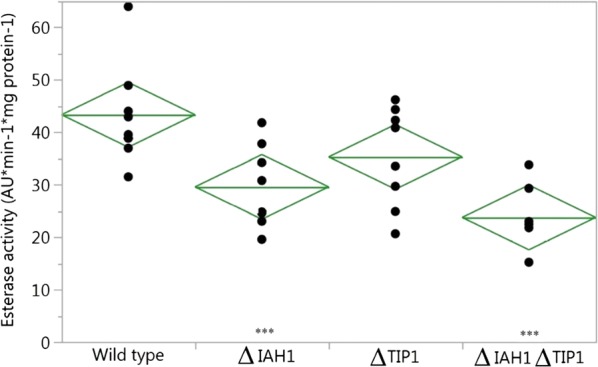
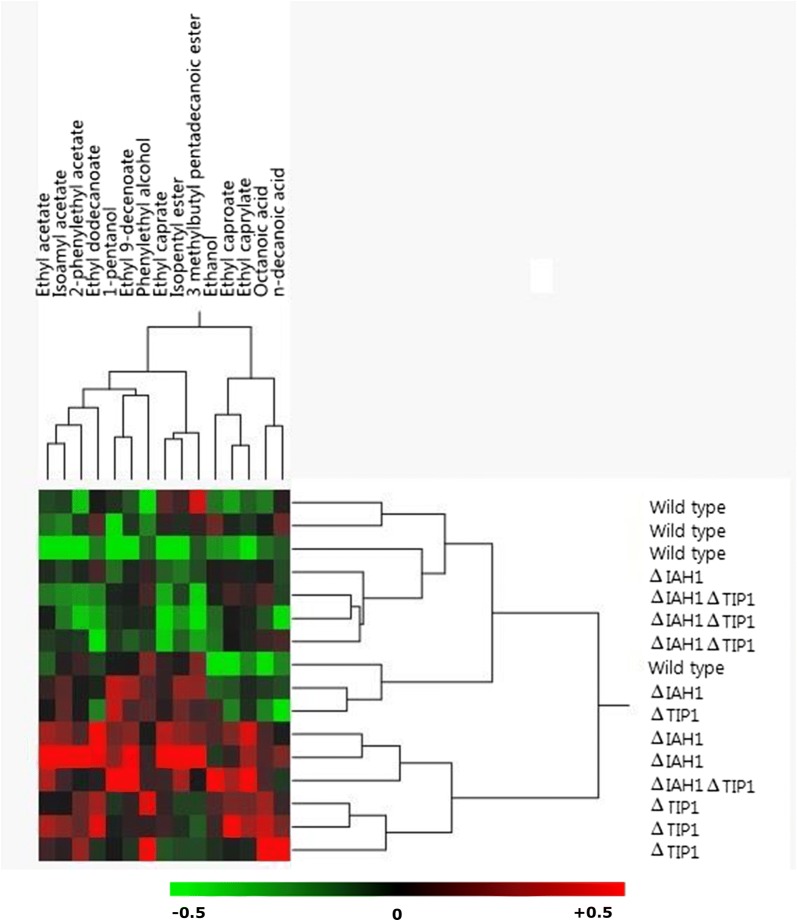
Saccharomyces cerevisiae mutants were constructed lacking esterase IAH1 and/or TIP1 using CRISPR-Cas9 genome editing. Esterase activity using 5-(6)-carboxyfluorescein diacetate (cFDA) as substrate was found to be significantly lower for ΔIAH1 and ΔIAH1ΔTIP1 mutants compared to wild type (WT) activity (P < 0.05 and P < 0.001, respectively). As expected, we observed an increase in relative abundance of acetate and ethyl esters and an increase in ethyl esters in ΔIAH1 and ΔTIP1, respectively. Interestingly, the double gene disruption mutant ΔIAH1ΔTIP1 showed an aroma profile comparable to WT levels, suggesting the existence and activation of a complex regulatory mechanism to compensate multiple genomic alterations in aroma metabolism.
酿酒酵母在全球范围内用于生产艾尔型啤酒。这种酵母负责产生具有特征性的水果香气化合物。酯类是酿酒酵母产生的一类重要的具有香气活性的次生代谢产物。先前的研究表明,导致酯类降解的酯酶活性可能是决定水果香气化合物丰度的关键因素。在此,我们通过使用CRISPR-Cas9基因组编辑技术敲除酿酒酵母的两种酯酶IAH1和TIP1,并研究这些敲除对酯酶活性和细胞外酯库的影响,来验证这一假设。
使用CRISPR-Cas9基因组编辑技术构建了缺乏酯酶IAH1和/或TIP1的酿酒酵母突变体。与野生型(WT)活性相比,以5-(6)-羧基荧光素二乙酸酯(cFDA)为底物时,ΔIAH1和ΔIAH1ΔTIP1突变体的酯酶活性显著降低(分别为P < 0.05和P < 0.001)。正如预期的那样,我们分别在ΔIAH1和ΔTIP1中观察到乙酸酯和乙酯的相对丰度增加以及乙酯增加。有趣的是,双基因破坏突变体ΔIAH1ΔTIP1显示出与WT水平相当的香气特征,这表明存在并激活了一种复杂的调节机制来补偿香气代谢中的多种基因组改变。