Khoyetsyan Aren, Kacimi Rachid, Tsakanova Gohar, Boyajyan Anna, Arakelyan Arsen, Yenari Midori A
Laboratory of Human Genomics and Immunomics, Institute of Molecular Biology NAS RA, Yerevan, Armenia.
Department of Neurology, University of California, USA.
Brain Circ. 2017 Jan-Mar;3(1):14-20. doi: 10.4103/2394-8108.203258. Epub 2017 Mar 29.
Ischemic brain injury induces both functional and structural disarray affecting the blood-brain barrier (BBB) which in return aggravates stroke outcomes. Complement system and its bioactive proteins are important molecular responders to ischemia. C5a protein along with its receptor C5a receptor 1 is a key component of this system with potent pro-inflammatory and chemoattractant properties. The purpose of this study is to investigate the role of C5a protein and its receptor which are believed to participate in the inflammatory response that follows ischemic insult.
To mimic an ischemic event in which C5a may contact brain endothelial cells after injury, we studied oxygen-glucose deprivation (OGD) followed by reperfusion in brain microvascular endothelial cells (b.End. 3) by only added C5a at the time of reperfusion. Cell death and viability were estimated by trypan blue and 3-(4,5-dimethylthiazol-2-yl)-2,5-diphenyltetrazolium bromide assays, respectively. Tight junction protein zonula occluden (ZO-1) levels were analyzed by Western blot analysis, and nitric oxide (NO) was assessed using the Griess reagent.
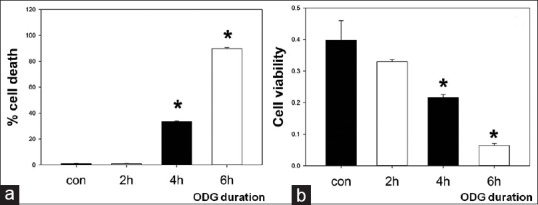
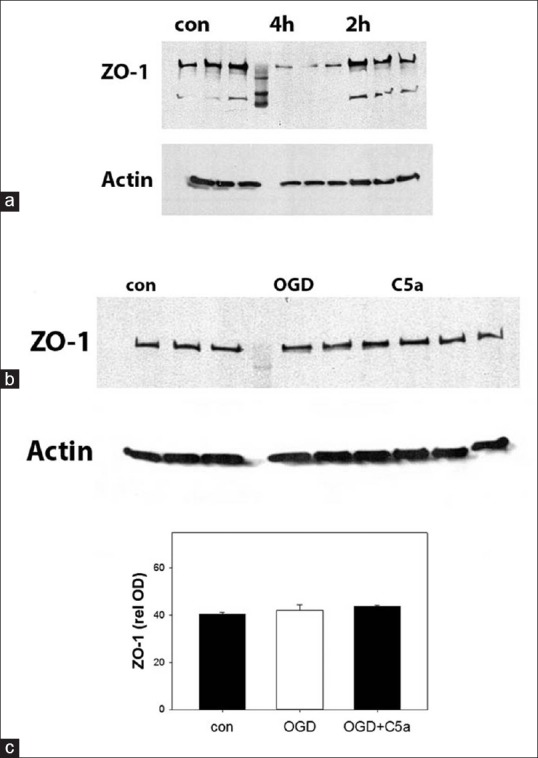
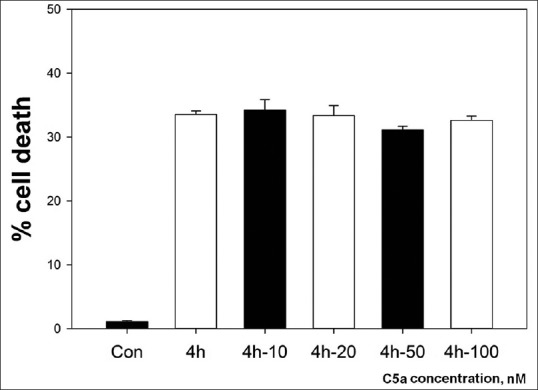
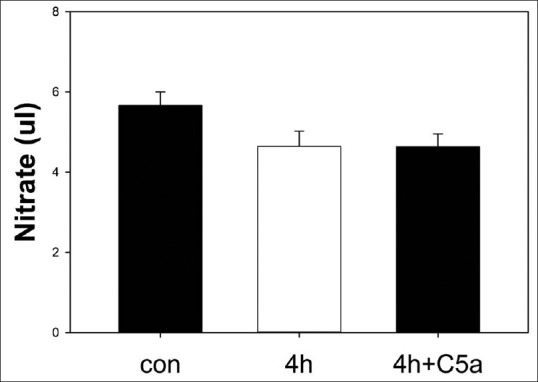
Brain-derived endothelial cell was susceptible to OGD-induced injury in a duration-dependent manner as was the presence of ZO-1 protein. However, the addition of C5a protein had no notable effects even when used at high concentrations up to 100 nM. While OGD led to reduction in ZO-1 protein levels, no change was seen following the addition of C5a. Finally, OGD led unexpectedly to small decreases in NO generation, but this was again unaltered by C5a.
Our study suggests that complement system protein C5a may not have a direct role in the disruption of BBB, following brain ischemia. This is in contrary with previous literature that suggests a possible role of this protein in the inflammatory response to ischemia.
缺血性脑损伤会导致功能和结构紊乱,影响血脑屏障(BBB),而血脑屏障的改变又会加重中风后果。补体系统及其生物活性蛋白是对缺血的重要分子反应者。C5a蛋白及其受体C5a受体1是该系统的关键组成部分,具有强大的促炎和趋化特性。本研究的目的是探讨C5a蛋白及其受体在缺血性损伤后炎症反应中的作用,据信它们参与了这一炎症反应。
为模拟C5a在损伤后可能与脑内皮细胞接触的缺血事件,我们通过在再灌注时仅添加C5a,研究了脑微血管内皮细胞(b.End. 3)中的氧葡萄糖剥夺(OGD)后再灌注情况。分别通过台盼蓝和3-(4,5-二甲基噻唑-2-基)-2,5-二苯基溴化四氮唑试验评估细胞死亡和活力。通过蛋白质免疫印迹分析分析紧密连接蛋白闭合蛋白(ZO-1)水平,并使用格里斯试剂评估一氧化氮(NO)。
脑源性内皮细胞对OGD诱导的损伤呈时间依赖性敏感,ZO-1蛋白的情况也是如此。然而,即使使用高达100 nM的高浓度C5a蛋白,添加后也没有显著影响。虽然OGD导致ZO-1蛋白水平降低,但添加C5a后未见变化。最后,OGD意外导致NO生成略有减少,但这同样不受C5a影响。
我们的研究表明,补体系统蛋白C5a在脑缺血后血脑屏障的破坏中可能没有直接作用。这与先前文献表明该蛋白在缺血炎症反应中可能起作用的观点相反。