Yang Hong-Jie, Liu Xin, Qu Chuan, Shi Shao-Bo, Yang Bo
Department of Cardiology, Renmin Hospital of Wuhan University, Hubei Key Laboratory of Cardiology, Cardiovascular Research Institute, Wuhan 430060, China.
Chronic Dis Transl Med. 2018 Mar 5;4(3):192-198. doi: 10.1016/j.cdtm.2018.01.004. eCollection 2018 Sep.
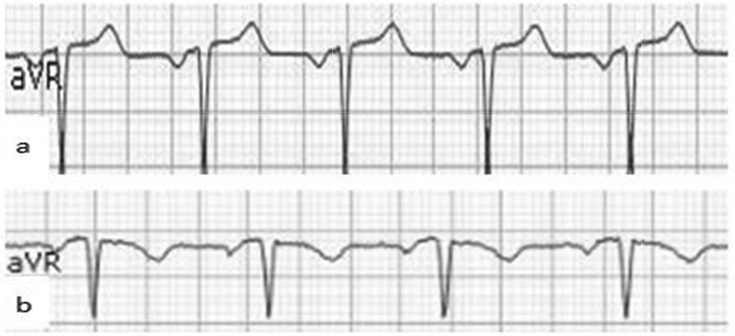
Upright T wave in lead aVR (TaVR) has recently been reported to be associated with cardiovascular death and mortality in general population and in patients with prior cardiovascular disease (CVD). However, the evidence for the predictive ability of TaVR in patients with ischemic stroke (IS) is lacking.
A total of 625 consecutive patients with IS (mean age: 66 ± 12 years; 379 male) were enrolled in this study between January 2013 and December 2014. Patients were divided into upright TaVR (≥0 mV; = 201) and negative TaVR (<0 mV; = 424) groups. All patients were evaluated with respect to clinical features and in-hospital clinical results.
Overall, the prevalence of upright TaVR was 32.2% at baseline. Patients with an upright TaVR were older, had a higher percentage of CVD and hypertension, higher level of MB isoenzyme of creatine kinase (CKMB), faster heart rate, higher rate of QT prolongation > 450 ms, higher rate of negative T in lead II, higher rate of negative T in lead V6, higher rate of ST depression, and longer QTc duration. During the mean follow-up period of 20.0 ± 5.8 months, 29 (4.6%) patients experienced all-cause death and 12 (1.9%) patients experienced cardiovascular death, the primary end point. Concomitantly, 94 (15%) patients experienced recurrence of IS, the secondary end point. After adjusting for clinical covariates, upright TaVR was independently associated with all-cause death [hazard ratio (): 2.88, 95% confidence intervals (): 1.07-7.73], cardiovascular death (: 3.04, 95% : 1.07-8.64), and IS recurrence (: 1.86, 95% : 1.08-3.20).
Upright TaVR in patients with IS is associated with increased mortality and recurrence of IS.
近期有报道称,肢体导联aVR直立T波(TaVR)与普通人群以及既往有心血管疾病(CVD)患者的心血管死亡和全因死亡相关。然而,目前尚缺乏TaVR对缺血性卒中(IS)患者预测能力的相关证据。
2013年1月至2014年12月期间,本研究共纳入625例连续性IS患者(平均年龄:66±12岁;男性379例)。患者被分为TaVR直立组(≥0 mV;n = 201)和TaVR阴性组(<0 mV;n = 424)。对所有患者的临床特征和住院临床结局进行评估。
总体而言,基线时TaVR直立的患病率为32.2%。TaVR直立的患者年龄更大,CVD和高血压的比例更高,肌酸激酶MB同工酶(CKMB)水平更高,心率更快,QT间期延长>450 ms的比例更高,II导联T波倒置的比例更高,V6导联T波倒置的比例更高,ST段压低的比例更高,QTc间期更长。在平均20.0±5.8个月的随访期内,29例(4.6%)患者发生全因死亡,12例(1.9%)患者发生心血管死亡(主要终点)。同时,94例(15%)患者发生IS复发(次要终点)。在对临床协变量进行校正后,TaVR直立与全因死亡独立相关[风险比(HR):2.88,95%置信区间(CI):1.07 - 7.73]、心血管死亡(HR:3.04,95% CI:1.07 - 8.64)以及IS复发(HR:1.86,95% CI:1.08 - 3.20)。
IS患者的TaVR直立与死亡率增加和IS复发相关。