Xia Bingqing, Wang Fengyan, Friedrich-Rust Mireen, Zhou Fang, Zhu Jingyu, Yang Hua, Ruan Weishan, Zeng Zhirong
Department of Gastroenterology, Zhongshan People's Hospital, Zhongshan, Guangdong.
Department of Gastroenterology, The First Affiliated Hospital, Sun Yan-sen University, Guangzhou.
Medicine (Baltimore). 2018 Sep;97(39):e11816. doi: 10.1097/MD.0000000000011816.
Transient elastography (TE) has been validated as an effective noninvasive tool for the assessment of liver fibrosis. The XL probe is a new probe that was initially designed for use in patients with obesity. A meta-analysis was performed to assess the feasibility and efficacy of TE using the XL probe.
In September 2016, we systematically searched the PubMed and Science Direct search engines. The feasibility of TE was evaluated based on the failure rate and the results of the unreliable liver stiffness measurement (LSM). The efficacy of TE was measured using sensitivity, specificity, and summary receiver-operating characteristic as measures/indices assessed in different stages of fibrosis. Heterogeneity was measured using the chi-squared test and the Q-statistic. We used the 95% confidence interval (95% CI) as an effect measure.
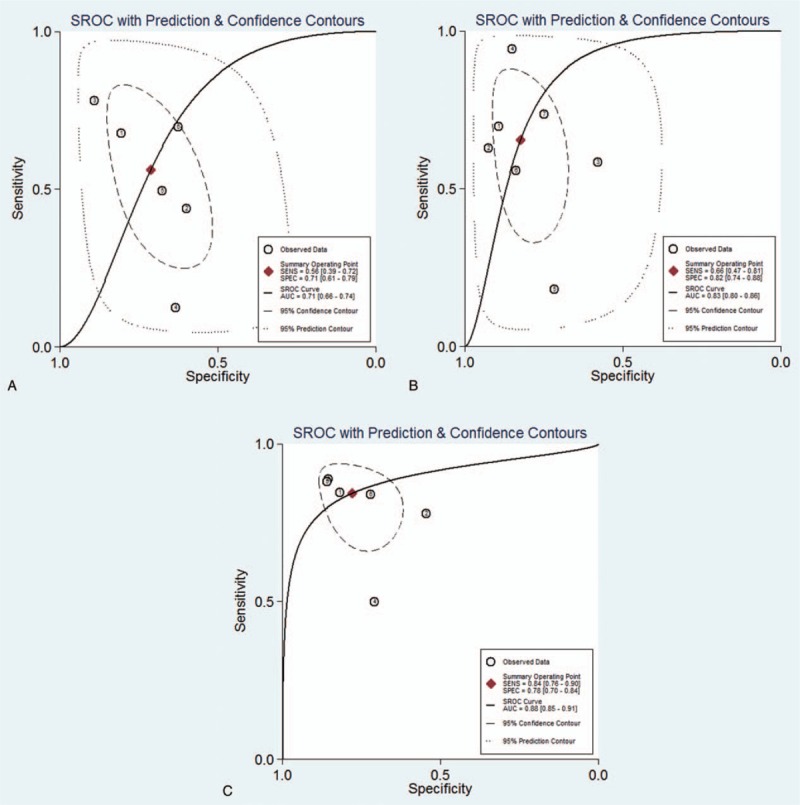
We included 8 studies in the meta-analysis. When the XL was compared to the M probe, the former showed a lower risk of failure rate [relative risk (RR) 0.24, 95% CI 0.14-0.38]. In patients with a body mass index ≥30 kg/m, the XL probe showed a statistically significantly lower risk of failure rate (RR 0.16, 95% CI 0.08-0.32) but no significant improvement (RR 0.76, 95% CI 0.50-1.16) in the unreliable LSM result. In patients showing liver fibrosis stage ≥F2, the XL probe showed a sensitivity of 0.56 (95% CI 0.39-0.72), specificity of 0.71 (95% CI 0.61-0.79), and an area under the curve (AUC) of 0.71. The results observed in patients with liver fibrosis stage F4 were more promising with a sensitivity of 0.84 (95% CI 0.76-0.90), specificity of 0.78 (95% CI 0.70-0.84), and an AUC of 0.88.
TE using the XL probe demonstrates significant diagnostic utility in patients with liver fibrosis and is likely to be more reliable than the M probe in patients with obesity. Large prospective multicenter studies are, however, necessary to establish the new cut-off values to be used for the XL probe in patients with obesity.
瞬时弹性成像(TE)已被证实是评估肝纤维化的一种有效的非侵入性工具。XL探头是一种最初设计用于肥胖患者的新型探头。进行了一项荟萃分析以评估使用XL探头进行TE的可行性和有效性。
2016年9月,我们系统地检索了PubMed和Science Direct搜索引擎。基于失败率和不可靠的肝脏硬度测量(LSM)结果评估TE的可行性。使用敏感性、特异性和汇总受试者工作特征作为在纤维化不同阶段评估的指标来衡量TE的有效性。使用卡方检验和Q统计量测量异质性。我们使用95%置信区间(95%CI)作为效应量度。
我们在荟萃分析中纳入了8项研究。当将XL探头与M探头进行比较时,前者显示出较低的失败率风险[相对风险(RR)0.24,95%CI 0.14 - 0.38]。在体重指数≥30kg/m²的患者中,XL探头显示出统计学上显著较低的失败率风险(RR 0.16,95%CI 0.08 - 0.32),但在不可靠的LSM结果方面没有显著改善(RR 0.76,95%CI 0.50 - 1.16)。在肝纤维化≥F2期的患者中,XL探头的敏感性为0.56(95%CI 0.39 - 0.72),特异性为0.71(95%CI 0.61 - 0.79),曲线下面积(AUC)为0.71。在肝纤维化F4期患者中观察到的结果更有前景,敏感性为0.84(95%CI 0.76 - 0.90),特异性为0.78(95%CI 0.70 - 0.84),AUC为0.88。
使用XL探头的TE在肝纤维化患者中显示出显著的诊断效用,并且在肥胖患者中可能比M探头更可靠。然而,需要进行大型前瞻性多中心研究来确定肥胖患者中用于XL探头的新临界值。