Whiteside Mark A, van Horik Jayden O, Langley Ellis J G, Beardsworth Christine E, Madden Joah R
Centre for Research in Animal Behaviour, University of Exeter, Exeter, Devon, United Kingdom.
Game and Wildlife Conservation Trust, Fordingbridge, Hampshire, United Kingdom.
PeerJ. 2018 Sep 28;6:e5674. doi: 10.7717/peerj.5674. eCollection 2018.
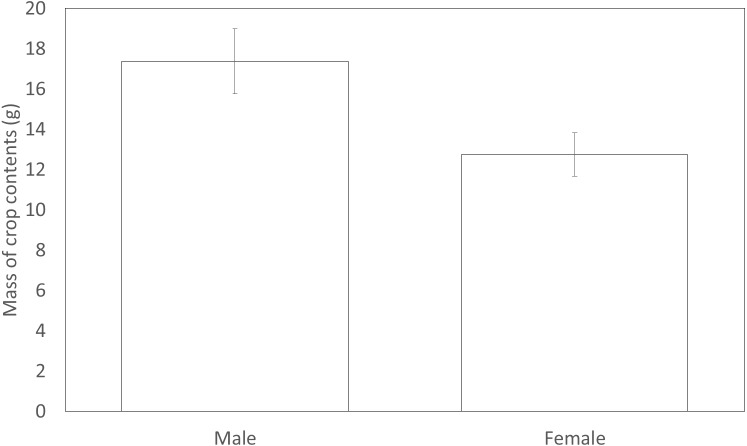
Fine scale sexual segregation outside of the mating season is common in sexually dimorphic and polygamous species, particularly in ungulates. A number of hypotheses predict sexual segregation but these are often contradictory with no agreement as to a common cause, perhaps because they are species specific. We explicitly tested three of these hypotheses which are commonly linked by a dependence on sexual dimorphism for animals which exhibit fine-scale sexual segregation; the Predation Risk Hypothesis, the Forage Selection Hypothesis, and the Activity Budget Hypothesis, in a single system the pheasant, ; a large, sedentary bird that is predominantly terrestrial and therefore analogous to ungulates rather than many avian species which sexually segregate. Over four years we reared 2,400 individually tagged pheasants from one day old and after a period of 8-10 weeks we released them into the wild. We then followed the birds for 7 months, during the period that they sexually segregate, determined their fate and collected behavioural and morphological measures pertinent to the hypotheses. Pheasants are sexually dimorphic during the entire period that they sexually segregate in the wild; males are larger than females in both body size and gut measurements. However, this did not influence predation risk and predation rates (as predicted by the Predation Risk Hypothesis), diet choice (as predicted by the Forage Selection Hypothesis), or the amount of time spent foraging, resting or walking (as predicted by the Activity Budget Hypothesis). We conclude that adult sexual size dimorphism is not responsible for sexual segregation in the pheasant in the wild. Instead, we consider that segregation may be mediated by other, perhaps social, factors. We highlight the importance of studies on a wide range of taxa to help further the knowledge of sexual segregation.
在交配季节之外,精细尺度的性别隔离在两性异形和一夫多妻制物种中很常见,尤其是在有蹄类动物中。有许多假说预测了性别隔离,但这些假说往往相互矛盾,对于共同原因没有达成共识,也许是因为它们是针对特定物种的。我们明确测试了其中三个假说,这些假说通常与表现出精细尺度性别隔离的动物对两性异形的依赖有关;捕食风险假说、觅食选择假说和活动预算假说,在一个单一的系统——雉鸡中进行测试;雉鸡是一种大型、定居的鸟类,主要生活在陆地上,因此类似于有蹄类动物,而不是许多进行性别隔离的鸟类物种。在四年的时间里,我们从一天大开始饲养了2400只单独标记的雉鸡,经过8 - 10周的时间后将它们放归野外。然后我们追踪这些鸟7个月,在它们进行性别隔离的期间,确定它们的命运,并收集与这些假说相关的行为和形态学测量数据。在雉鸡在野外进行性别隔离的整个时期内,它们都是两性异形的;雄性在体型和肠道尺寸上都比雌性大。然而,这并没有影响捕食风险和捕食率(如捕食风险假说所预测的)、饮食选择(如觅食选择假说所预测的),或觅食、休息或行走所花费的时间(如活动预算假说所预测的)。我们得出结论,成年期的性别大小差异并不是野生雉鸡性别隔离的原因。相反,我们认为隔离可能是由其他因素介导的,也许是社会因素。我们强调对广泛分类群进行研究对于增进对性别隔离知识的重要性。