Gasparini Clelia, Dosselli Ryan, Evans Jonathan P
Centre for Evolutionary Biology, School of Biological Sciences (M092) University of Western Australia Crawley 6009 Australia.
CIBER, ARC Centre of Excellence in Plant Energy Biology University of Western Australia Crawley 6009 Australia.
Evol Lett. 2017 May 3;1(1):16-25. doi: 10.1002/evl3.2. eCollection 2017 May.
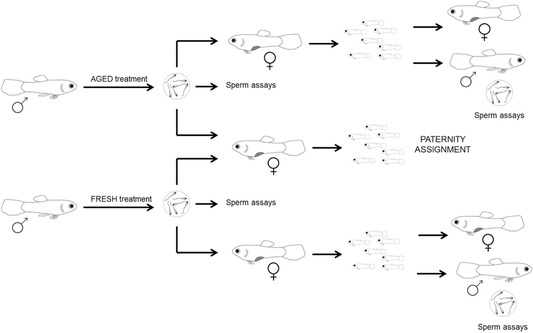
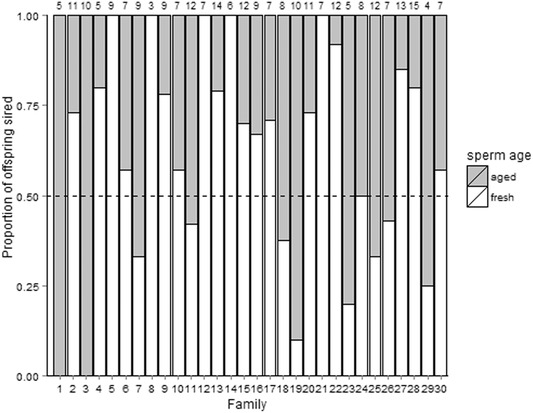
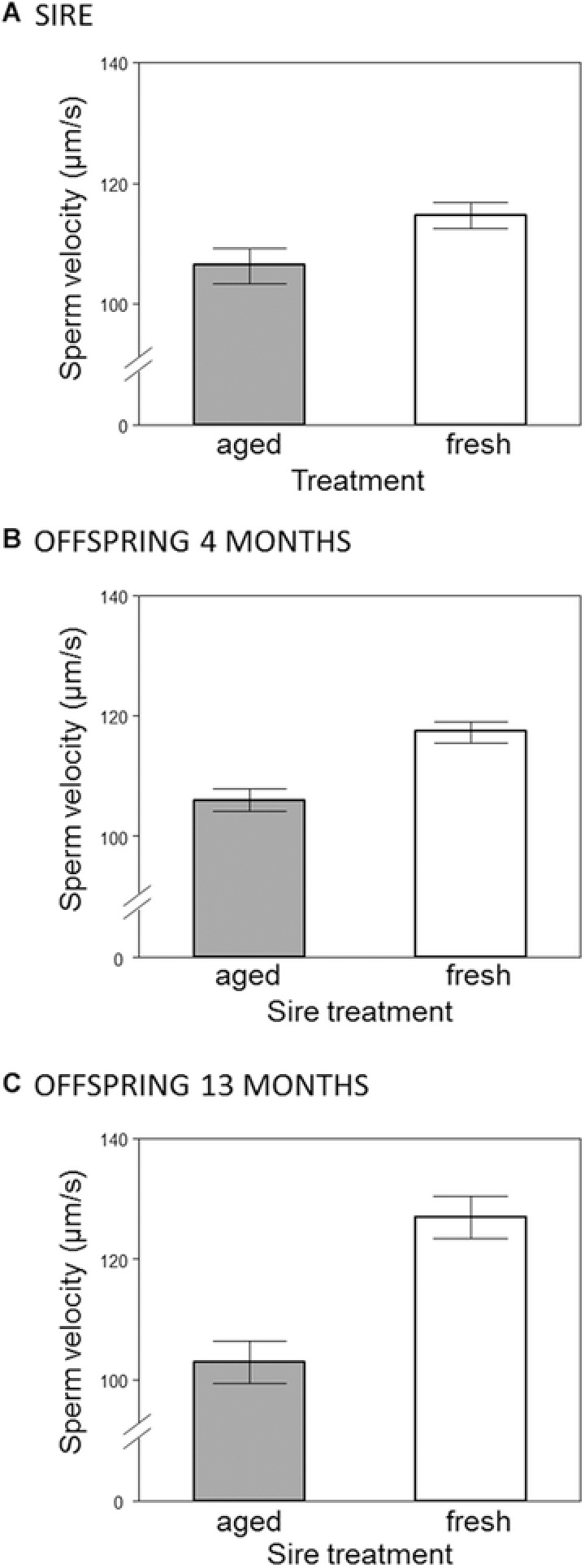
Recent studies suggest that environmentally induced effects on sperm phenotype can influence offspring phenotype beyond the classic Mendelian inheritance mechanism. However, establishing whether such effects are conveyed purely through ejaculates, independently of maternal environmental effects, remains a significant challenge. Here, we assess whether environmentally induced effects on sperm phenotype affects male reproductive success and offspring fitness. We experimentally manipulated the duration of sperm storage by males, and thus sperm age, in the internally fertilizing fish . We first confirm that sperm ageing influences sperm quality and consequently males reproductive success. Specifically, we show that aged sperm exhibit impaired velocity and are competitively inferior to fresh sperm when ejaculates compete to fertilize eggs. We then used homospermic (noncompetitive) artificial insemination to inseminate females with old or fresh sperm and found that male offspring arising from fertilizations by experimentally aged sperm suffered consistently impaired sperm quality when just sexually mature (four months old) and subsequently as adults (13 months old). Although we have yet to determine whether these effects have a genetic or epigenetic basis, our analyses provide evidence that environmentally induced variation in sperm phenotype constitutes an important source of variation in male reproductive fitness that has far reaching implications for offspring fitness.
最近的研究表明,环境对精子表型的影响能够超越经典孟德尔遗传机制,进而影响后代的表型。然而,要确定这些影响是否完全通过射精传递,而不受母体环境影响,仍然是一项重大挑战。在此,我们评估环境对精子表型的影响是否会影响雄性的繁殖成功率和后代的适应性。我们通过实验操纵了体内受精鱼类雄性的精子储存时间,从而控制了精子的年龄。我们首先证实,精子老化会影响精子质量,进而影响雄性的繁殖成功率。具体而言,我们发现老化的精子在速度上存在缺陷,并且在射精竞争使卵子受精时,其竞争力低于新鲜精子。然后,我们使用同精人工授精(非竞争性),用老化或新鲜的精子对雌性进行授精,结果发现,由实验性老化精子受精产生的雄性后代在性成熟(四个月大)时以及随后成年(13个月大)时,精子质量持续受损。尽管我们尚未确定这些影响是基于遗传还是表观遗传,但我们的分析提供了证据,表明环境诱导的精子表型变异是雄性繁殖适应性变异的重要来源,对后代适应性具有深远影响。