Kim Kyoung Min, Lee Sae Young, Rhee Yumie
Division of Endocrinology and Metabolism Department of Internal Medicine Seoul National University Bundang Hospital and Seoul National University College of Medicine Seongnam Republic of Korea.
Lilly Korea Ltd. Jung-ku Seoul Republic of Korea.
JBMR Plus. 2017 Jun 6;1(1):36-45. doi: 10.1002/jbm4.10005. eCollection 2017 Aug.
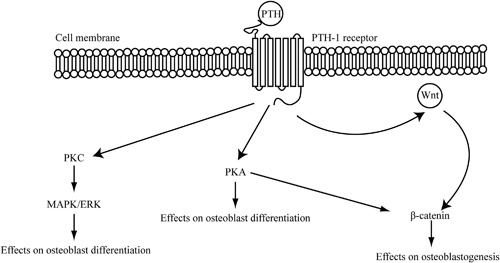
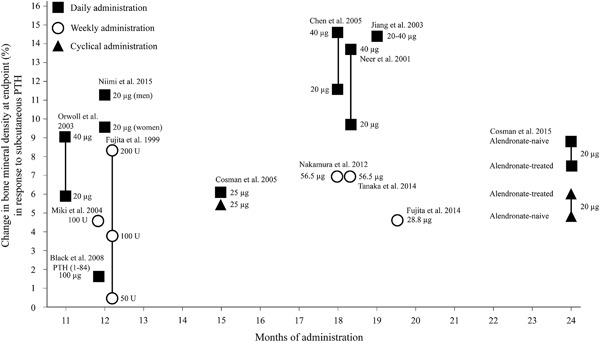
Recombinant human parathyroid hormone (PTH) is the key anabolic agent used for preventing fracture in postmenopausal women with osteoporosis. In bone metabolism, PTH signaling is mediated through a G protein-coupled receptor that affects various post-receptor signaling pathways. Results of preclinical and clinical studies have shown that PTH improves both the structure and strength of bone tissue. Once daily subcutaneous injection of the PTH fragment, teriparatide (PTH [1-34]), is the most commonly recommended formulation and dosing strategy in clinical practice. However, other dosing intervals, formulations, and routes have been investigated in preclinical and clinical studies. In particular, once-weekly and cyclical administration have been investigated mainly as a means of reducing the high direct costs of treatment. In preclinical studies, bone formation/resorption markers, bone mineral density measurements, and histomorphometric parameters improved with both once-daily and once-weekly administration. However, the magnitude and duration of such improvements were generally greater with once-daily PTH administration. In clinical studies, reductions in fracture incidence were also noted with both once-daily and once-weekly PTH administration, although improvements in nonvertebral fractures are less evident with once-weekly administration. This narrative review details the differences between PTH formulation and dosing strategies in relation to preclinical and clinical efficacy/safety parameters, although it should be stressed that no head-to-head studies allow direct comparisons. This review also seeks to outline practical considerations involved with PTH prescribing and new directions in research regarding routes of administration. © 2017 The Authors. is published by Wiley Periodicals, Inc. on behalf of the American Society for Bone and Mineral Research.
重组人甲状旁腺激素(PTH)是用于预防绝经后骨质疏松症女性骨折的关键促合成药物。在骨代谢中,PTH信号通过一种G蛋白偶联受体介导,该受体影响各种受体后信号通路。临床前和临床研究结果表明,PTH可改善骨组织的结构和强度。每日一次皮下注射PTH片段特立帕肽(PTH [1-34])是临床实践中最常推荐的剂型和给药策略。然而,临床前和临床研究中已经对其他给药间隔、剂型和给药途径进行了研究。特别是,主要作为降低高昂直接治疗成本的一种手段,已经对每周一次和周期性给药进行了研究。在临床前研究中,每日一次和每周一次给药均可改善骨形成/骨吸收标志物、骨密度测量值和组织形态计量学参数。然而,每日一次给予PTH时,这些改善的程度和持续时间通常更大。在临床研究中,每日一次和每周一次给予PTH均能降低骨折发生率,尽管每周一次给药时非椎体骨折的改善不太明显。本叙述性综述详细阐述了PTH剂型和给药策略在临床前和临床疗效/安全性参数方面的差异,不过应当强调的是,尚无直接比较的头对头研究。本综述还旨在概述PTH处方的实际考虑因素以及给药途径研究的新方向。© 2017作者。本文由Wiley Periodicals, Inc.代表美国骨与矿物质研究学会发表。