Rheumatology Department, Consorci Corporació Sanitària Parc Taulí, Institut d'Investigació i Innovació Parc Taulí I3PT, Universitat Autònoma de Barcelona, Parc Taulí s/n, 08208, Sabadell, Barcelona, Spain.
Rheumatology Department, Hospital General Universitario Reina Sofía/IMIBIC/Universidad de Córdoba, Córdoba, Spain.
Arthritis Res Ther. 2018 Oct 3;20(1):221. doi: 10.1186/s13075-018-1724-7.
To assess HLA-B27 influence on the clinical phenotype of Ankylosing Spondylitis (AS) patients.
An observational, cross-sectional and descriptive study of AS patients from the Spanish REGISPONSER database was performed. Demographic, clinical, disease activity (Bath Ankylosing Spondylitis Disease Activity Index (BASDAI), Bath Ankylosing Spondylitis Functional Index (BASFI), erythrocyte sedimentation rate (ESR), and C-reactive protein (CRP)), and radiographic data (Bath Ankylosing Spondylitis Radiology Index (BASRI) score) were compared regarding HLA-B27 status. A univariate and multivariate analysis was performed to identify variables independently related to the presence of HLA-B27.
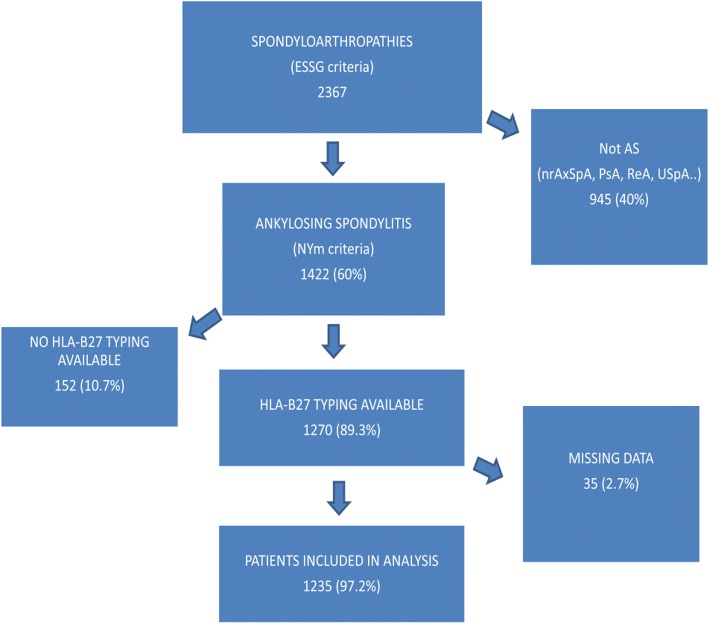
Data from 1235 patients (74.8% male) were analyzed; 1029 were HLA-B27 positive (83%). HLA-B27-positive patients showed higher family aggregation and an earlier onset of disease compared with those who were HLA-B27 negative. HLA-B27-negative patients presented statistically higher BASDAI and BASFI scores and higher prevalence of arthritis, dactylitis, and extra-articular manifestations (psoriasis and inflammatory bowel disease (IBD)) but not anytime uveitis compared with those who were HLA-B27 positive. In the multivariate analysis, family history (odds ratio (OR) 2.10, 95% confidence interval (CI) 1.27-3.49), younger age at diagnosis (OR 0.97, 95% CI 0.96-0.98), presence of peripheral arthritis (OR 0.53, 95% CI 0.32-0.89), dactylitis (OR 0.16, 95% CI 0.05-0.56), psoriasis (OR 0.45, 95% CI 0.26-0.78), and IBD (OR 0.22, 95% CI 0.12-0.40) were the main variables independently related to the presence or not of HLA-B27.
In Caucasian AS patients, the presence of HLA-B27 is related to an earlier disease onset and higher family aggregation. Absence of HLA-B27 is related to a higher frequency of peripheral arthritis, dactylitis, and extra-articular manifestations. Being HLAB27 positive is not related to a higher burden of disease or anytime uveitis.
评估 HLA-B27 对强直性脊柱炎(AS)患者临床表型的影响。
对西班牙 REGISPONSER 数据库中的 AS 患者进行了一项观察性、横断面和描述性研究。比较了 HLA-B27 状态与人口统计学、临床、疾病活动度(Bath 强直性脊柱炎疾病活动指数(BASDAI)、Bath 强直性脊柱炎功能指数(BASFI)、红细胞沉降率(ESR)和 C 反应蛋白(CRP))和影像学数据(Bath 强直性脊柱炎放射学指数(BASRI)评分)。进行了单变量和多变量分析,以确定与 HLA-B27 存在相关的独立变量。
共分析了 1235 例患者(74.8%为男性)的数据;其中 1029 例 HLA-B27 阳性(83%)。与 HLA-B27 阴性患者相比,HLA-B27 阳性患者的家族聚集性更高,发病年龄更早。HLA-B27 阴性患者的 BASDAI 和 BASFI 评分更高,关节炎、指炎和关节外表现(银屑病和炎症性肠病(IBD))的患病率更高,但与 HLA-B27 阳性患者相比,任何时候的虹膜炎都没有更高。在多变量分析中,家族史(比值比(OR)2.10,95%置信区间(CI)1.27-3.49)、诊断时年龄较小(OR 0.97,95%CI 0.96-0.98)、外周关节炎(OR 0.53,95%CI 0.32-0.89)、指炎(OR 0.16,95%CI 0.05-0.56)、银屑病(OR 0.45,95%CI 0.26-0.78)和 IBD(OR 0.22,95%CI 0.12-0.40)是与 HLA-B27 存在或不存在相关的主要变量。
在白种人 AS 患者中,HLA-B27 的存在与疾病发病较早和家族聚集性较高有关。HLA-B27 缺失与外周关节炎、指炎和关节外表现的发生率较高有关。HLA-B27 阳性与疾病负担较高或任何时候的虹膜炎无关。