Mun Kwang Ho, Yu Gyeong Im, Choi Bo Youl, Kim Mi Kyung, Shin Min-Ho, Shin Dong Hoon
Department of Preventive Medicine, Keimyung University School of Medicine, Daegu, Korea.
Department of Preventive Medicine, Hanyang University College of Medicine, Seoul, Korea.
J Prev Med Public Health. 2018 Sep;51(5):248-256. doi: 10.3961/jpmph.18.112. Epub 2018 Sep 7.
Several studies have investigated the effects of serum uric acid (SUA) levels on chronic kidney disease (CKD), with discrepant results. The effect of SUA levels on CKD development was studied in the Korean rural population.
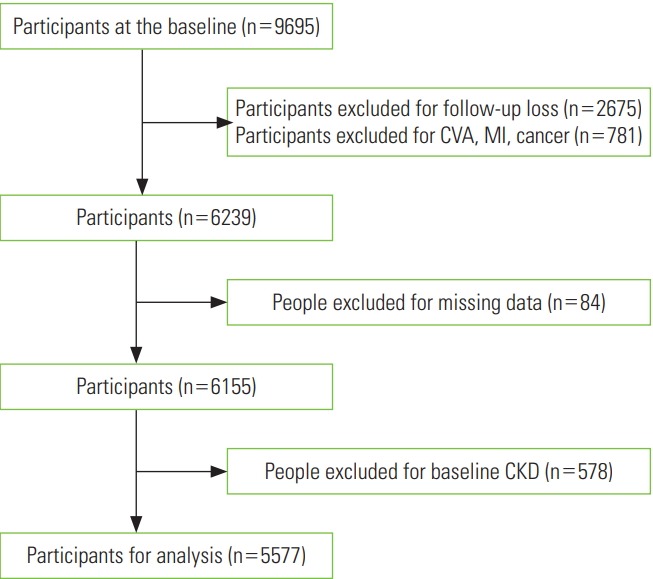
A total of 9695 participants aged ≥40 years were recruited from 3 rural communities in Korea between 2005 and 2009. Of those participants, 5577 who participated in the follow-up and did not have cerebrovascular disease, myocardial infarction, cancer, or CKD at baseline were studied. The participants, of whom 2133 were men and 3444 were women, were grouped into 5 categories according to their quintile of SUA levels. An estimated glomerular filtration rate of <60 mL/min/1.73 m2 at the time of follow-up was considered to indicate newly developed CKD. The effects of SUA levels on CKD development after adjusting for potential confounders were assessed using Cox proportional hazard models.
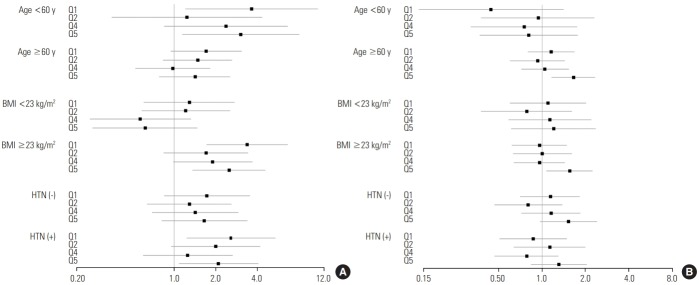
Among the 5577 participants, 9.4 and 11.0% of men and women developed CKD. The hazard ratio (HR) of CKD was higher in the highest quintile of SUA levels than in the third quintile in men (adjusted HR, 1.60; 95% confidence interval [CI], 1.02 to 2.51) and women (adjusted HR, 1.56; 95% CI, 1.14 to 2.15). Furthermore, CKD development was also more common in the lowest quintile of SUA levels than in the third quintile in men (adjusted HR, 1.83; 95% CI, 1.15 to 2.90). The effect of SUA was consistent in younger, obese, and hypertensive men.
Both high and low SUA levels were risk factors for CKD development in rural Korean men, while only high levels were a risk factor in their women counterparts.
多项研究探讨了血清尿酸(SUA)水平对慢性肾脏病(CKD)的影响,但结果存在差异。本研究在韩国农村人群中探讨SUA水平对CKD发生发展的影响。
2005年至2009年间,从韩国3个农村社区招募了9695名年龄≥40岁的参与者。其中,5577名参与随访且基线时无脑血管疾病、心肌梗死、癌症或CKD的参与者被纳入研究。参与者中,男性2133名,女性3444名,根据SUA水平的五分位数分为5组。随访时估计肾小球滤过率<60 mL/min/1.73 m²被视为新发CKD。使用Cox比例风险模型评估调整潜在混杂因素后SUA水平对CKD发生发展的影响。
在5577名参与者中,男性和女性发生CKD的比例分别为9.4%和11.0%。SUA水平最高五分位数组的CKD风险比(HR)高于男性和女性的第三五分位数组(男性调整后HR为1.60;95%置信区间[CI]为1.02至2.51;女性调整后HR为1.56;95%CI为1.14至2.15)。此外,男性SUA水平最低五分位数组的CKD发生也比第三五分位数组更常见(调整后HR为1.83;95%CI为1.15至2.90)。SUA的影响在年轻、肥胖和高血压男性中是一致的。
高SUA水平和低SUA水平都是韩国农村男性发生CKD的危险因素,而在女性中只有高SUA水平是危险因素。