Badran Abdul, Shepard Matthew J, Ksendzovsky Alexander, Murayi Roger, Hayes Christina, Smart DeeDee, Chittiboina Prashant
University of Cambridge, Churchill College, Storey's Way, Cambridge, UK; National Institute of Neurological Disorders and Stroke, Bethesda, MD, USA.
National Institute of Neurological Disorders and Stroke, Bethesda, MD, USA; University of Virginia Health System, Department of Neurologic Surgery, Charlottesville, VA, USA.
J Clin Neurosci. 2018 Dec;58:226-228. doi: 10.1016/j.jocn.2018.08.028. Epub 2018 Oct 1.
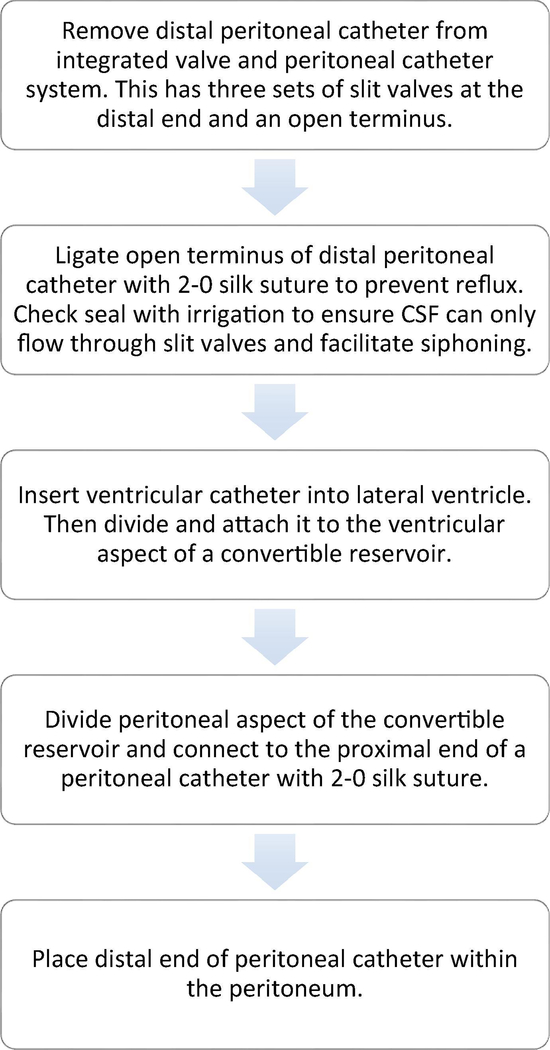
Low-pressure hydrocephalus (LPH) is a rare clinical diagnosis, characterized by neurologic decline and ventriculomegaly that persists despite normal to low intracranial pressure. LPH is typically managed by negative-pressure drainage via ventriculostomy, followed by low-resistance shunt insertion. We present the case of a middle-aged man with a history of hemangioblastomatosis who had spontaneous subarachnoid hemorrhage. He was treated with a ventriculoperitoneal shunt and then underwent resection of a Meckel's cave hemangioblastoma and whole brain irradiation. One month later, he presented to us with worsening symptoms and hydrocephalus despite shunt interrogations and revisions revealing no malfunction. Ventriculostomy drainage at negative-pressure was required for resolution of symptoms and ventriculomegaly, leading us to a diagnosis of LPH. This was successfully treated using an improvised ultra-low pressure valveless ventriculoperitoneal shunt, with maintained resolution of LPH for over one year. The system was created by ligating the distal slit valve end of a peritoneal catheter to prevent reflux and allow sub-zero pressure drainage by siphoning.
低压性脑积水(LPH)是一种罕见的临床诊断,其特征是尽管颅内压正常或偏低,但仍出现神经功能衰退和脑室扩大。LPH通常通过脑室造瘘术进行负压引流,随后插入低阻力分流管进行治疗。我们报告一例患有血管母细胞瘤病病史的中年男性,他发生了自发性蛛网膜下腔出血。他接受了脑室腹腔分流术治疗,随后切除了梅克尔腔血管母细胞瘤并进行了全脑照射。一个月后,尽管对分流管进行了检查和修复,未发现故障,但他的症状仍在恶化且出现了脑积水。需要进行负压脑室造瘘引流以缓解症状和脑室扩大,这使我们诊断为LPH。使用简易的超低压力无阀脑室腹腔分流管成功治疗了该病,LPH症状持续缓解超过一年。该系统是通过结扎腹膜导管的远端裂隙瓣膜端来创建的,以防止反流并通过虹吸作用实现负压引流。